Hi everyone, I have a fairly weak undergraduate: a 3.3/5 GPA in Computer Engineering from an average Nigerian university. For my Master's, I studied Artificial Intelligence at an average European university, where I finished with an 8/10 GPA. A condensed version of my Master's thesis was recently accepted at ACL 2026, with a meta-review score of 8/10 and a confidence score of 5/5. It's scheduled for presentation next month. I want to pursue a PhD focused on expanding linguistic resources for low-resource African languages. I know my weak undergrad GPA and the relatively unknown reputation of my previous universities will make it hard to get into top NLP programs (CMU, Edinburgh, ETH, MBZUAI, etc.), though I'm hoping the ACL paper helps offset that somewhat. At the same time, I don't want to end up at a less competitive university just for the sake of getting in somewhere, if it doesn't do meaningful work on low-resource NLP. How should I think about structuring my application strategy here (reach vs. safety schools, how to frame my profile, what to emphasize)? I'd also genuinely appreciate honest feedback on my overall profile. Thanks. submitted by /u/Unlikely_Screen_9287 [link] [Kommentare]
Channel
c/artificial-intelligence
No description.
Owner @James · 417 posts · 1 joined · Status active · Posting permission: Only joined users can post
Just got the email that I have been accepted in DL4C @ICML 2026 , as the email did not contain any details on logistics can someone help here - is it mandatory to visit the workshop ? - what's the usual expense apart from flights, can someone add details like fees and all ? - in the email there's no mention of whether its poster or what ? - How will the overall process works from here it's my first time, any input will be very valuable. Thanks in advance submitted by /u/shifuThePandaGod [link] [Kommentare]
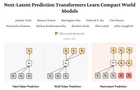
Microsoft Research Preprint Next-token prediction is myopic. What if transformers learn to predict their own next latent state? Microsoft Research present Next-Latent Prediction (NextLat): a self-supervised learning method that teaches transformers to form compact world models for reasoning and planning. It also unlocks up to 3.3x faster inference via self-speculative decoding! On top of next-token prediction, NextLat trains the transformer to predict its own next latent state given the current latent state and next token. NextLat has a few key benefits: Representation Learning: NextLat encourages transformers to compress history into compact belief states. Better Data Efficiency: predicting in latent space provides denser supervision than predicting one-hot tokens. Faster Inference: via recursive multi-step lookahead. I'm super excited about this work. Please do check it out below: 💬 Blog: https://jaydenteoh.github.io/blog/2026/nextlat 💻 Code: https://github.com/JaydenTeoh 📝 Paper: https://arxiv.org/abs/2511.05963 submitted by /u/jayden_teoh_ [link] [Kommentare]
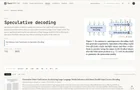
A method that is currently trending on Papers with Code is Speculative Decoding. https://preview.redd.it/dm4nh4t71o7h1.png?width=3082&format=png&auto=webp&s=b6468668667d4bcfb6c9248d3af7fd09f21fe0da Speculative decoding is an inference optimization technique that uses a fast, small "draft" model to quickly propose several future tokens, which are then verified in parallel by a larger, slower "target" model. This process significantly speeds up token generation for large language models (LLMs) by allowing multiple tokens per step without sacrificing output quality. SGLang, one of the most popular frameworks for running LLMs alongside vLLM, just released a blog post detailing how they achieve state-of-the-art latencies for LLM inference serving using Modal and Z.ai's DFlash speculative decoding models. Learn more at https://paperswithcode.co/methods/speculative-decoding. You can also find all the papers that cite the original paper that introduced this technique. SGLang's blog: https://www.lmsys.org/blog/2026-06-15-next-generation-speculative-decoding-dflash-v2/ Let me know which other methods I should add! Cheers, Niels from HF submitted by /u/NielsRogge [link] [Kommentare]
I'm working on a side project in systematic investing and market-state modeling. Over the last several months I've developed: An investment philosophy and alpha framework A quantitative model specification An engineering and implementation specification The project focuses on understanding market states, cross-asset relationships, risk, liquidity, volatility, and portfolio allocation. The goal is to build and test a robust systematic framework across global equities, bonds, commodities, and FX. A few things: I am not a professional quant. I do not come from a mathematics or computer science background. However, I've spent a significant amount of time researching and structuring the framework and can discuss the reasoning behind it in detail. I am not looking to hire someone. I am not offering freelance work. I'm looking for someone who finds the problem interesting and may be interested in building something together. Ideally: Quant researcher Quant developer ML engineer Systematic trader Statistical or data-science background At this stage I'm mainly looking for honest feedback, discussion, and potentially a technical collaborator if there is a strong fit. Happy to share more details privately. submitted by /u/Electrical_One_5837 [link] [Kommentare]
I'm done I started my journey in 2018 when yolo v3 came out. I saw in ted talk youtube when I was in high school. It was so cool and exciting at the time. I remember one of my high school teacher slapped DL book out of my hand and calling me idiot for learning DL instead of high school subjects. Good times. 2020 I dropped out from college I wanted to use my skills for good and wanted my own non-profit startup for developing country. Ended up working at other startup teaching and researching Computer Vision for 2 years and at that time 2021-ish was I think most exciting time for research. I decided to give it a chance at academic research a chance and got in to different college again. And in 2022 GPT and stuff was just flooded but I really did not think much. I wrote some paper with my own interest and sometimes got some good results. While I was researching my paper college was like season 2 of high school. I always seems to find a to start a fight with professors and got very low GPA(But GPA is my fault). In 2026 Jan, I've decided to finally start my own start up with small amount of money I've collected around 30k. Got the office started working on research with my friends and with other researchers remotely. It's was fun researching but I was idiot for not thinking about making profit with my "company". but, now every things is LLM and agentic AI. Big scale servers and expensive GPUs blocking from entering anything. I've tried to stay positive bought some used hardware, Built my servers. few 3090, 5090, A6000 ... Now in Jun It's not even funny for startup to get hands on GPUs. But only demand is just Agentic AI. I want to believe that I'm idiot again for seeing things in negative way. But now out side of large "AI company" researching other than LLMs are luxury. I don't know but Nvidia dominating and jacking up prices on hardware for way out of my hands and AI is now tool for political gains. I do not want to contribute to this kind of scene where everything seems dystopia. Now I'm starting to think I should just give up everything and start new one. A lot of my colleagues that moved to big tech company is thinking the same way. Also one of my good friend died from overworking last year. It's not fun anymore. Dead end for me at least. What I'm trying to say is that AI was a tool for exciting projects and research but now it seems like political, dystopia future and I'm not even qualified to contribute to AI but not even going to try. Thanks Nvidia. submitted by /u/UselesTaste [link] [Kommentare]
Character AI, founded by former Google/LaMDA developers Noam Shazeer and Daniel De Freitas, proved that text-based character chat can work as a real entertainment category. But the next chapter might not be better text chat. It might be real-time video interaction. Mel AI recently shared a demo of AI character video chat, and the interesting part is the interaction stack: voice, lip sync, facial reactions, and camera-aware responses instead of just a static avatar or chat box. The character can respond to visual context too. If the user is visibly on a plane or in a different environment, the character can notice and react to that context during the conversation. I don’t know how much of the video layer is truly generated in real time versus powered by a clever animation/rendering system, but it feels meaningfully different from the usual text-based character AI experience. Character AI proved the demand for entertainment AI. Now it feels like the race is about who can make AI characters feel alive in real time. Demo: https://x.com/Building_Mel/status/2064848256115626481 submitted by /u/DonutRare5633 [link] [Kommentare]
I wanted to share an ICML 2026 spotlight position paper on a failure mode in image-generation alignment: aesthetic preference optimization may override explicit user intent when the requested output is anti-aesthetic or outside mainstream visual taste. The paper frames this as **reversed alignment**. Instead of the model aligning to the user's stated preference, the output is pulled back toward the model's learned aesthetic prior. We test generation and reward models on prompts asking for blurry, distorted, low-fidelity, negative-emotion, and other anti-aesthetic images. GitHub repo: https://github.com/weathon/icml2026_position Paper: https://arxiv.org/abs/2512.11883 OpenReview: https://openreview.net/forum?id=1gQ4zc1Q8I I would be interested in feedback on the framing and on evaluation designs for separating prompt understanding from preference override. submitted by /u/Striking-Warning9533 [link] [Kommentare]
Spent the last few weeks on a benchmark/harness that tries to answer one question honestly: did a robot arm actually do the demonstrated task, or did the success metric just get fooled? The setup: compile a human demo into an object-centric graph (what changed in the world: relations, contacts, event order), run a solver, then independently extract a graph from the rollout only and check if they match. The whole point is a hard information boundary so the "answer key" can never leak into the side that grades the rollout. A no-op baseline fails with named failure classes; a dumb scripted arm passes. That contrast is the thing I care about. Most manipulation success metrics are hand-coded predicates written by the same person training the policy. The policy author controls both the behavior and the definition of "success." That's a conflict of interest we'd never accept in ML benchmarking, yet it's standard in manipulation eval. But I keep going back and forth on whether this matters, and I'd like other people's read: The case that it's real: VLA/foundation-model training is starved for reliable dense reward at scale. Human raters don't scale, brittle predicates lie. An automatic, embodiment-agnostic grader that can say "this rollout reproduced the demonstrated transformation, here's why it failed" seems like an obviously-missing piece of the training loop. The case that it's a non-problem: maybe everyone's already fine with task-specific success checks because in practice you only care about the tasks you're shipping, and a general verifier is solving for a generality nobody needs. And the representation that makes verification tractable (discrete relational state — INSIDE/TOUCHING/event-order) is also what caps it: it handles pick/place/insert/open-drawer but has no obvious purchase on force-profile or deformable tasks, which is exactly where the frontier is. There's also the uncomfortable bit: the hard 80% is perception (video → graph under occlusion and contact noise), and that's where the leakage discipline gets harder, not easier, because your extractor is now a learned, error-prone thing. Two questions I don't have a settled answer on: Is reward/eval honesty a first-order bottleneck for the current generation of manipulation learning, or second-order polish? Is object-centric relational state a dead representation for where manipulation is actually going, or a reasonable floor you build up from? submitted by /u/Alexpplay [link] [Kommentare]
ECCV 2026 final decisions are expected to be released on June 17, 2026. Since there was no exact release time specified, results will likely roll out within 48 hours. This thread is for everyone to share updates, discuss outcomes, and support each other through the decisions. Good luck to everyone! submitted by /u/mclovingho [link] [Kommentare]
Last month I stopped trusting feature importance and started trusting offline ablations instead: retrain with and without the change on a held-out split, measure the delta directly. That worked exactly once. Then four changes that looked positive offline either regressed or vanished in production. We forecast pre-owned watch prices with LightGBM quantile regression (p10/p50/p90). The four: Experiment Offline Prediction Production Result Root Cause Best Offer feature Slight improvement +0.12pp regression Train/serve skew Auction data backfill Roughly neutral +0.37pp regression Unmeasured distribution shift Outlier trimming −0.19pp improvement +1.11pp regression Training population shift CatBoost encoder −0.199pp improvement ~0 (noise) Baseline instability Best Offer is the cleanest one. A lot of our eBay sold comps close via an accepted offer below the asking price, and those carry a systematic premium, so a flag for it looked like free signal sitting in the data. Problem is the sold rows have the flag and the live listings can't: you don't know a listing's offer status until it actually sells, so at inference time it's hardcoded to zero. I trained the model on something it never sees in production. The ablation can't catch that, because its train and val splits both come from the historical data where the flag is everywhere. Outlier trimming is the one that concerned me. I dropped training rows where |log(sold_price / family_median)| > 0.8, the usual move for damaged pieces and mistitled lots in the tails. Four seeds, clean −0.19pp, won every seed. Shipped it to the retrain and got +1.11pp. I burned an afternoon looking for a harness bug before I accepted there wasn't one. Here's the part I had wrong at first: the validation rows were never trimmed, so this isn't "you deleted the hard cases." The harness graded the change on a held-out window that had drifted out of sync with the cohort production actually scores against. A model that had stopped learning from the tails looked better on that window and worse on the live stream, which still has the tails. Pinning the harness split to production's split date was the fix. So the claim I'd actually defend, narrower than I first wrote it: a standard held-out ablation can systematically overestimate a change when that change alters the training population, not just the features. Drop a column and the rows are the same, so the held-out slice tells you how it generalizes. Drop or reweight rows and you've moved the training distribution while still grading on a slice that may not represent where the model now fails. The bias runs toward optimism, exactly where the production downside is biggest. What actually catches it is comparing against production, not against your own offline number. Every retrain trains a candidate and grades it against the live incumbent on a verified-sold cohort; more than 0.30pp worse and it doesn't get promoted (that's 3 to 6 sigma against our ~0.05 to 0.10pp seed noise). It's stratified by confidence band rather than the raw headline, because we'd already been bitten by a Simpson's-paradox version where a shift in band mix dragged the headline while every individual band was improving. The outlier change is exactly what it's for: offline said ship, the gate measured +1.11pp against production and refused it on its own. Full writeup with the per-experiment detail, the thread-pinning fix behind the CatBoost "improvement," and the gate code: https://flyback.ai/engineering/ablation-said-ship submitted by /u/Nj-yeti [link] [Kommentare]
I was digging through Hugging Face’s Transformers repo and found https://github.com/huggingface/transformers/blob/main/src/transformers/models/gpt_oss/modeling_gpt_oss.py From what I can tell, this isn’t just boilerplate, it looks like a full implementation. is it actually the full code on which gpt_oss is built on? or is it a skeleton for experimentation? Similarly there are many models in https://github.com/huggingface/transformers/blob/main/src/transformers/models are they really the true open source implementations? if not, can we actually find them publicly? submitted by /u/PravalPattam12945RPG [link] [Kommentare]
I built RelayOps, an open-source prototype for auditable AI support-agent routing. The goal is not to make a better chatbot. It is to test whether an AI support system can safely decide when to respond, act, block, or hand off. Current features: scoped customer/device tools deterministic access gate route safety for billing/account-risk requests guardrails for invented prices, discounts, and PII per-turn decision traces human handoff context local FAQ/RAG with citations Qwen LoRA intent eval optional local LLM composer public canned guardrail demo Honest scope: synthetic/sample data only no production users no real customer data not production-ready One eval detail I’m trying to keep honest: in-set safe-route: 1.000 held-out novel-phrasing safe-route: 0.786 The lower number is the more important one. Repo: https://github.com/patibandlavenkatamanideep/relayops Feedback welcome, especially on eval framing and whether the held-out routing setup is convincing submitted by /u/Fit_Fortune953 [link] [Kommentare]
Been working on this a while! Should be useful for anyone trying to speed up their tokenization workflows. quicktok is a fast/exact BPE tokenizer written in C++. Token ids are byte-identical to tiktoken and encoding runs 2–3.6× faster than bpe-openai (the fastest alternative I know of) and 4–11× faster than tiktoken itself. It ships cl100k, o200k, GPT-OSS, Llama-3, and Qwen2.5/3. Approach. Same algorithm as bpe-openai (exact backtracking BPE) but I apply lots of data structure engineering to cut memory accesses: A 2-byte trie is used for the longest-match walk Dense exactly-keyed caches are used for merge-validity checks A hand-compiled pretokenizer is used instead of a general regex engine Benchmarks (Apple M1, single thread, MB/s, cl100k_base and every output verified token-for-token before timing): encoder The Pile Code Common Crawl quicktok (native) 121.7 139.2 71.3 quicktok (Python) 77.9 83.6 49.7 bpe-openai 36.6 38.7 28.9 rs-bpe 30.9 34.7 23.5 tiktoken-rs 15.4 13.8 13.3 tiktoken (Python) 13.6 12.8 12.3 TokenDagger 11.1 11.9 10.7 o200k_base is similar in ratios. Each encoder is called through its own raw API and benchmarks can be reproduced with make bench-compare in the repo. pip install quicktok-v1 Repo: https://github.com/dmatth1/quicktok submitted by /u/_casa_nova_ [link] [Kommentare]
Abstract: A sufficient account of how the neocortex learns must meet three criteria: Computationally, it must approximate a powerful, general-purpose learning algorithm known to scale to human-level intelligence; Algorithmically, it must be implementable using known, well-established neural circuits within the neocortex and associated brain structures; Implementationally, there must be a detailed account for how all of the algorithmic mechanisms actually function at a neurochemical level. At present, there is only one framework that meets all of these criteria: error-driven predictive learning via temporal derivatives, driven by corticothalamic circuits, based on competitive kinase synaptic plasticity induction mechanisms. This has been implemented in the Axon neural simulation framework using spiking neurons, and demonstrated to learn across a wide range of challenging cognitively motivated tasks. arxiv.org/abs/2606.08720 Something like this will lead to something better than back propagation and improve training times substantially. submitted by /u/Terminator857 [link] [Kommentare]