Channel
c/robotics
No description.
Owner @master · 624 posts · 1 joined · Status active · Posting permission: Every logged-in user can post
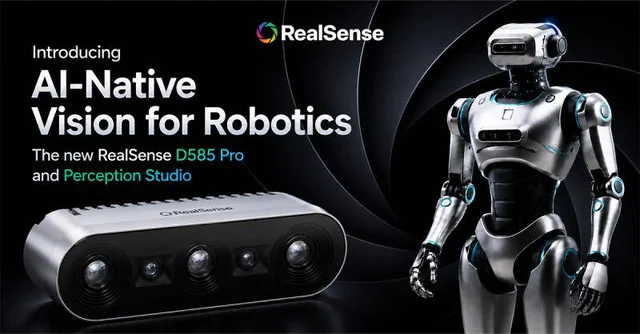
Learn more: https://www.realsenseai.com/press-release/at-automate-2026-realsense-unveils-the-d585-pro-and-perception-studio/ submitted by /u/Chemical-Hunter-5479 [link] [Kommentare]
I'm currently pursuing an M.Tech in Mechanical Engineering and have been considering a transition into Robotics. My exposure to robotics is limited to basic theoretical concepts like kinematics, and I don't have any hands-on robotics experience. For those already working in the field, is it worth making the switch at this stage? How challenging is it to break into robotics from a mechanical background, and what does the career growth look like? I'd appreciate any honest insights from people who have been through a similar journey. submitted by /u/sahil-wagle [link] [Kommentare]
So we're using an ESP32S with a TJA1050 transceiver and basically we're using this setup to operate a rover using ROS2 Humble and MAVLink commands, so it has a lot of modules like actuators, PDB, mini-arm, and etc connected through a CAN bus network. Now the issue is that we will be using multiple BLDCs for our rover's arm and these motors continuously send out updates (or heartbeats or sth) so using these BLDCs in the same network seems like the MCU will lag or slow down and just be downright ineffective. So is there any way to isolate the motors to a different network or CAN line? I was thinking of adding another MCU on top of the ESP32 to only handle the motors but is there an alternative to this approach, preferably one without adding more hardware? submitted by /u/Sadhya [link] [Kommentare]
I've been working on an open-source pet companion robot called OpenPaw, and wanted to share the navigation system I built for it. The hardware is an ESP32-S3 running ESP-IDF with a camera, DRV8833 motor driver, VL53L0X distance sensor, and MLX90634 temp sensor. It hosts its own WiFi AP — no cloud, no internet needed. The navigation works like this: I created virtual portals in my home using the Auki posemesh network (like GPS waypoints indoors). Each portal has X, Y, Z coordinates. A phone app built with Flutter connects to a local bridge API and loads these portals. When you scan a portal QR code with the phone's camera, the app records your position AND compass heading using the phone's magnetometer. This gives the robot both location and orientation — the two things needed for autonomous movement. The robot runs a PWM-based odometry task that estimates its position from motor commands every 50ms. A /api/pose endpoint returns real-time X, Y, and heading. A /api/trajectory endpoint logs the full path. The app shows all this on a 2D map overlay with portal markers, the robot's position, heading arrow, and traveled path updating every 500ms. The portal dropdown on the control screen lets you select any destination. The app calculates direction and distance from the robot's current position to the target in real time. The entire stack — ESP-IDF firmware, Flutter app, Auki bridge API — is open source. Build guide and schematics are documented. What navigation approaches have you used for indoor robots without GPS? I'm planning to add wheel encoders next for better accuracy. submitted by /u/Single_Gas_3063 [link] [Kommentare]
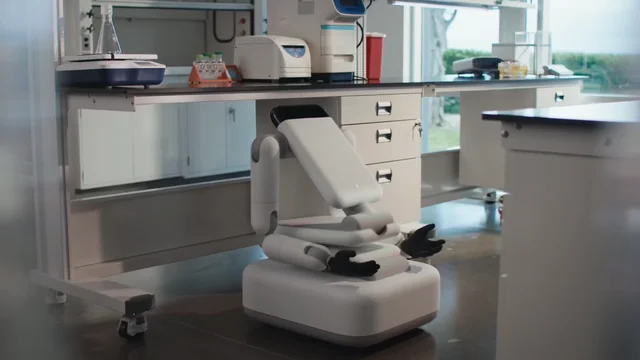
From Genesis AI on 𝕏: https://x.com/gs_ai_/status/2066869851659121128 Website: https://www.genesis.ai/ submitted by /u/Nunki08 [link] [Kommentare]
So I've been trying to add some modification to my Unitree Go2 robot and I've tried every WebRTC techniques in the internet available. But I never could connect to the robot Using WebRTC. I've tried to use SDK2 for mod but SDK only Works via ethernet. I've also tried to do sudo update and Rosbridge installation via ssh but its always 0% for some weird reason. But It pings other sites like google.com just fine. How can I get this headache solved? submitted by /u/Big_Sample9338 [link] [Kommentare]
Hi everyone, Has anyone here reviewed or submitted a paper through the ICRA/IROS transfer review process? I submitted through the transfer option for IROS and was rejected, so I’m trying to better understand how the process works. What can reviewers see: the previous reviews, only the author response/revision summary, or something else? For those with experience, did the transfer process feel helpful, or could it bias reviewers since they know the paper was previously rejected? Any insights from the reviewer or author side would be appreciated. submitted by /u/nikolaskagia [link] [Kommentare]
I hope this is the right place for this post. This idea doesn’t seem far-fetched or futuristic to me - I believe it’s technically achievable today. Mods, please let me know if this belongs elsewhere I want to suggest a home robot for daily life missions. The purpose of this robot is to help people with everyday tasks at home - cooking, cleaning, and everything in between - at an affordable price. Principle Architecture: The robot is wheeled (not humanoid) and controlled by an LLM. Instead of human-like arms, it uses swappable tools. Each tool is designed for a specific task. The LLM controls the robot through 3 protocols only: API commands - the LLM tells the robot what to do Shared map - the robot maps the house in 2-3 hours on first setup. Both the robot and the LLM share the exact same map Visual images - the robot sends photos to the LLM, the LLM sees what is happening and makes decisions The Tools: Each tool contains its own API and README file. When the robot connects a tool, the LLM reads the README and immediately knows how to use it - like installing an app. Examples: egg breaker, dish washer, floor cleaner. Each tool costs ~$50. A whole ecosystem of tools can be built around this robot. The base unit has iRobot-style floor cleaning built in. Example: Making an Omelette The user says to the robot: ‘Please make me an omelette.’ The LLM understands the request and breaks it down into steps: The LLM checks the map and locates the kitchen The robot navigates to the kitchen The LLM sends a command: connect the egg-breaking tool The robot takes a photo of the refrigerator area - the LLM sees the photo and says: ‘open the fridge, the eggs are on shelf 2’ The robot takes the eggs The egg-breaking tool breaks the eggs into the pan The robot connects the cooking tool The LLM monitors the cooking via photos in real time The omelette is ready All of this happens automatically, with no human involvement. Target price: ~$2,000 for the robot, ~$50 per tool. This idea is free for anyone who wants to build it. Good luck! submitted by /u/Narrow-Necessary-947 [link] [Kommentare]
I work in robotics, and have for almost a decade now. I keep noticing that a huge chunk of search-under-uncertainty problems, in robotics and outside it, converge on the same two-step architecture: generate variation indiscriminately first, then apply a scoring/selection pressure that keeps what works and discards what doesn't. No model of the problem is required upfront. Most the "intelligence" lives in the selection step, not the generation step. The clearest version of this in our own field is sampling-based motion planning. RRT and its relatives don't try to compute a path analytically. They expand randomly in many directions through the configuration space and then retain/extend the branches that make progress toward the goal, pruning the rest. Genetic algorithms and evolution strategies (CMA-ES, for instance) run an identical loop in parameter space instead of configuration space: generate a population of variants, score them against a fitness (cost) function, keep the survivors, repeat. Simulated annealing is a single-particle version of the same thing, generate a random perturbation, accept or reject it based on a score. Once I started paying attention to this pattern, I noticed it shows up well outside robotics too, in places that have nothing to do with computer science: Slime mold expanding in all directions through a maze of food sources, with the inefficient tendrils pruned back, and famously reconstructing something close to the Tokyo rail network when food sources are placed at the positions of major stations. Evolution itself: random mutation generates variation with zero regard for whether it's useful, and survival does the selecting after the fact. Neural development: neurons and synaptic connections proliferate in directions that aren't pre-planned, and dopamine-linked reinforcement selectively stabilizes the ones that turn out to matter. Once I started looking for more instances, I found two more that fit the same structure almost exactly: The immune system: B-cells mutate antibody variants somewhat randomly (somatic hypermutation) and the ones that bind the pathogen get clonally selected and expanded. Thought/creativity: you can't generate a genuinely novel idea by deduction from evidence that it's correct. The evidence only exists after the idea does. Novelty has to come first; judgment comes second. That last one turns out to have a surprisingly direct precedent. Henri Poincaré, describing how he worked out the theta-fuchsian functions, wrote that ideas rose in crowds and collided in his mind until pairs interlocked into stable combinations, almost like watching his own unconscious work made partially visible to consciousness, and that what got selected from that flood of combinations was governed by something close to an aesthetic sense of mathematical elegance. That's a generate-then-select loop running inside a human mind, described in 1908. The principle has been formalized more than once since then, from different directions: Richard Dawkins' Universal Darwinism: the claim that variation/selection/retention isn't a biology-specific mechanism but a substrate-independent algorithm that biology happens to be one instance of. Donald Campbell's blind variation and selective retention (BVSR), later developed extensively by Dean Keith Simonton, which applies the same two-step structure directly to creative cognition. Karl Popper's conjectures and refutations model of how knowledge grows: blind generation of new theories, followed by selective retention of the ones that survive criticism. Popper explicitly treated this as the same process as biological evolution, just running on ideas instead of organisms. Gerald Edelman's Neural Darwinism (Theory of Neuronal Group Selection), the formal version of the neuron/dopamine point above: synaptic overproduction followed by activity-dependent selective stabilization. Worth flagging here: I'm not claiming the expansion step is ever truly random. In every example above, the variation is guided. Slime mold follows chemoattractant gradients, not isotropic noise. Mutation isn't uniform across a genome, there are hotspots and repair biases. Axon growth follows chemical guidance cues, not random angles. Informed RRT* deliberately biases sampling toward the goal region instead of sampling uniformly. Even Poincaré's account isn't pure randomness, he describes an aesthetic sense that seems to steer which combinations even get generated, not just which ones survive afterward. Liane Gabora has made this exact critique of BVSR, that calling the variation "blind" overstates how random it actually is. But that's the part I find more interesting, not less. The expansion step across all of these systems is intelligently informed, biased toward promising regions by something the system already "knows," and yet it still needs the separate selection/scoring step on top of that guidance to actually converge. Neither half does the job alone: the guidance is too crude or too local to solve the problem outright (that's why expansion is still happening at all instead of direct computation), and the selection pressure has no foresight of its own, it only works because it's filtering output that the guided expansion already biased toward viable territory. Has anyone else found that this specific combination, intelligently biased expansion paired with a separate selection/scoring step, actually performs best in practice? I have personally found, that at least for my applications in autonomous vehicles and motion planning, this combination works the best. Curious whether other people doing sampling-based planning, evolutionary algorithms, or other search methods have found the same thing I have: that this architecture outperforms the alternatives, rather than just being one option among several that works comparably well. I will personally only ever use this type of algorithm after realizing this is how nature does it. Lastly, I am not proposing that analytical algorithms are better or worse than machine learning algorithms. I believe that HOW this is solved is irrespective of the fundamental search algorithm of the universe I have observed. I believe that it is the expand, then score mechanism that is important here, and does not exclude any method of expansion or scoring, as I have observed this in the above stated forms across nature. Thanks for the read if you're here, I've been thinking about this all year and needed to post it somewhere. submitted by /u/Pepperoni-Flame [link] [Kommentare]
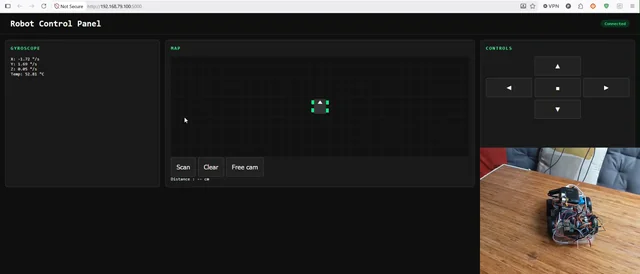
Hi r/robotics ! I’m currently working on a robotic car project for mapping, and I’d like to share my progress and get some feedback from the community. So far, the main issues I’ve encountered (and resolved) are as follows: - Synchronizing the car’s position on the map (as indicated by the gyroscope) with the position of the digitized image based on the car’s position - Managing the motors’ power supply (complex wiring) However, there are still a few issues for which I could use some advice. - It seems that over time, a discrepancy is developing between the robot’s position on the map and its actual position as measured by the gyroscope. Is this an inaccuracy in the gyroscope that could be corrected through code? - The scanner works but remains fairly inaccurate; any recommendations are welcome - The robot’s path tends to veer off course, so I’m considering adding speed encoders to implement a path correction system (I assume the problem stems from the fact that the speed of each motor isn’t always precise) My goal is to build a fully autonomous car capable of mapping its surroundings (I'll add a webcam). Feel free to share any ideas you might have. my target is build a full self driving car able to mapping his environment ( i will adding webcam). Github : https://github.com/enzocolombat/EC-Hub/ submitted by /u/Pasteque9000 [link] [Kommentare]
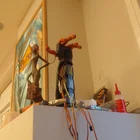
So this is my 2nd project and final project in high school, quite ambitious i gotta say. I was trying to make a anthropomorphic robotic hand . So i grabbed the palm and finger design from here. But i wanted to make my own thingys where the strings are attached , and add adduction ( fingers get clamped together). I learned how to use fusion and how to 3d print , i didnt know what was clearance. I learned that quickly . I dont have a 3d printer at home so i needed to pay for everything , i spent all my budget for this project , and i was so close to finishing everything but , my strings lacked tension and some 3d printed parts broke and i really dont want to spend more money. I finally decided to postpone the project until september because i got in an engineering school and i hope they have a 3d printer i can use freely. On top of that i think its better to try out some new stuff throughout the summer like i want to make those plasma ball thingys with the glass surrounding it and you can touch it. I am a little disappointed cause i was so close but let's see. I left you some pics too submitted by /u/MINII_man [link] [Kommentare]
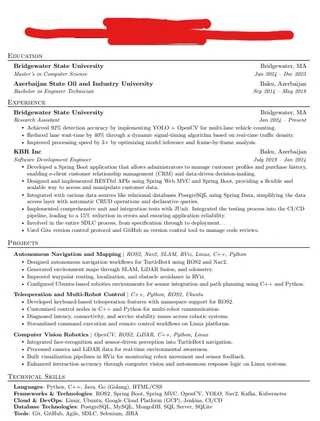
Title: Resume Review for Automate 2026 / Robotics Software Engineer (Master's Student) Hi everyone, I'm attending Automate 2026 in Chicago and would appreciate feedback on my resume. I'm a Master of Science in Computer Science at Bridgewater State University (graduating December 2025). I have 4+ years of software engineering experience and hands-on robotics experience with ROS2, TurtleBot4, SLAM, Nav2, OpenCV, computer vision, and autonomous navigation projects. I'm targeting these roles: Robotics Software Engineer Robotics Engineer Autonomous Systems Engineer Computer Vision Engineer Software Engineer (Robotics) I'd appreciate feedback on: Is my resume strong enough for robotics and automation companies? Are there any red flags? Should I emphasize my robotics projects more than my software engineering experience? Is the resume optimized for career fairs and recruiter screening? What skills or keywords are missing? Thanks in advance for any advice. submitted by /u/RaufBairamov [link] [Kommentare]