

Language models typically reason via explicit chain-of-thought (CoT), generating intermediate steps token-by-token. Latent CoT offers an alternative: it performs multi-step reasoning in the model's hidden states, replacing decoded tokens with continuous representations for greater efficiency. However, existing latent CoT methods underperform explicit CoT beyond 1B parameters, and the gap widens with scale. Looped, or recurrent-depth, Transformers, which reuse their weights to increase computation depth without adding parameters, are a natural fit for latent reasoning. We therefore ask whether looped Transformers can bridge this gap. We answer affirmatively with a simple recipe: a looped padded Transformer that processes K latent blocks in parallel for R iterations, with a cross-entropy loss on each latent position's gold CoT-step token, similar to explicit CoT supervision. We instantiate it as LOTUS (Looped Transformers with parallel supervision on latents). LOTUS is, to our knowledge, the first latent-CoT method to bridge the gap to explicit CoT at the 3B scale, while cutting thought-phase latency by 2.5x-6.9x from compact math expressions to natural language. Projecting LOTUS's post-loop latents through the base LM head recovers the gold reasoning steps and even surfaces alternative valid intermediate steps, evidence that its latent space is interpretable and CoT-aligned. Ablations confirm that both the looped backbone and the parallel supervision on gold CoT tokens are essential. Code is available at https://github.com/yingfan-bot/lotus.


This issue of CCSI Investment Perspectives was contributed by Aniruddha Pravin Jaydeokar. He is a Researcher at the Columbia Center on Sustainable Investment with a focus on leveraging innovative financial structures and instruments to drive systems-level change in mining and energy value chains, as well as in the decarbonization of hard-to-abate sectors. He has done prior research in geothermal energy across Southeast Asia and North America.



It’s a long-running medical mystery: Why have so many people under 50 in affluent countries been developing colorectal cancer in recent decades?Something new is triggering a jump in what’s known as early-onset colon and rectal cancer (EOCRC). The rates have been going up for the last 20 years and no one knows why it’s happening.

Hi everyone, LinkForge recently crossed 5,000 downloads on the Blender Extensions platform, which was a nice milestone. The project started as a Blender extension for building robot models, but over time it has evolved into something a bit different: a programmable Intermediate Representation (IR) for robot descriptions. My goal isn't to replace URDF or XACRO. Instead, I see them as compilation targets, while the IR becomes the editable source model that can be validated before export. The core is written as a standalone Python engine, so it can run in Blender, from the CLI, or in automated pipelines. I'm curious what others think: Do you think robotics is missing a proper intermediate representation between CAD/design tools and formats like URDF or MJCF, or do existing workflows already solve this well? I'd genuinely appreciate feedback from people building robots professionally. GitHub: https://github.com/arounamounchili/linkforge Blender Extension: https://extensions.blender.org/add-ons/linkforge submitted by /u/Mysterious_Dare2268 [link] [Kommentare]

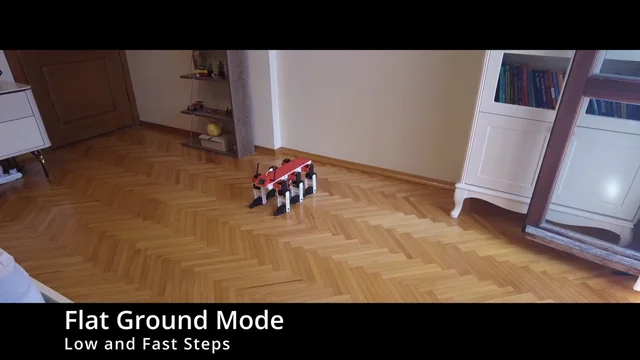
I have been working on this project over the past 6 months. Its a 3d printed hexapod robot dog, I call it HexaDog ZBD (English Pronunciation of ZBD means raggedy in Turkish). I used ESP32 S3 for its brains, 2x PCA9586 boards for servo connections, 18x DS3218 servos, 1x IMU, 3x 15a 300W buck converters and almost 2kg of PLA. Total robot weight is about 2.7KGs with 3s2p 18650 batteries (some sparks were created during the earlier design of the battery case) I have been testing it indoors and outdoors I am quite happy and surprised for the amount of work I got out of ESP32. I plan to convert the gait mechanism from Inverse Kinematics to a small neural network through imitation learning and run it on ESP32 as well if one core can handle the neural network while the other handles the WiFi access point and screen updates it will be golden! I have done the neural network generation from IK and controlled the robot with it in Pybullet now I have to try it on real robot. Total BoM was a close to 400 USD in Turkey (Import Taxes), but I checked on Ali and if you source them form China you can lower the costs down to about 200 USD. Amazon US prices are close to 300 USD. I plan to open source all desing files, scripts and android controller app APK. I am currently cleaning all my design files and scripts and organizing them so once I upload them there are no bugs. I wanted to get community opinion on it to see if anyone would also be interested in building one. If you wish to test it out in simulation before attempting to build one, the github repo link below contains a Pybullet demo of the robot. You can download it and control it in an empty Pybullet environment and check out the simulation script for yourself. https://github.com/serdarselimys/HexaDogZBD-PybulletDemo Let me know what you think, I wanted it to be an affordable and simple modular platform for anyone interested in robotics to experiment with it. submitted by /u/Xerd-R [link] [Kommentare]