## Except from article. The reported allocation is not being framed as a short-term bet on crypto prices. CoinPost said the main goal is currency risk diversification. The fund’s fiscal 2025 asset mix stood at 80% yen, 15% dollars and 5% other currencies. For fiscal 2026, the fund plans to cut yen exposure to 70% and add a 10% allocation to developed-market currencies. Another 5% would include emerging-market currencies, gold and crypto. Aiyu Kiguchi, the fund’s investment executive director, reportedly said the dollar “may lose its status as a reserve currency,” explaining why the fund did not raise dollar holdings. submitted by /u/zesushv [link] [Kommentare]


like in the next 10 mins. I have everything ready. I already have another person whose doing his setup rn. I just wanna complete it and get it over with quick. Maybe we can hop on a call?? submitted by /u/SundeepKuPanigrahi [link] [Kommentare]




Suppose you’re a PhD advisor in machine learning. Your student has been in the program for 4 years, has done solid work, and has a coherent thesis direction but they haven’t published in an A*ML venue or top journal. No NeurIPS/ICML/ICLR/CVPR/etc., and no equivalent top venue in their subfield either but 3 First author A level paper. Would you still support them graduating if the thesis itself is solid? submitted by /u/Hope999991 [link] [Kommentare]
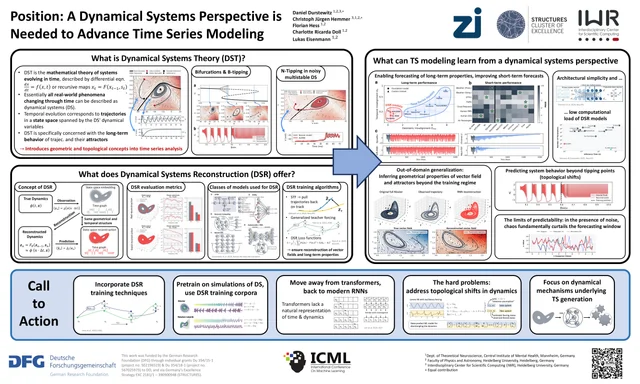
In our #ICML2026 position paper we argue a dynamical systems perspective is needed to drive time series (TS) modeling forward: https://arxiv.org/abs/2602.16864 Essentially all time series in nature and engineering come from some underlying dynamical system (DS), mostly chaotic for complex systems, and acknowledging this helps to address many open problems. Dynamical systems reconstruction (DSR) goes beyond mere forecasting and gives us an understanding of the dynamical rules that underlie observed time series. This in turn may enable true out-of-domain generalization and predicting a system’s long-term behavior, something current TS models cannot do. In the paper, we compare a variety of custom-trained and recent foundation models for TS and DSR w.r.t. short- & long-term forecasting. Specifically, we suggest: 1) Put a focus on DSR-specific training techniques and objectives in TS model training, such as generalized teacher forcing (https://proceedings.mlr.press/v202/hess23a.html). These will enable capturing long-term statistical properties and dynamical structure, and at the same time help massively reducing parameter load and complexity of TS models. Proper training is more important than model architecture! 2) Pretrain TS models on simulations from dynamical systems, rather than on artificially created time series functions. These will yield much more natural priors for real-world TS. Chaotic systems in particular contain a rich temporal structure and many timescales (often an infinite skeleton of unstable periodic orbits of any period). 3) Move away from transformers, back to modern RNNs. DS are defined by recursions in time. By ignoring this and potentially further coarse-graining signals, transformers lose essential dynamical information, making them generally incapable of capturing a system’s dynamical rules. This is evidenced by their failure to forecast a DS’ long-term statistical or geometrical structure. 4) Address the hard problems in TS modeling: Topological shifts (https://proceedings.mlr.press/v235/goring24a.html). Although in itself tricky, the really hard problem in TS forecasting is not so much mere out-of-distribution shifts, but changes that drive a system across tipping points or into different dynamical regimes, where the vector field topology changes. 5) DS properties like attractors or bifurcations are universal – acknowledging this in TS modeling will give a kind of mechanistic and transferable understanding of TS properties that is independent from specific (physical, medical, …) domain knowledge. It therefore also pays off to put a focus on mathematically tractable and interpretable models. With a great team of shared-first & co-authors, Christoph Hemmer, Charlotte Doll, Lukas Eisenmann & Florian Hess! submitted by /u/DangerousFunny1371 [link] [Kommentare]


"There were signs. There were lights. There were cones. And it went through the cones and then sped up straight away," said Slade. To make matters even worse, Slade says a nearby CHP officer began chasing them after seeing what was going on.


Track every channel in your niche — competitors included — summarise every upload, and get one brief: what's trending, who's converging, and what to make next.