 K
↗
K
↗
AI phone infrastructure for emerging markets — local numbers and sub-20ms voice streaming to AI agents across Africa, LATAM & MENA.
 E
↗
E
↗
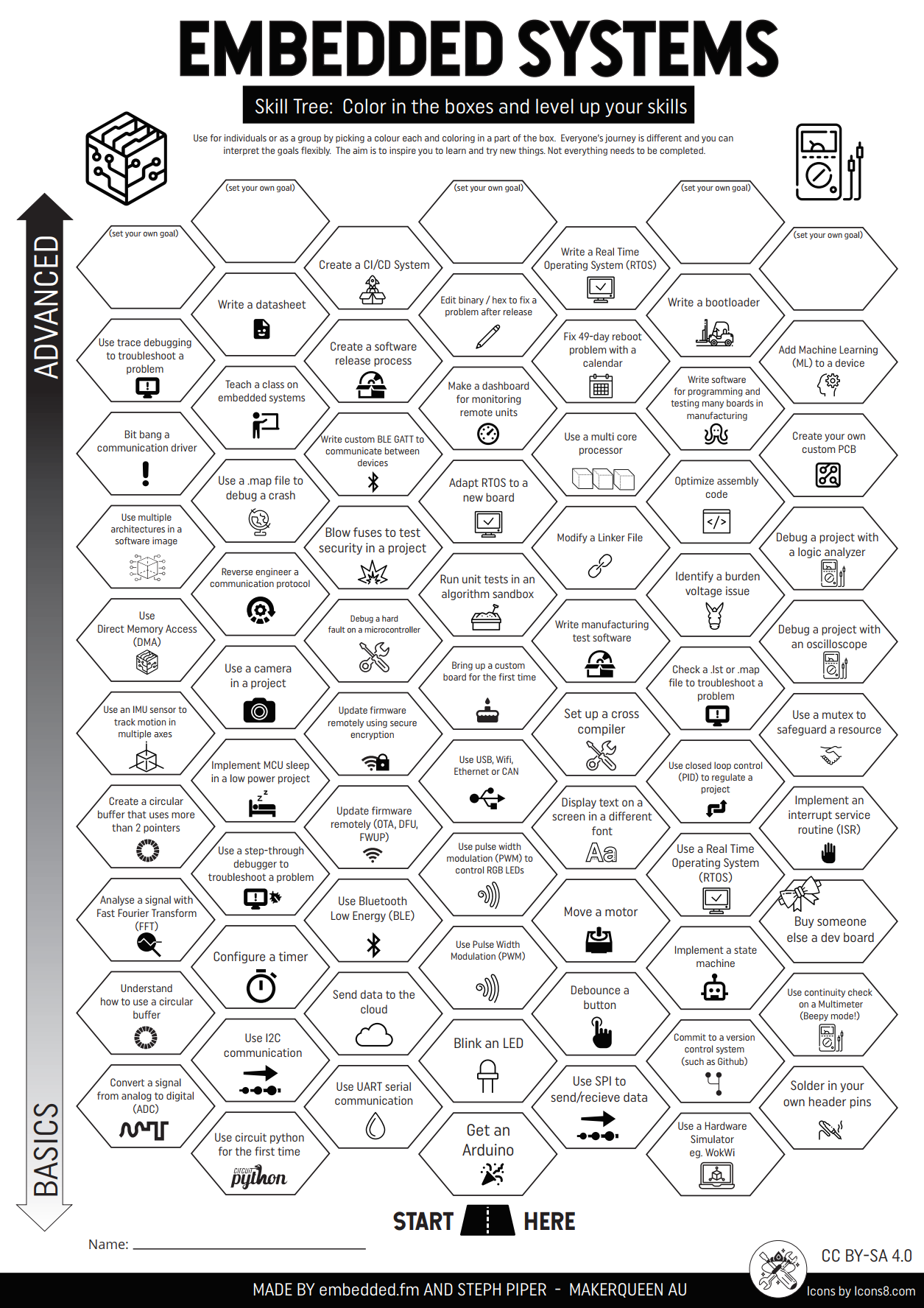
The Embedded.fm Patreon Slack group and I put together an embedded skills tree with the help of Steph Piper (aka MakerQueen ). You can find a template in Steph’s github repository (where she has one for 3D Printing and Modelling too!). Embedded Skills Tree
R
↗
Bought a shit ton of Litecoin at $100. It's now at $40. I'm down 60%. Need it to go up 150% to even break the fuck even. I'm down so much. Is there any hope? So depressing. submitted by /u/Prestigious_Way_738 [link] [Kommentare]
 R
↗
R
↗
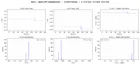
Follow-up to my v2 trajectory post. The RViz trajectory had visible zig-zag jitter even when the robot was stationary. Before deciding what filter to apply, I wanted to actually measure the noise and understand what's driving it. The problem The v2 system uses a physically fixed AprilTag (tag1) as a world frame anchor. The Pi detects it each frame, inverts the camera→tag transform to get world→camera, and publishes that as a TF. The zig-zags in the trajectory come from frame-to-frame instability in that pose estimate. The root cause is AprilTag PnP pose ambiguity — the solver has two valid geometric solutions for a planar tag and flips between them. The flip shows up as a large swing on one axis, typically ±15cm, even with the camera stationary. On top of that, small angular errors get amplified into position noise through the matrix inversion: at ~74cm tag distance, a 5° rotation error becomes ~6.5cm of position noise in world frame. The question I wanted to answer before touching the filter: how much does tag size actually move the needle? Method Added a single_tag_world_mode flag to config so ManualTracker can run with just the world anchor tag in frame — no chase target needed. Camera held stationary, pointed directly at the tag, for ~2–3 minutes per condition. Raw camera-frame poses recorded automatically to JSON. Four conditions: 5cm and 20cm printed tags, each with room lights on and off. All four plots below share identical axis scales so the distributions are directly comparable. Results Condition σ X σ Y σ Z (depth) 5cm — lights off 3.4 cm 0.5 cm 4.5 cm 5cm — lights on 5.1 cm 1.7 cm 3.7 cm 20cm — lights on 2.7 cm 0.4 cm 1.4 cm 20cm — lights off 2.1 cm 1.0 cm 1.7 cm (Images: 5cm lights off → 5cm lights on → 20cm lights on → 20cm lights off) What the plots show Tag size dominates. Going from 5cm to 20cm cuts depth noise by roughly 3x. The distributions tighten and become more unimodal — the PnP flip signature (broad or bimodal histogram on X and Z) is clearly visible in the 5cm sessions and largely absent in the 20cm sessions. Lighting is secondary. For the 5cm tag, lights-on is actually worse on X (σ 5.1 vs 3.4cm), likely because uncontrolled ambient light causes glare that degrades corner localization on a small tag. For the 20cm tag the lighting effect is small enough that it's not the thing to optimize. Best condition across all three axes simultaneously: 20cm + lights on (σX=2.7cm, σY=0.4cm, σZ=1.4cm). What's next This experiment was groundwork, not a fix. The noise is reduced but still present — 2cm+ std dev on X and Z with a stationary camera is not acceptable for a usable world frame. The next step is a filter, but the right choice (EWMA, velocity gate, Kalman, or some combination) depends on understanding the noise characteristics, which is what this data was for. Still deciding. Open to suggestions from anyone who's dealt with PnP jitter on planar markers before. References Post history v2 trajectory post v1 tag chaser PiCar-X introduction Hardware / code PiCar-X on Amazon Git repo submitted by /u/okineedaplan [link] [Kommentare]
R
↗
Hey i was working on a 6dof robot arm and completely new to this And just found out about inverse kinematics I'm having trouble trying to find the right material to learn it where can I find good material submitted by /u/OkCash6221 [link] [Kommentare]
R
↗
Hello, WACV conference submission deadline is by the end of this week, good luck everyone! Does anyone know what the expected format/duration of the video for the supp. mat. is? The guidelines only mention: The supplementary material can be either PDF or ZIP only (maximum 200MB). Supplementary material may include videos, proofs, additional figures or tables, more detailed analysis of experiments presented in the paper, or code. It is a bit vague for a first-time submission to this conference. Any help appreciated. submitted by /u/LetterheadOk7021 [link] [Kommentare]
R
↗
I recently visited a robotics space that’s focused specifically on humanoid robots. Not industrial arms, warehouse AGVs, or general automation, but bipedal / human-form platforms. It’s part of an incubator-style setup for early-stage teams working in this niche. What surprised me most wasn’t actually the full robots. The complete humanoid demos were interesting, of course, but the component side stood out more: actuators, dexterous hands, sensing systems, and all the less visible hardware that makes these machines possible. It made me think that the real progress may be happening below the “cool demo video” layer. Another thing I noticed was the visitor mix. Over just a couple of weeks, there seemed to be people coming through from different parts of the world: corporate visitors, researchers, MBA / exec ed groups, and others trying to understand where the field really is. The common question seemed to be: are humanoids actually close to being useful in real-world environments, or is this still mostly future-facing R&D? The incubator model itself also felt notable. Instead of every startup trying to build everything alone, the space seems designed to put founders, suppliers, researchers, and component companies near each other. That kind of clustering has worked in other deep-tech sectors, so I’m curious whether humanoids need the same thing to move faster. A few questions I’m still thinking about: Are humanoid robots finally approaching real product-market fit, or are we still in the “ten years away” phase? Which use cases are most likely to come first: logistics, manufacturing, elder care, inspection, retail, or something else? Is the recent momentum mostly driven by hype and funding, or are there specific technical bottlenecks that have genuinely improved? Are components like actuators and robotic hands the real near-term market before full humanoids become practical? I’m interested in how people here read the current moment. For those working in robotics, automation, or related hardware: does this feel meaningfully different from previous humanoid waves? submitted by /u/Great_Arachnid5776 [link] [Kommentare]