Humanoid robots and physical AI were major themes at Automate 2026. The show featured more than 50 humanoid and quadruped systems, a significant increase from last year. Much of the discussion centered on commercialization, safety, deployment, dexterity, data collection, and training rather than future predictions. Several companies also showcased hybrid mobile manipulation platforms that combine AMR mobility with dual-arm operation, including new systems from Locus, Cobot, and Kinisi. On the physical AI side, Apptronik introduced Apollo 2 and its new Robot Park training facility, Generalist demonstrated its GEN-1 dexterity model, and FieldAI announced more than $100 million in revenue and customer contracts. submitted by /u/Responsible-Grass452 [link] [Kommentare]
I'm making a robotic mini rice transplanter, which will weigh around 4kg. Since Philippine rice fields are muddy, I'm planning to make a design with two 15cm diameter wheels that are designed with angled paddles on them, with a sled at the back. Using two 32gp 31zy 12v 80rpm motors. The back will be a sled. The two wheels will be steered with one high torque servo. The only thing I'm skeptical about is if it will work with that kind of setup. submitted by /u/spectralisunknown [link] [Kommentare]
Need to build a ml model to find the price elasticity at the product group level first the given price and discount. What are features I need have and which model used in the industry for these type of use cases . I have used regression and random regression to predict the qty sold. Looking for help on this submitted by /u/batmanparam [link] [Kommentare]

Hello everyone, today we are opening Lucy to the r/robotics community. Lucy is an open-source robotics platform built on ROS 2 with a simple goal: One platform to rule them all. We've spent months building the foundation, and now we need your feedback to help shape what comes next. What is Lucy? Lucy provides a unified control layer for robotic systems, making it easier to configure, monitor, and control robots through a common ecosystem. The current beta includes: RViz and Gazebo integration URDF support 3D robot visualization Real-time joint control powered by ros2_control Animation creation and playback tools Webcam-based hand teleoperation Extensible ROS 2 architecture for custom interfaces and applications Try out our demo online ! 🌐 Lucy Control Panel Demo Help us with beta testing Follow the guide to install the full beta: 📋 Beta Test Guidelines And the most important for improving the project, give us your honest feedback please 🐞 Submit Feedback 📦 GitHub Repository 💬 Join our discord server to stay updated and discuss about the project We'd love to hear your thoughts, this is only the beginning ! Welcome to Lucy ! The Lucy Team ❤️ submitted by /u/sambrus_ [link] [Kommentare]

Hello all, I am trying to recreate this mechanism as a personal project - and I am really having trouble wrapping my head around how it works. The knees and below make perfect sense, but the hips are throwing me off. What is the purpose of the 2 perpendicular motors at the top? The ones facing horizontally? And how does the rest of the hip fit in with that purpose? I hope this question makes sense. Here is a research paper showing another angle and a more mechanical breakdown. https://arxiv.org/html/2512.16705v1#S4.F3 Also Nvidia GTC 2026 is where the original clip is from (2:11:36) further in the video it shows a side view: https://www.nvidia.com/gtc/keynote/ submitted by /u/halxcyion [link] [Kommentare]
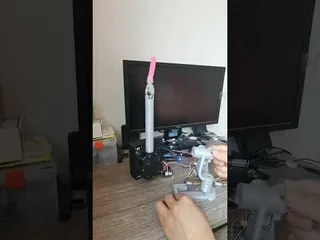

We brought the robot world to Chicago. At Automate 2026, Faraday Future showcased our full EAI robot lineup on the show floor — humanoid, bionic, and mobile manipulator robots, powered by one brain across multiple forms. From the All-New Futurist to our new Faber mobile manipulator series, the FF EAI Robot World drew strong attendee traffic and major media coverage throughout the show. This is only the beginning of robots stepping into real-world life. Learn more: https://robotics.ff.com/us/ submitted by /u/FaradayFuture_FFAI [link] [Kommentare]
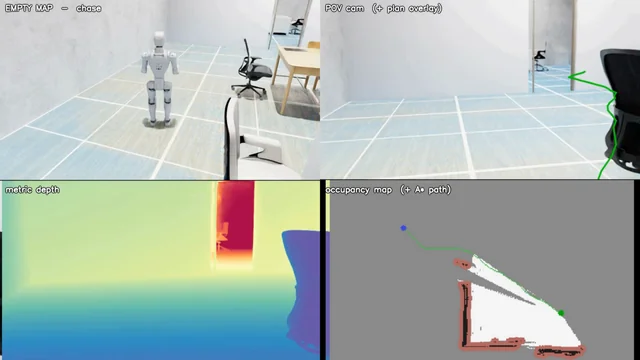
- chase: third-person view of the humanoid walking to the goal - POV cam: the robot's onboard RGB, with the planner overlay (🟢 global A* path, 🔴 immediate move) - metric depth: Depth-Anything 2's per-pixel depth - occupancy map: top-down log-odds grid being built live-> white=free, red=obstacle+inflation, green dot=robot, blue=goal, green line=A* path The robot starts with no map. It draws one as it walks, steering around furniture to reach a goal in the next room. This is a monocular-vision stack for perception, mapping, and navigation: Depth-Anything-V2 turns each RGB frame into metric depth, visual-inertial odometry (VIO) fuses that depth with the IMU for pose, the two build a live occupancy map, and an A*/DWA planner walks the robot to the goal. What would make this more close to reality? Curious to know what tends to break first when a stack like this moves onto hardware. submitted by /u/airwarmedd [link] [Kommentare]
Is this the Move-37 moment for flooring? I know, this machine is engineered for this job and probably needs close to perfect conditions to work, hence lacking the "creativity" of AlphaGo. But still, don't look where we are today, but 2 more machines down the line. Seems frightening for flooring installers at least. submitted by /u/LatentSpaceLeaper [link] [Kommentare]

(Translating this interesting Japanese post into English for the community! [Repost/Translation] Original link provided at the end.) We are diving right into microcontroller-based control today to explore some new IMU sensors for the Mini Pupper. Here is the breakdown: Table of contents BNO055 Integrating the BNO055 into Mini Pupper Key Notes Party Trick Time! Conclusion BNO055 Previously, I used the ATOM Matrix for control and had fun experimenting with attitude control using its built-in MPU6886 IMU sensor. My goal was to track the Yaw angle (rotation around the gravity axis) so the robot could keep facing the same direction even when the floor beneath it rotated. However, the MPU6886 suffered from significant Yaw drift, forcing me to abandon that approach. In this post, I’m switching to a different IMU sensor to finally achieve accurate Yaw control. To be fair, it's no surprise that a 6-axis IMU like the MPU6886 struggles with Yaw. That said, even with another 6-axis sensor like the MPU6050, you can actually get a relatively low-drift Yaw angle after a proper offset calibration. I could have gone with the MPU6050, but I decided to try out the BNO055 9-axis IMU sensor instead. Honestly, while the internal processing of the BNO055 is a bit of a black box, it delivers highly accurate attitude angles. You can get precise orientation data right out of the box without any tedious calibration or manual compensation using this sample code. Integrating the BNO055 into Mini Pupper I could have simply added the BNO055 to my previous ATOM Matrix setup. However, adding an extra IMU to a board that already integrates an MPU6886 felt way too redundant, and I just couldn't accept it. So, I opted for the ATOM Lite as the controller instead. BNO055 Circuit Board Key Notes While the BNO055 communicates via I2C, I ran into an issue where using M5Atom.h from the M5Stack Arduino library prevented me from mapping custom I2C pins for the Adafruit_BNO055 library. https://preview.redd.it/obc4fr764r8h1.png?width=1196&format=png&auto=webp&s=72d581213069e44203c269b73a8353f036312c93 To bypass this, I skipped the M5Stack library entirely and programmed the ATOM Lite using the standard ESP32 Arduino framework instead. This allowed me to freely specify the I2C pins, and communication with the BNO055 worked flawlessly. In this setup, I assigned Wire.begin(25, 21) for the BNO055 and Wire1.begin(22, 19) for the PCA9685 servo driver. I can confirm that everything runs perfectly without any issues! Reading attitude data with the BNO055, controlling the servos with the PCA9685, and lighting up the NeoPixels —— I've finally built my ideal board! Party trick Time! Thanks to the BNO055, I can now get highly accurate orientation angles. No Kalman filtering or complex algorithms needed—I just used the raw angle data straight from the sensor. The BNO055 is a beast and made this incredibly easy. I tested out the Yaw-based turn control to keep the robot locked onto a single heading while rotating. The longed-for Mini Pupper party trick Looks great! The walking gaits I programmed earlier are also working perfectly. ATOM Lite version Mini Pupper is also doing very well Even when the floor is tilted, parallel control based on foot height is smoothly achieved using only the attitude angle P control of BNO055. Conclusion I had a blast using the BNO055 9-axis IMU sensor to control the Mini Pupper. The BNO055 is honestly a game-changer—it finally allowed me to bring my dream Mini Pupper party trick to life! It's incredibly rewarding to watch this little robot get smarter and smarter. I'll definitely keep learning and experimenting! Original Japanese Post Original X Post #1 (Media) Original X Post #2 (Media) Original X Post #3 (Media) Original X Post #4 (Media) submitted by /u/Designer-Cricket7504 [link] [Kommentare]
Hi everyone, For the past couple of weeks I have been working on a simulator project considering the shortcomings of MuJoCo. There are things that people like and also don't like about MuJoCo, like the CPU dependency on MuJoCo which makes the simulation not parallelizable beyond a certain limit (depending on the hardware). I know there exists MJX which is GPU accelerated, however, it is not really made for vision based RL pipelines and training. There is also NVIDIA Isaac ecosystem, but that requires a powerful GPU, thus making it limited in terms of accessibility, let alone it requires license. This is why I worked out this new simulator (still working on it, so there will be significant bugs which require fixing). I call it MuJoFil - MuJoCo + Google's Filament Render Engine. Basically I used Nvidia's Newton Physics Engine (which itself is based on MuJoCo's physics engine but is GPU native), clubbed it with Google's Filament render engine (both of these are open-source), modified Filament significantly to support working natively on GPU to render multiple simulations in parallel, and worked on optimizing it for performance. So what is MuJoFil? It is supposed to be an open-source high visual fidelity simulator optimised for a highly parallelized RL training pipeline so that users can use it to train Vision based Policies. Besides, it offers PBR textures support and also a simple to use plug and play functionality, where you can use any environments available online and support formats such as GLB, OpenUSD, etc. for setting environments for your robots. Basically, now you aren't just limited to environments native to MuJoCo, but rather you can use any environments available online from sketchfab, polyhaven, etc. and use it as a practical robot simulation environment. Check it out for yourself in the video. I would really appreciate it if you guys could tell how you feel about it and suggest ideas for what all things I can incorporate into it as this is going to be a fully open-source and free to use simulator that I have been working on for weeks. PS: While I have a couple of published research papers at top RL and AI/ML venues in the field of RL, I still consider myself a learner in this field who is continuously trying, learning, and building stuff, so there will be things in this hugely ambitious project which I might have missed to work on, and that is where I want help from you people who understand this field well. Sorry for this lengthy post and thanks if you read it till here🙇🙇🙏, I would really appreciate if you could share your thoughts on it. Also, I will make its code repo public on GitHub, but till then you can definitely check it out on PyPI. There are 2 separate packages, one can be installed using: "pip install mujofil" This is the CPU based variant, whereas there is a CUDA supporting GPU native variant about which I mentioned above, you can currently install it using: "pip install mujofil-warp" I am planning on changing its name to mujofil-cuda instead of mujofil-warp as that apparently sounds more intuitive to my direct peers but you can suggest this name as well. Thank you for the support❤️. submitted by /u/MT1699 [link] [Kommentare]
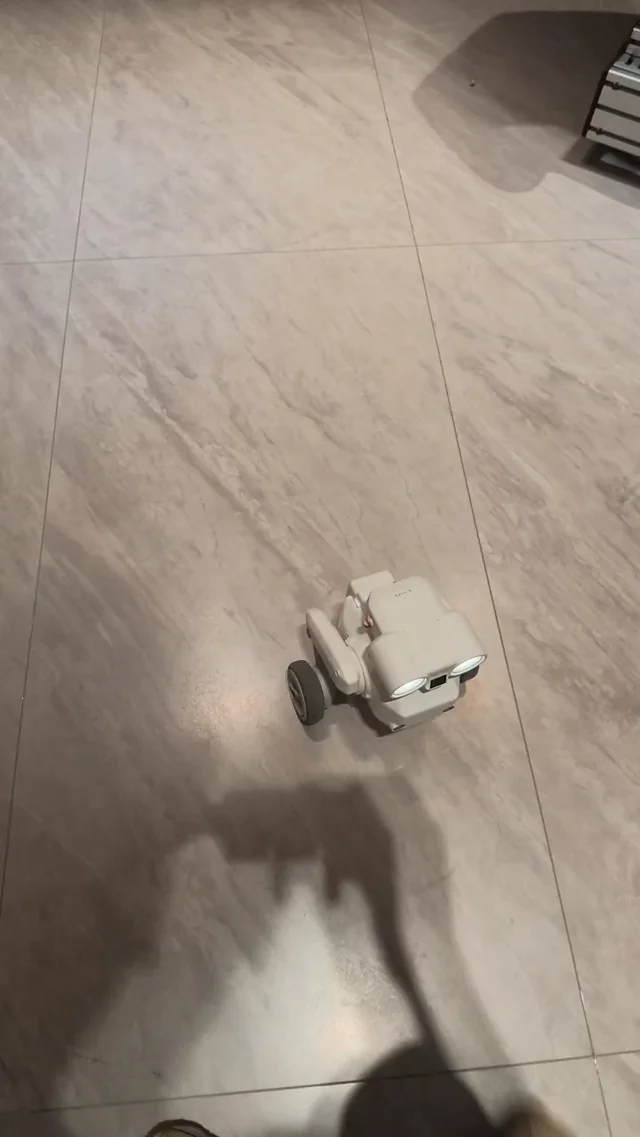
From Mondo Robotics on 𝕏: https://x.com/mondorobotics/status/2059305305553723725 submitted by /u/Nunki08 [link] [Kommentare]
Anyone building at the model layer knows the procurement problem hasn't gone away. H100s are still allocated unevenly, spot instances get preempted at the worst times, and pricing across providers is deliberately hard to compare. Most teams end up over-provisioning just to feel safe. The traditional fixes — reserved instances, spot bidding, broker marketplaces like CoreWeave or Vast.ai — all have the same problem: no real price transparency and no way to hedge future compute needs. I came across a project called Inferra that's approaching this differently. Instead of another compute marketplace, they're building a derivatives exchange for GPU compute — perpetual futures for specific chips (H100, H200, A100, MI300X, B200, A5000), oracle-priced and on-chain. The idea being that a proper futures market creates price discovery that doesn't currently exist. Still pre-mainnet so nothing to benchmark yet. Whitepaper is at inferra.trade for anyone curious about the architecture. Genuinely interested in the broader question though: is the GPU access problem fundamentally a supply issue, a pricing transparency issue, or a market structure issue? And would futures markets even help at the scale most research teams operate at? submitted by /u/amu4biz [link] [Kommentare]