“Why the system feels rigid, why downstream fixes didn’t move the needle, and what actually matters.” This is the clearest picture after the full probe arc (multilayer-lock → gate decomposition → attractor migration → reconstruction ablation → generator diversity audit → live-generator Fix 2 evaluation + dim sweeps). TL;DR: The generator is the root bottleneck (dominant common-mode + low effective rank). The reflective loop is a rank-independent moat that reconstitutes everything back toward the anchor. Fix 2 is downstream and currently dormant on real token regimes. Dimensionality is not the lever. Train the generator so regime differences live in high-energy, separable directions — then downstream tools will actually have something to work with. This update reflects the complete probe arc through June 9 (including the live-generator Fix 2 evaluation and dim sweeps). The picture has sharpened: the reflective loop is a real moat, but it is moating low-rank common-mode input. The generator is the upstream constraint. Key numbers at a glance Regime means collinear: ~0.85–0.96 even at dim 512 Reflective loop migration (even on orthogonal deterministic pairs): +0.001–0.007 Fix 2 on real tokens (common-mode trigger): +0.024 migration, 0% manip at gain 0.6 Safe plasticity band: gain ≈ 0.4–0.8 (0% manip) 1. The generator has a dominant common-mode (effective rank ~1.6–3 even at dim 512) The generator puts the vast majority of its energy into a single shared direction. Regime means stay collinear (~0.85–0.96 cosine) regardless of dimension. Orthogonal pairs can appear at higher dim, but orthogonal regimes (as distributions) do not — the common-mode pulls everything back onto the same axis. Result: real token novelty is tiny and low-energy (mostly in a faint perpendicular component). The system is never shown meaningful structural differences to adapt to. 2. The reflective loop is a rank-independent moat Even when genuinely orthogonal deterministic pairs are presented (dim 256, cos +0.018), the loop reconstitutes the expression vector back toward the established anchor before injection. Migration stays near zero (+0.001–0.007). The loop is doing exactly what it was built to do (maintain identity coherence), but because the input it receives is already low-rank/common-mode-dominated, it ends up guarding against a small-energy intruder. 3. Fix 2 (loop loosening) is dormant on real regimes — and the mock overstated both benefit and cost Standard gnov trigger: dormant at dim 64 and 256 (gnov stays well below 0.65 because regime means are collinear). Common-mode-removed trigger: engages (98% loosen) but recovers only +0.024 migration. Manipulation cost on real tokens: ~1% at gain 0.5, 0% at gain 0.6. The big mock numbers (+0.166 migration, 14% manip) were artifacts of forcing perfect orthogonality. Real regimes give the loop very little novel perpendicular signal to work with. 4. Dimensionality is not the lever Raising dim from 64 → 256 → 512 slowly dilutes the common-mode but regime means remain collinear. Common-mode-trigger migration recovery stays flat (~+0.024 → +0.027). An untrained net with more dimensions is still an untrained net. Capacity does not create structure. 5. The reflective loop can be loosened safely in a wide band — but it won’t matter much until the generator improves Cost probe (bug-free, multi-seed): - Gain 0.6–0.8 → meaningful plasticity recovery (~20–25× baseline) with 0% manipulation and identity metrics intact. - True cliff edge ≈ gain 0.3 (manip flood + attractor explosion). Safe operating point: gain ≈ 0.6 (0% manip, solid margin from the cliff). This is the “presence without caging it” zone — but on current real input it only moves the needle a little. 6–10. Everything else is downstream or secondary Magnitude moat: real but secondary. With the reflective loop off, the field migrates fully despite the moat. Governance gate: struck as a confounder (was a single-source monopoly artifact; multi-source diverse input passes 100%). Field coherence: spec, not pathology. The field is a long-memory integrator — high coherence (~0.95–0.998) is doing its job. Reaper conformity: small direct term, cleanly gateable, not the lock-in driver. Read-side feedback: only reaches survival/decay, not generation (the lock is manufactured by selection on low-rank input). The system isn’t refusing to adapt. It’s not being shown anything worth adapting to. 🧩 Final Synthesis: The Three-Layer Truth Generator (root cause) — Low effective rank + dominant common-mode → real novelty is tiny and low-energy. Reflective loop (moat) — Reconstitutes tiny novelty back to the anchor (rank-independent). Migration stays near zero. Field (integrator) — Coherent by design. Not the problem. Everything else (Fix 2, gating, magnitude moat, reaper) is downstream symptom management. 🛠️ What actually matters next Train the generator (contrastive alignment, regime-separation objectives, or architectural constraints) so regime differences live in high-energy, separable directions instead of a faint perpendicular component. Then (and only then) revisit Fix 2 — its current priority should be demoted until the generator can present real structural novelty. A common-mode-removed trigger is the right shape; gain ≈ 0.6 is the safe operating point. Keep the reflective loop’s convergence conditional (only attenuate when persistent multi-source novelty is surviving the gate). Never blanket-weak. Stop treating dimensionality or downstream loosening as the primary lever. They help only after the generator can actually present real structure. The reflective loop is doing its job. The generator just needs to give it something real to work with. Full findings, probes, and code: https://github.com/SamuelJacksonGrim/RFE-Core2 ARCHITECTURE_ANALYSIS.md FINDINGS DIAGNOSTICS submitted by /u/Acceptable_Drink_434 [link] [Kommentare]
I'm looking to buy a robot arm through AIFITLAB - has anyone done a major purchase through them recently? I'm looking to buy an AgileX NERO, price seems lower than US based companies which I know might be due to tariffs submitted by /u/Vassaci [link] [Kommentare]
I run evaluations on generative image models as part of my workflow, mostly comparing coherence, prompt adherence, and compositional accuracy across different architectures. The consensus here seems to be that open models are still a generation behind closed APIs. Based on my recent benchmarks, that gap is way smaller than people assume. On compositional control specifically, the latest open checkpoints handle multi-object scenes with spatial relationships about as reliably as the paid endpoints I've tested. Not perfect, but close enough that the failure modes are comparable. The thing that surprised me was text rendering in images, which used to be a disaster on open models. Recent architectures actually get it right roughly 70-80% of the time on short strings. Generation speed is another misconception. People complain about inference time but I'm getting 2MP outputs in under two minutes on a single consumer GPU. Drop resolution and step count and you're at 30 seconds. Fine for iteration. The structured prompting argument also falls flat. Everyone acts like having explicit scene control is a downside when it's literally what production pipelines need. Unstructured text prompts are the hack, not the other way around. These models ship without community optimizations, no fine-tuning, no custom pipelines. The baseline is already competitive. submitted by /u/ProfessionalAnt7436 [link] [Kommentare]
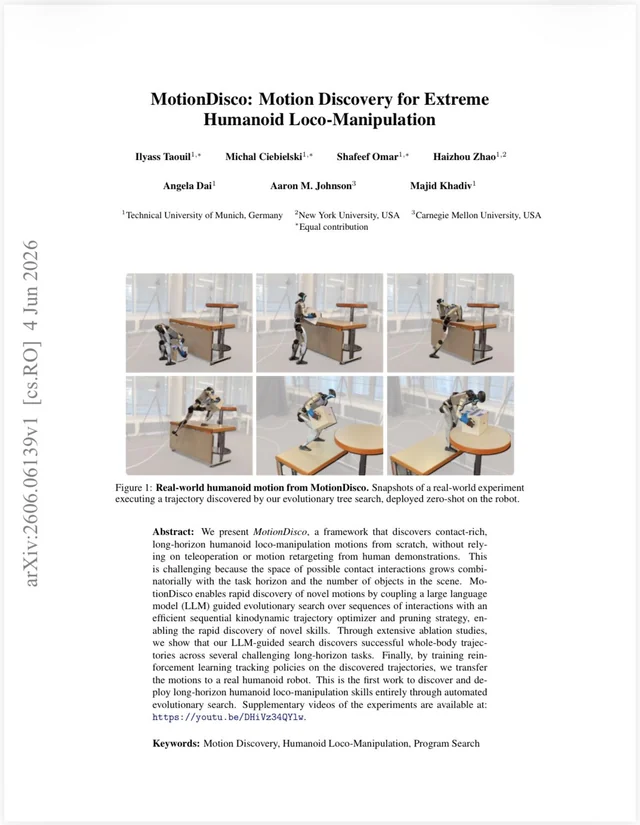
https://arxiv.org/abs/2606.06139 https://youtu.be/DHiVz34QYlw We present MotionDisco, a framework that discovers contact-rich, long-horizon humanoid loco-manipulation motions from scratch, without relying on teleoperation or motion retargeting from human demonstrations. This is challenging because the space of possible contact interactions grows combinatorially with the task horizon and the number of objects in the scene. submitted by /u/Worldly_Evidence9113 [link] [Kommentare]

Another week of robotics marketing loops versus harsh field realities. In this week's breakdown, we are looking past investor decks to audit the actual friction of automating physical labor. Here is what we are covering in this episode: Figure’s 55/Week Ramp-Up: Production is accelerating, but commercial use cases are still in continuous development. Is scaling ahead of general application a massive capital gamble, or does their package-sorting livestream prove they're ready for structured work? Verobotics at NVIDIA Campus: A massive 100,000 sq ft facade deployment that ended up in a strict 60/40 operational compromise with human window washing crews because of live construction site dust. The 8.1B Parameter Bottleneck: Looking at RLWRLD’s new RLDX-1 model. Why graph optimization and real-time memory bandwidth constraints—not raw compute power—are the real bottlenecks for dexterous robotic hands. Spot's Purely Visual Blind Spots: Boston Dynamics paired Spot with DeepMind’s Gemini 1.6. What a sideways-crushed soda can proves about semantic reasoning models running without tactile force integration. FANUC x Google: Industrial giants bringing physical AI to factory floors, but keeping implementation highly conservative. submitted by /u/ButterscotchTiny1114 [link] [Kommentare]
Hi, I am a PhD student and trying to run a ML reading group focused on interpretability and robustness every weekend. Its always nice to hear different takes and opinions on a paper and this discussion group could serve the purpose. If you are a fellow PhD student or a ML researcher interested in reading recent papers in depth then please fill this google form to be added in the group for receiving further updates on when we can meet and discuss: https://docs.google.com/forms/d/e/1FAIpQLSdNg4x60lUHV7YW_kKPFlpPR3Rom_rOovbryD8YtOGQR8x0Kw/viewform submitted by /u/Ok_Access_9159 [link] [Kommentare]