I recorded a rosbag from a simulation run where the robot behaved weirdly. The bag is about 15 GB. I know I can replay it in RViz and inspect topics in Foxglove, but I’m wondering what people usually do after that (sorry new to this field). Do you just inspect the log, find the bug, fix the code, and move on? Or is there a standard practice for keeping these logs and reusing them later? submitted by /u/Practical_Sir8080 [link] [Kommentare]
Like the title asks, I’m still learning but Is agentic AI already being implemented into the huge umbrella of “robotics”? Or more specifically, is it being implemented into hardware or robots? Generally where is agentic AI very useful in “robotics” ? submitted by /u/Frosty-Telephone-747 [link] [Kommentare]
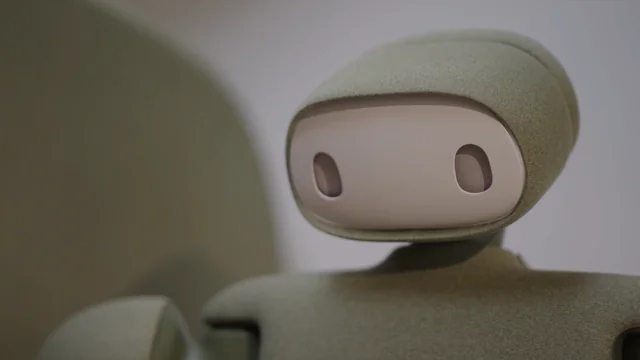
From Weave Robotics on 𝕏 (thread): https://x.com/weaverobotics/status/2072362538671706314 Website: https://www.weaverobotics.com/isaac-1 submitted by /u/Nunki08 [link] [Kommentare]
Paper Referred:- https://arxiv.org/pdf/2412.09871v1 Has anyone switched the transformer in the entropy model here to a Mamba model ? What could be the possible changes ? Just a ML fresher asking a genuine, since Mamba is more popular and saves computer (O(n)). Thanking you in advance ! submitted by /u/SoloLeveller07 [link] [Kommentare]
BMVC reviews will be out tomorrow. Making this parent thread for discussion. All the best everyone! submitted by /u/Hot_Version_6403 [link] [Kommentare]
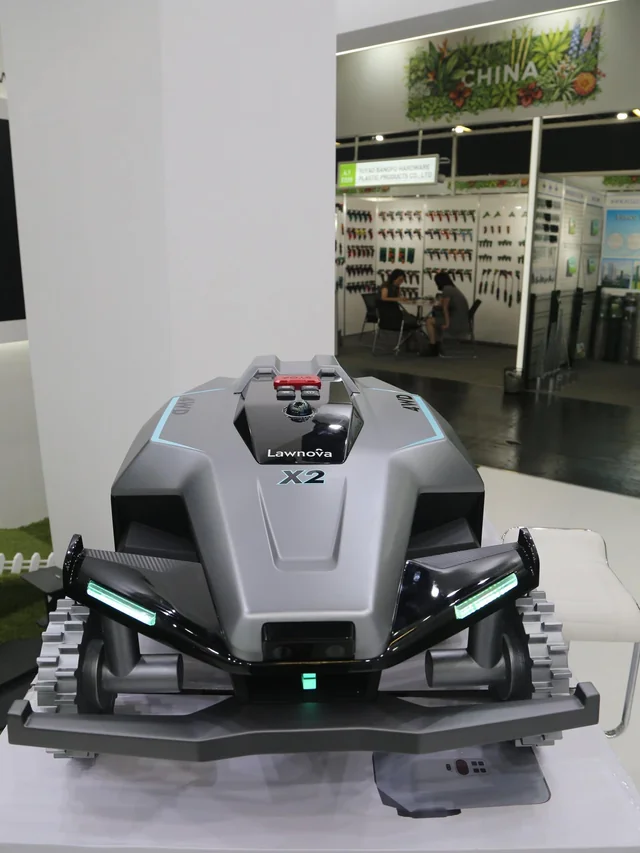
Our engineering team’s taste may be a little too direct/mechanical, so I’m genuinely not sure how regular consumers would feel about this robot mower’s exterior design. submitted by /u/Time_Marsupial_3886 [link] [Kommentare]
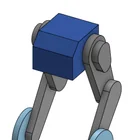
I'm designing a self-balancing robot and was wondering what calculations I need to make to determine how much my robot will need to weigh. The robot will have legs, and the height I'm looking for is somewhere between 500mm and 600 mm. I was considering using https://www.pololu.com/product/4751 as the wheel motors, but I don't know at what weight it'll be able to balance efficiently and at what weight it won't. My robot should be able to carry an object with a max weight of 450-500g, but I can lower that requirement if needed. basic design for robot submitted by /u/Confident_Mix803 [link] [Kommentare]
Hi everyone, The check in QR code is visible at my profile despite that my card isn’t accepting the payment transaction. What does that even mean? Thanks! submitted by /u/misplacedlion [link] [Kommentare]
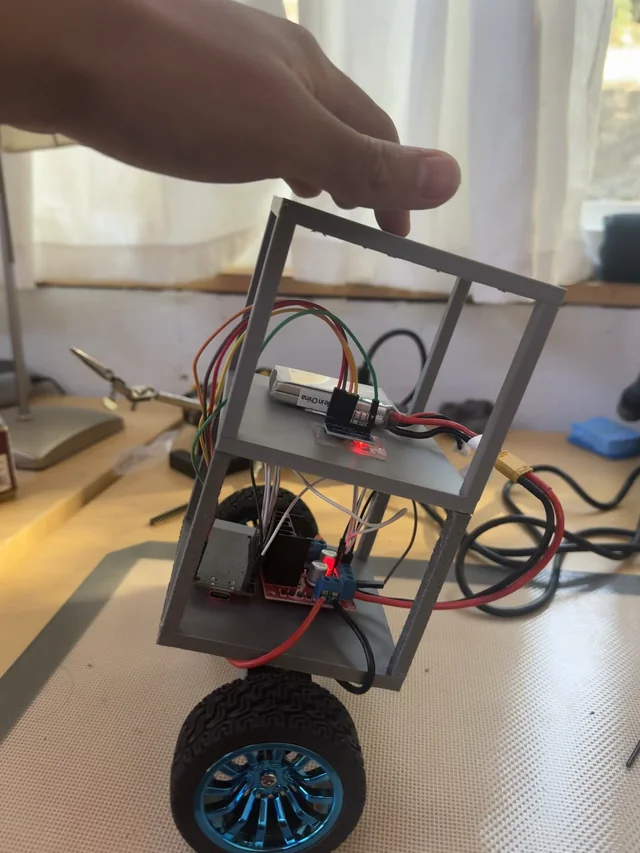
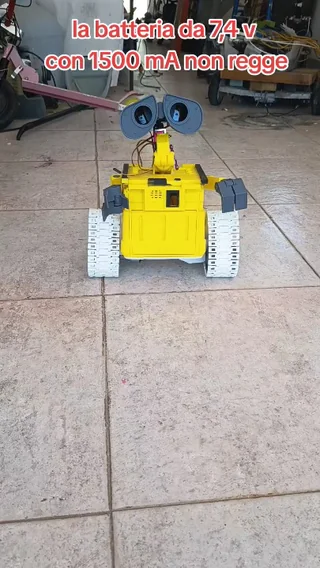
So i’ve created this robot using an ESP32, L298n motor driver, MPU 6050, and powered by a 7.4 2s Lipo Battery. I’ve been having a lot of trouble with the PID tuning, working solely on tuning for 4+ days with no results. I would really appreciate any advice! This is what I currently have: Code: https://docs.google.com/document/d/1wHsZ9ZLWXOu-upoTgflaRj04iTZKkDtYxoTk9kdxAj4/edit?usp=sharingb submitted by /u/bfffornever123 [link] [Kommentare]
Hey everyone, Over the past year I've been building this as a personal project (no company behind it, just me): a Python-based platform that takes measured input/output data from a physical system, automatically identifies the best mathematical model for it, designs an optimal controller (PID, LQR, MPC, and others), and generates ready-to-deploy C and Python code for the hardware. I've verified it extensively on synthetic benchmarks — DC motors, thermal systems, oscillatory mechanical systems, nonlinear processes — and it's holding up well. But I need to stress-test it on **real industrial or embedded data** before I can call it production-ready. **What I'm offering:** - Full analysis of your system's data (no charge) - A complete technical report: model accuracy, controller performance, stability margins - Ready-to-compile C code + Python implementation for your hardware - Everything is yours to keep and use **What I'm asking in return:** - A brief description of who you are, what company/project this is for, and what you're trying to achieve - Your honest feedback on the report and the generated code — does it make sense? Is the output useful? What's missing? This is genuinely valuable to me as a solo developer - Permission to mention you as a reference on my CV - Permission to cite the project as a validated use case (no sensitive data published — just "successfully deployed on [type of system] at [company/domain]") I'm keeping this to 1–2 pilots so I can give each one proper attention. **What kinds of systems are a good fit:** Motors, actuators, thermal processes, fluid systems, robotics, HVAC, industrial automation, biomedical devices — basically anything where you have logged sensor/actuator data and want better control. If this sounds useful, **send me a DM** with a short description of your system and what you're trying to achieve. I'll let you know if it's a good fit. Thanks for reading! submitted by /u/pipeline-control [link] [Kommentare]
Hey guys, I was playing around with Nanotron recently and got super frustrated by how many heavy, hardware-specific dependencies it imports at the module level ( flash-attn , triton, functorch , etc.). If you try to run it on older or budget GPUs like a T4 or V100, it just crashes on import. So I wrote Picotron (https://github.com/Syntropy-AI-Labs/picotron) to solve this. It's a clean-room rewrite that gets rid of all mandatory GPU-specific dependencies. It runs on pretty much any GPU that supports PyTorch (defaults to FP16 on older cards under compute capability 8.0, and BF16 on newer ones). It falls back to standard PyTorch SDPA by default, but still hooks into FlashAttention-2 at runtime if it detects you have it installed. I used an AI assistant to write a lot of the boilerplate/code modules, but I've got it working locally and just trained a tiny 2M model on FineWeb-Edu. Also added configs for: • GQA / MLA (Multi-head Latent Attention) • QK-Norm & logit soft-capping (Gemma 2 style) • Parallel FFN/Attn runs • ZeRO-1 wrapping on DDP Roadmap is pretty short right now: MoE prep (routing capacity factors and load balancing loss) Making dataset prep easier than streaming manually Check it out if you've been fighting with CUDA dependency hell: https://github.com/Syntropy-AI-Labs/picotron submitted by /u/Capital_Savings_9942 [link] [Kommentare]
I'm a B.Tech student in India graduating in mid-2029. Currently, I know Python, SQL, Docker, basic prompt engineering, and I've built a few LLM apps using BaaS like Supabase/Firebase. I’m running all this on an Intel i5 13th Gen laptop with an RTX 5050 (8GB VRAM). The Pivot: I originally wanted to be a generic ML Engineer, but I've realized the entry-level market for Jupyter Notebook/Python scripters is insanely saturated. Plus, most companies are just calling OpenAI APIs anyway. I want to pivot to the high-performance stuff: AI Backend / Distributed Systems Engineering. Instead of tuning the model, I want to be the guy building the infrastructure that serves the model to 10,000 users without the servers melting. My ultimate goal is top-tier Indian product companies (Zepto, Cred, etc.) or US remote startups. My Proposed Roadmap: I am dropping the "easy" BaaS tools and going low-level. Here is my plan for the next couple of years: The Language Shift: Dropping Python for backend, going all-in on Go (Golang) to master concurrency and memory pointers. The Database Shift: Moving away from Supabase to raw PostgreSQL (via Docker), eventually learning to scale it, plus Redis for caching. The Hardware/AI Constraint: Running models locally on my RTX 5050 using Ollama/vLLM. Learning how to deal with VRAM limits using quantization, PagedAttention, etc., before eventually moving to cloud AWS/GCP. The Distributed Scale: Learning Kafka/RabbitMQ, Vector Databases (Milvus/Qdrant) at scale, and eventually wrapping it all in Kubernetes. Basically, I want to build custom, high-throughput AI backends from scratch. My Questions for the Seniors: Is this roadmap actually viable for a 2029 grad, or is the learning curve for Distributed Systems + AI Infrastructure too brutal to do alongside a college degree? Is betting heavily on Go the right move for this specific AI systems niche? What blind spots am I missing here? Roast my plan. Be brutally honest! submitted by /u/SinkClassic4450 [link] [Kommentare]
I am building a perception pipeline from RGB-D for pick-and-place with a depth camera. The goal is to detect an object on a table, estimate its 3D position, and obtain a stable orientation that the robot can use to grasp it. In this post, I describe some things I learned during the first part of the implementation, after training the segmentation model: https://medium.com/@danieldoradotalaveron/getting-stable-yaw-for-robotics-pca-tabletop-and-the-beginning-of-my-tracking-pipeline-8b9dd3921d3a submitted by /u/nettrotten [link] [Kommentare]