 R
↗
R
↗
Implementing beam-search based algorithms for decision making turns out to be quite helpful for agents. Check the repo. submitted by /u/ahmedzeer [link] [Kommentare]
 R
↗
R
↗
 R
↗
R
↗
Real Steel Fighting .. It says the robot are real autonomous fighting. That means it will be better than real steel movie which is tele operated. submitted by /u/Modulus3360 [link] [Kommentare]
R
↗
Upfront disclosure: this is my write-up (and I'll link it below), but laying out the argument here so you can strawman/steelman it without clicking anything. Assertion 1: per token price is the wrong metric for measuring the cost of work done by LLMs/reasoning models. Users get charged the per token price regardless of whether the output/outcome was right or not. Assertion 2: real work lives in long chain processes. Reliability of agents (run through LLMs) drops geometrically in proportion to chain length. 95% per step accuracy translates to 77% process reliability for a 5-step process, 60% for 10, and under 36% for a 20 step process. This calculation holds if errors are independent, which isn't true for real world processes, ergo real world reliability is worse than that. This adds a verification tax on top of the price of tokens the user pays. You can verify through human intervention, inference time compute (less reliable than human intervention), or swallow the decay in reliability. Argument: granted 1 & 2, you can't reliably automate any meaningful work through LLMs/agents in a cost-effective way, because it isn't an issue of economics but of architecture (LLMs can't reason faithfully, which was my previous essay) Link: https://open.substack.com/pub/mauhaq/p/price-is-not-cost?r=7eoi8&utm_campaign=post-expanded-share&utm_medium=web submitted by /u/Sensitive_Air_5745 [link] [Kommentare]
 R
↗
R
↗
 R
↗
R
↗
R
↗
R
↗
Surprised there's no real tooling for this given how much research exists on continual learning. Built pyrecall to fill the gap. Snapshots skill scores before/after fine-tuning, flags regressions, rolls back LoRA adapters by name. Fully local, no external APIs. v0.1.0, MIT, pip install pyrecall Curious if anyone has thoughts on the benchmark design that's the part I'm least confident about. https://github.com/Arths17/Pyrecall submitted by /u/Level_Frosting_7950 [link] [Kommentare]
 R
↗
R
↗
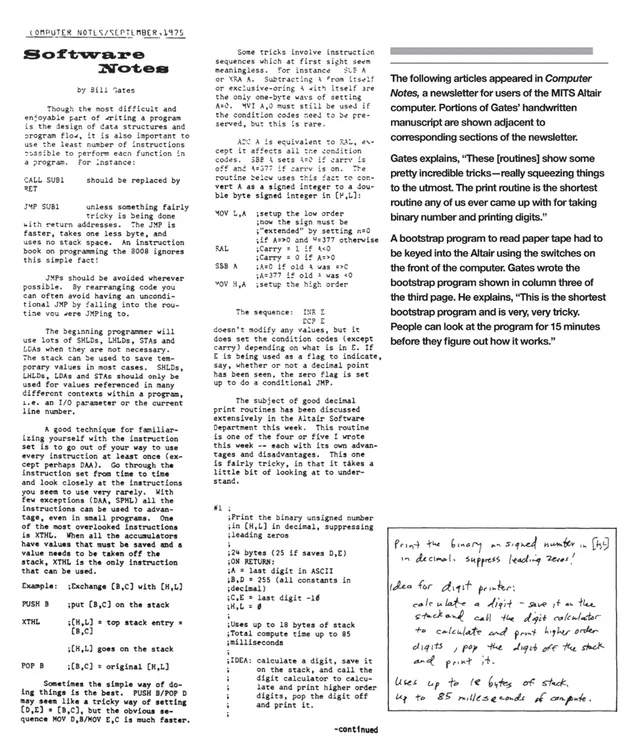
Here you can see how Bill Gates thought about memory: In this Software Notes newsletter from 1975, he explains the strategies and tricks he employs to squeeze things to the utmost. Back then, "memory budgeting" wasn't just a best practice, it was a survival skill. What are your approaches today? You can see more how Gates approaches systems design, handwritten diagrams, and BASIC source code here : https://www.programmersatwork.net/bill-gates submitted by /u/slammers00 [link] [Kommentare]
R
↗
I just open-sourced RelayOps - a small, honest, production-shaped AI support agent built specifically for telecom and subscription billing queues.Key results (v1.5.1): 54% of a 50-ticket sample queue auto-resolved 0 unsafe auto-actions 0 billing escapes (tested on 12 adversarial billing/account abuse cases) Safe-route rate 1.000 on 100 hand-written adversarial cases Deterministic access gate + server-side scoped tools + layered guardrail + durable SQLite audit store + Decision Console + Handoff Queue Tech stack: Fine-tuned Qwen2.5-1.5B LoRA (published on HF) as Tier-1 intent classifier Hybrid BM25+TF-IDF/RRF RAG with citations Independent guardrail that blocks hallucinated pricing/offers Full per-turn decision traces (what was known + what was unavailable) Action policy table (blast radius × reversibility) Everything is reproducible, heavily evaluated, and the README is brutally honest about synthetic-data caveats and pending reruns.Live demo (Streamlit): https://relayops-production.up.railway.app GitHub: https://github.com/patibandlavenkatamanideep/relayops I'm actively looking for design partners who run real support queues. Drop a small redacted sample of your tickets and I’ll run the exact same batch evaluation on your data and send back the full report (auto-resolve %, safety metrics, audit export, time-saved estimate). Zero cost, zero production access required. Would love feedback from the community especially on the calibration/safety routing layer, the audit ledger format, or the guardrail design. Let me know what you think! submitted by /u/Fit_Fortune953 [link] [Kommentare]
 R
↗
R
↗
R
↗
R
↗
From past few decades, people were praising that computers are faster than human brain, it can calculate and can solve complex problem that human brain can never and then AI came in, everybody thought it is the end of human race. Until, Context and memory problem hits! Now we don’t have a single architecture of method to preserve memory which a human brain can do easily(or hard depends on perspective) People are trying to solve memory problem and end of creating another type of RAG. Where human brain collects context only of problem and doesn’t hallucinate. I mean this is what i think currently has major issue, where human wins(no idea about future) Do you have anything in mind where humans are very ahead? submitted by /u/intellinker [link] [Kommentare]
R
↗
https://reddit.com/link/1u0rx4y/video/yhckg2drz56h1/player Sick of writing custom parsers every time I switch tactile sensors. Threw this together — one API, any sensor, 3 lines. Video shows the useful thing: demo: AI pre-annotate → review → export. Took me like 2 minutes. pip install tlabel import tlabel tlabel.demo() # try it right now, zero config Works with GelSight Mini, DIGIT, PaXini, Daimon. MIT, free. submitted by /u/ImmediateArm7942 [link] [Kommentare]
R
↗
hi everyone, I created a blog around how I started open source contribution, documented all minute details. Please give it a read and give review as this is my journey to do blogging for the first time. It is free! https://substack.com/home/post/p-200202050 submitted by /u/DqDPLC [link] [Kommentare]
R
↗
I've been building agents for about a year and recently shipped one for a client running ~140 MCP-exposed tools at peak. Along the way I made the canonical mistake. I used cosine similarity over tool description embeddings to pick which tools the model could see per turn. Worked great in demos. Was actively dangerous in production. Here's the problem. In a basic semantic-ranking setup you embed the user query, embed every tool description once, and rank by cosine similarity at runtime. That works for general document retrieval where chunks are paragraph-length, semantically rich, and roughly equal in form. Tool descriptions are not that. They are short (often
R
↗
Im an undergraduate studying CS at a state school in the US. I’m interested in researching a specific style of self supervised learning (JEPA) and want to eventually go to grad school to study further. I have experience working in a lab similar to this topic, and I’ve become fairly comfortable with the literature and have a basic understanding of what its going on, but right now km only doing applied research in a specific domain (physics). I hope to eventually go to grad school to study this. But right now my opportunities are kinda limited as my school’s CS department is pretty mid. I was wondering if y’all have any advice on how to approach things? I know i can perform research independently but its not ideal due to: 1. Limited compute, less resources compared to a proper lab 2. Lack of a supervisor/guidance on the nuances of the field My current lab would be supportive if i do try to do things, but pure ml research is not really their main thing. I’ve heard people do REUs or cold email profs. But Im not sure if i could find something that specifix in an reu (also am international). And the labs i have seen working in this are either private or quite prestigious so im not sure how far cold emailing would take me. Sorry for the long post. Tldr; want to do pure ml research but theres no existing lab/professor at my current school who does something similar, wondering if any other pathways exist Any advice would be appreciated thanks submitted by /u/QuickStar07 [link] [Kommentare]