 R
↗
R
↗
Check the FF (Nasdaq: $FFAI)'s EAI robot "super group" at Automate 2026 — North America's largest robotics show. submitted by /u/FaradayFuture_FFAI [link] [Kommentare]
R
↗
Hi everyone, I'm a Computer Science + Applied Mathematics major at a T15 CS university, focusing on machine learning, and I'll be an incoming junior this fall. My long-term goal is to land ML-focused internships and eventually work in machine learning or AI-related roles. I recently completed an introductory AI/ML course that covered the fundamentals of: * Data preprocessing (handling missing data, feature scaling, train/test splits, categorical encoding) * Regression (linear, polynomial, SVR, decision trees, random forests) * Classification (logistic regression, KNN, SVMs, Naive Bayes, decision trees, random forests) * Clustering (K-Means, hierarchical clustering) * Association rule learning (Apriori, Eclat) * Reinforcement learning (UCB, Thompson Sampling) * NLP (tokenization, bag-of-words, sentiment analysis) * Deep learning (ANNs, CNNs) * Dimensionality reduction (PCA, LDA, Kernel PCA) * Model selection and boosting (cross-validation, grid search, XGBoost) I've also completed two research/internship experiences: * Built a Human Activity Recognition model using KNN. * Developed a Louvain clustering pipeline for beauty product datasets. From a coursework perspective, I've completed Linear Algebra, Calculus III, and will soon be taking Applied Linear Algebra and Probability & Statistics. Given my current background, what projects, activities, courses, competitions, or skills would you recommend I focus on over the next year to become a stronger candidate for ML internships? Are there any gaps in my knowledge that stand out? submitted by /u/Reasonable_File663 [link] [Kommentare]
 R
↗
R
↗
R
↗
R
↗
Talk to a lot of ML teams who ship models but skip any adversarial testing before deployment. Feels like security review for models is way behind where it is for regular software. Anyone here actually doing this at their job? submitted by /u/Xorphian [link] [Kommentare]
 R
↗
R
↗
Would a ASL-ML from BO3 work in real life as a Autonomous Quadruped Robot. I kinda think it could only problem would be power/batteries. If it would work what could it be used for? I mainly think security, patrolling important assets etc. submitted by /u/LowAcanthocephala528 [link] [Kommentare]
 R
↗
R
↗
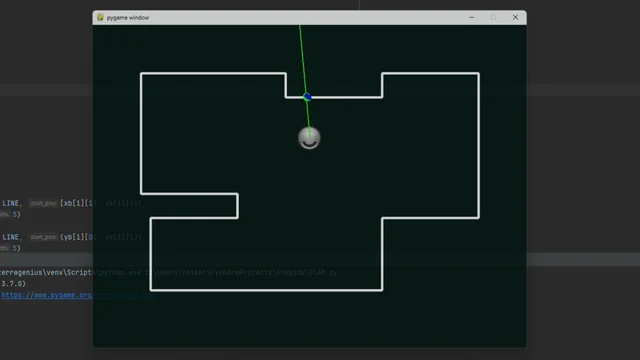
In this python simulation: a robot spins a sensor and receives the distance. I made the distance more inaccurate the farther it is from a wall. The white lines are the actual walls The green dots are the raw, inaccurate data points the blue lines are my attempt at trying to interpret the data points into walls The algorithm works like this: For every green dot, if there are two close dots, it finds the best fit line, deletes the middle dot, and moves the other two onto the best fit line. This averages out the slopes between the green dots to allow for slope comparison. For every green dot, if the angle of the lines connected the green dot in front and behind are similar, then they are clipped into just two dots (similar to the first filter). However, as you can see, it is making walls even farther off from the green points, especially for vertical sections. I suspect this is because I'm using y=mx+b, and the slope for a vertical line is undefined, so I think the algorithm has a hard time approaching that. For context, I'm an incoming freshman trying to design an algorithm for a roomba without any prior knowledge on SLAM algorithms, so I would greatly appreciate any resources for a better implementation or just general feedback. submitted by /u/ExerciseCrafty1412 [link] [Kommentare]
R
↗
Hello guys, I’m a 3rd year mechanical engineering student (21 yo). I’m planning to start a YouTube Channel which I’ll do online interviews with engineers working in Aerospace and Robotics Industry about their specialization and their experiences. Are there any of you would be interested in to be my guest? submitted by /u/bertgolds [link] [Kommentare]
R
↗
We just did a big revamp of WeightsLab and wanted to share it here. If you’ve ever spent hours debugging a training run only to discover it was a data problem all along, this is for you. WeightsLab lets you pause training mid-run, inspect your live loss signals, and catch mislabels, class imbalance & outliers before they tank your model. Open source, PyTorch-native, built for CV engineers working with images, videos & LiDAR point cloud data. Would love to hear what the community thinks and if it looks useful, and helps more people find it: [ https://github.com/GrayboxTech/weightslab] submitted by /u/taranpula39 [link] [Kommentare]
 R
↗
R
↗
R
↗
R
↗
Months ago, I got my first maintenance project. Before this, I had only built new solutions from scratch and maintained my own code. But maintaining someone else's system feels completely different. It’s a prescriptive recommendation system that uses XGBoost models and Differential Evolution for optimization. The problem is that everything is in a single repository: raw data ingestion, transformations, model training, reporting, the optimization engine, post-processing, and MUCH more. The only thing outside the repo is the frontend website. To me, it looks like a massive, super complicated monolith. After almost 3 months, I still find new "patches" (quick fixes) every single day. Every time I do, I have to re-learn how the system works. The documentation is very generic and a total mess; it mixes the original design with patches from the two maintenance teams that came before me. I’ve checked some of the docs, but definitely not all of them, because there are about 50 long markdown files. Have you ever dealt with a prescriptive system like this? How do you survive? Honestly, I’m debating whether to just quit or keep patching the code however I can until the project ends—even though I know that’s not the right way to do things. submitted by /u/DescriptionBorn153 [link] [Kommentare]
R
↗
R
↗
I graduated with my bachelor's in a top 3 CS program and have had a rough recruiting season. I received a full time offer as AI Product Engineer at a tax software company, where they are trying to become more AI native. It's essentially a PM + AI engineering role. Long term I'd love to work at a frontier lab or in a research/more technical role at an AI startup. So, should I take up the offer or pursue my master's at the same school? I am able to defer my master's but don't feel fully comfortable accepting the offer just to only work there for 6 months... At the same time it's not fully aligned with where I want to be long term and feel I can do better, but recruiting was also really difficult. Note, I'm not able to pursue my Master's while working, the company was firm on this TC 126k submitted by /u/jollyjove [link] [Kommentare]
 R
↗
R
↗
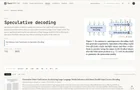
A method that is currently trending on Papers with Code is Speculative Decoding. https://preview.redd.it/dm4nh4t71o7h1.png?width=3082&format=png&auto=webp&s=b6468668667d4bcfb6c9248d3af7fd09f21fe0da Speculative decoding is an inference optimization technique that uses a fast, small "draft" model to quickly propose several future tokens, which are then verified in parallel by a larger, slower "target" model. This process significantly speeds up token generation for large language models (LLMs) by allowing multiple tokens per step without sacrificing output quality. SGLang, one of the most popular frameworks for running LLMs alongside vLLM, just released a blog post detailing how they achieve state-of-the-art latencies for LLM inference serving using Modal and Z.ai's DFlash speculative decoding models. Learn more at https://paperswithcode.co/methods/speculative-decoding. You can also find all the papers that cite the original paper that introduced this technique. SGLang's blog: https://www.lmsys.org/blog/2026-06-15-next-generation-speculative-decoding-dflash-v2/ Let me know which other methods I should add! Cheers, Niels from HF submitted by /u/NielsRogge [link] [Kommentare]
R
↗
Character AI, founded by former Google/LaMDA developers Noam Shazeer and Daniel De Freitas, proved that text-based character chat can work as a real entertainment category. But the next chapter might not be better text chat. It might be real-time video interaction. Mel AI recently shared a demo of AI character video chat, and the interesting part is the interaction stack: voice, lip sync, facial reactions, and camera-aware responses instead of just a static avatar or chat box. The character can respond to visual context too. If the user is visibly on a plane or in a different environment, the character can notice and react to that context during the conversation. I don’t know how much of the video layer is truly generated in real time versus powered by a clever animation/rendering system, but it feels meaningfully different from the usual text-based character AI experience. Character AI proved the demand for entertainment AI. Now it feels like the race is about who can make AI characters feel alive in real time. Demo: https://x.com/Building_Mel/status/2064848256115626481 submitted by /u/DonutRare5633 [link] [Kommentare]
R
↗
Hi everyone, I'm a PhD researcher at Mainz University of Applied Sciences, Germany. My dissertation looks at how interface and UX design shape user trust in AI/LLM-based chatbots, specifically how to support calibrated trust, where users neither over-rely on a system nor dismiss a capable one. As part of this, I've developed a structured method that helps designers or developers decide which trust-related interface elements to use in a chatbot, and how strongly to apply them, depending on the use context. I'm looking for practitioners to apply the method to a worked example and tell me whether it's understandable, useful, and applicable in practice. Critical feedback is exactly what I'm after; there are no right or wrong answers. Who I'm looking for: People who design, build, or research AI/LLM-based products, e.g.: UX, product, or interaction designers AI/ML engineers, data scientists, or applied-AI / conversational-AI practitioners Advanced students or researchers in these areas You should be comfortable reading and responding in English. What's involved (~20-30 min, at your own pace): Read a short description of the method and a sample chatbot case Apply the method step by step to that case, noting your reasoning as you go Rate it on three dimensions (clarity, usefulness, applicability) and leave open feedback Details: Fully anonymous online survey. Voluntary, no compensation. No personal data is required beyond a few optional questions about your professional background. Responses are used only for my dissertation, and you can stop any time before submitting. Consent details are on the first page. Survey link: https://ww3.unipark.de/uc/ux4ai/ Happy to answer questions in the comments or by DM. Thanks for considering it! submitted by /u/pparker20 [link] [Kommentare]