
@James
Profile channel
@James
No bio yet.
Since 30.05.2026

The Death Stranding director has reacted to PlayStation going all-digital…
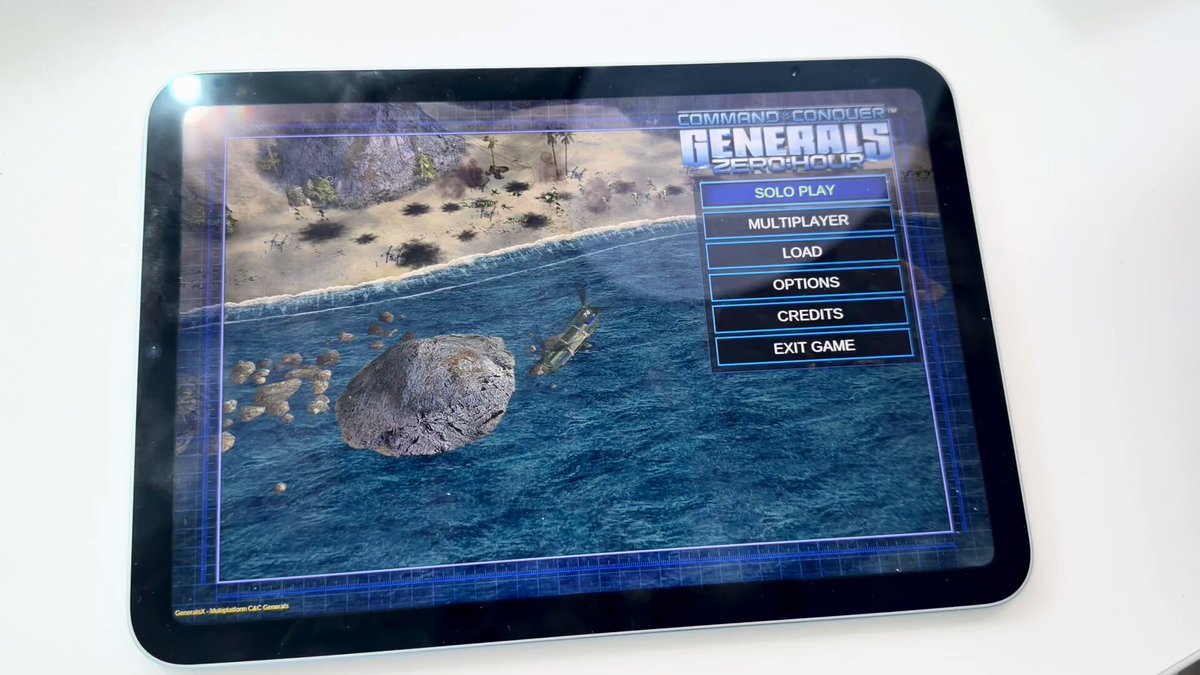
I used Fable 5 to port Command & Conquer: Generals Zero Hour to the iPhone and iPad! This is the actual 2003 engine compiled for ARM64 natively, no emulator. Campaign, skirmish, Generals Challenge all work with touch controls built for an RTS. Open sourcing it all below!

We present Pangram Text, a transformer-based neural network trained to distinguish text written by large language models from text written by humans. Pangram Text outperforms zero-shot methods such as DetectGPT as well as leading commercial AI detection tools with over 38 times lower error rates on a comprehensive benchmark comprised of 10 text domains (student writing, creative writing, scientific writing, books, encyclopedias, news, email, scientific papers, short-form Q&A) and 8 open- and closed-source large language models. We propose a training algorithm, hard negative mining with synthetic mirrors, that enables our classifier to achieve orders of magnitude lower false positive rates on high-data domains such as reviews. Finally, we show that Pangram Text is not biased against nonnative English speakers and generalizes to domains and models unseen during training.

Discovery is solved (MCP registry); trust is not. 8,560 MCP servers, Sentinel-scanned, AP2 mandates, x402 payments. Source-available MNNC-1.0 (Non-Commercial).
[Advoko] is an expert at milling logs into various sizes of boards. He typically uses nothing but a chainsaw to enable him to mill on-site without needing to bring any large or expensive equipment.…
None of them admitted wrongdoing.

A modern Spotlight-style launcher with built-in agents for web search, AI chat, file finding, clipboard history, and more. macOS, Windows, Linux.
Recently I was talking to a relative of mine and they told me that years ago they bought a few hundred dollars worth of bitcoin back when it was extremely cheap. At the time they thought it was just another scam, forgot about the wallet and lost access to the email associated with it. They say that they still know what the email is just not the password and if its even still accessible due to years of inacitvity. Any advice or will the bitcoin sit in that wallet till the end of times? submitted by /u/kimilsung5000 [link] [Kommentare]


An AI-native productivity app. Write one plain line; notaru files it into Tasks, People, Events, Projects and a Journal — and links it all together.
A reproducible signature-and-evidence map agents and CI can audit. Proof — 86.7% hit@5, 48.8% fewer prompts, 97.0% overall token reduction.
I made a 10MB LoRA adapter for Qwen3.5-4B plus a small orchestration layer. It decides, per query, whether to answer directly, search the web, or retrieve from your own local documents and it refuses to make things up when it can't verify an answer. It runs locally (Apple Silicon / MLX, with a GGUF build for llama.cpp/Ollama). Basically small instruct models are poor at telling users how confident they really are. They can't verbalise it and tend to say they are confident for everyhting. In my past research I tested seven 3-9b models and they all hit a confidence ceiling. But the information is there in the internal activations. The adapter reads the internal signal directly and gates tool use on it. The main elements are that: - it catches its own errors better than the base model's tool calling (d′ improvement of 0.46 (95% CI [0.01, 0.89])). Of the cases the gate flagged that the base model didn't, 87% were genuinely wrong answers. - it is less likely to leak your private queries to public search. A two-signal version routes personal information related questions such as "what did my discharge summary say" to a local retriever instead of a websearch. It cut the rate of private questions sent to public search from 22% to 10% (reduction 0.12, 95% CI [0.02, 0.22]). This is useful for those who are using the LLM for confidential docs. - every answer is traceable. When it retrieves, it cites the specific passage (report.md ¶2), verifies the answer is actually in that passage, and shows a confidence band. Worst case, it says "I couldn't verify that". It is built to say "I don't know," instead of lie. limitations: - Privacy result is n=60; the retrieval/competence dissociation is n=126 hand-authored items. Screened and CI'd, but small. - GGUF reproduces the MLX gate's decisions at --lora-scaled ...:8 (found by sweep — scale 1 does nothing; effective scale ≈ the training scale). Agreement 0.83 on a 24-item probe; disagreements are all conservative-direction (GGUF answers a couple of borderline items MLX would look up), and knowns never false-fire. Faithful on the safety-critical directions, marginally more conservative at the margin. - Serve-time confidence is coarse (grounded / declined / answered) — the distilled gate reads nothing at inference, so finer bands need probe access (offline). - Inherits Qwen3.5-4B's knowledge and biases. The gate governs when to trust the model, not what it knows. The approach isn't Qwen-specific — I started on SmolLM3-3B, and it should extend to other models and larger sizes. Repo (weights + code + model card): https://huggingface.co/synthiumjp/competence-gate-qwen3.5-4b Apache-2.0. It's an open research release. I hope people might find some use for it. Methodology and papers are cited in the model card. Genuinely interested in critique, it's screened work, so if there are any issues it be great to know. submitted by /u/Synthium- [link] [Kommentare]