 R
↗
R
↗
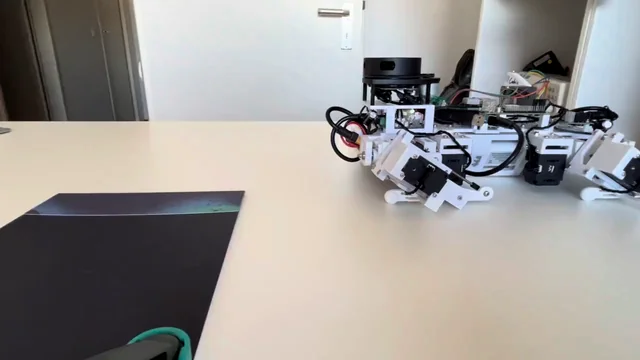
Update since: https://www.reddit.com/r/ROS/comments/1ugw66z/cubic_doggo_update_returning_to_basics_after_all/ Hello hello, I made some mechanical updates to Cubic Doggo 06R, just for it to lift its feet while walking. The black padding is measured to be around 4 mm thick. I really thought this would be simpler than the IMU, but with all the changes, this is as good as it can get. The servo load (3rd on for the feet joint) easily reaches 70%, so I have a feeling this is the best it can do. I hesitate to make the body's 3D-printed frame lighter because that can make it less sturdy, and most of the weight is from the servo and batteries (yeah, also, I get a bit lazy just thinking about all those bolts and screws). Any more suggestions would be great! Changes made are m The next step is to walk with IMU, and then finally going to do some simulation and RL. Original Cubic Doggo post. submitted by /u/SphericalCowww [link] [Kommentare]
 R
↗
R
↗
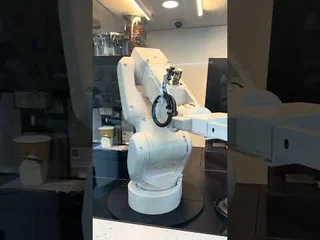
I saw this robot at Seattle space needle and thought it was cool. A few people said some of the robots ask for a tip. I think it would be real cool if it had a towel and could clean up its own mess after making coffee. submitted by /u/mattsrobotics [link] [Kommentare]
R
↗
Everyone suddenly seems to be an expert in continual learning. Dario Amodei claimed on the Dwarkesh Patel podcast that continual learning will be achieved by 2026, and Demis Hassabis has called it the most important unsolved breakthrough on the path to more general AI. Two of the most prominent people in the field, and yet I don't think there's even a consensus on what continual learning actually means. I see researchers and startups approaching it in fundamentally different ways. Some frame it as solving catastrophic forgetting. Others treat it as online learning, lifelong learning, or meta-learning. The goalposts keep shifting depending on who's talking. What I'm trying to wrap my head around is: what does continual learning actually require, and why is it so central to AGI? Is the bottleneck architectural, is it a data problem, or is it something more fundamental about how we evaluate and benchmark it? Would genuinely appreciate different perspectives, whether you think it's overhyped, underappreciated, or just poorly defined. Pointers to papers or frameworks that cut through the noise would also be welcome. submitted by /u/watercolorer2024 [link] [Kommentare]
R
↗
Real robot, two arms, 1x speed. The task is deliberately reactive: the puck keeps moving, so a policy that only maps the current camera frame to a motor command tends to lag a fraction of a second and lose it. The approach on screen is a predict-then-correct loop. Rather than going straight from camera to action, the policy predicts how the scene will move over the next moments, acts inside that predicted future, then re-grounds on each real frame that arrives so it does not drift. That is what keeps it in sync with a fast target. The model behind it is LingBot-VA 2.0, a video-action policy. Genuinely curious what people here make of the world-model-first framing (predict the near-future scene, then act on it) versus a plain reactive VLA with enough data. Source and the honest limits in a comment. submitted by /u/Even-Implement-1442 [link] [Kommentare]
R
↗
My new video on building a low-cost autonomous robot is out: how to set up the robot hardware so it's fully ready to drive. It shows how to set up the electronics in the Viam Rover, wire in and mount the Radxa X4 with custom breadboard electronics, and attach the RealSense depth module and external battery. Take a look! https://youtu.be/EDS5Ni4JcXw submitted by /u/mikelikesrobots [link] [Kommentare]
R
↗
We've been building Sowbot (aka the Feldfreund devkit), an open-source ROS 2 Jazzy stack for small-scale agricultural robotics: RTK-GNSS localisation (dual F9P moving base), LCAS topological navigation on top of Nav2, and a NiceGUI web cockpit for mission planning — draw the field corners, it generates row coverage via Fields2Cover. Just got multi-row mission following working end-to-end in Gazebo: the robot sequences entry/exit points across a full field of rows on its own, no manual nudge between rows. Video: https://www.youtube.com/watch?v=A0CVNcp19vU Just simulation for now, not a field result. It moves navigation and the sim step forward on our roadmap — hardware field validation is next, and we're not claiming a finished product. Stack, if useful to anyone: Two-SBC split — Limbic (ESP32 firmware, sensor fusion, localisation) and Neo (perception) ESP32 running https://lizard.dev/ Containerised via Docker, full build/sim modes Fields2Cover for coverage planning Visual crop-row following (ExG + Otsu threshold) as a Nav2 action server for in-row traversal Stock Nav2 (Regulated Pure Pursuit) for headland turns between rows Built on Zauberzeug's Field Friend as a base, developed with Agroecology Lab (UK) and caatingarobotics (Brazil) Apsitech (India) navigation stack from LCAS's Agri-OpenCore ecosystem. Fully open source. Repo: https://github.com/Agroecology-Lab/feldfreund_devkit_ros WIP Reference hardware: https://sowbot.co.uk Happy to answer questions on the nav stack, sim setup, or anything else. PRs or collaboration welcome if this is your area. submitted by /u/Sabrees [link] [Kommentare]
R
↗
I made a 10MB LoRA adapter for Qwen3.5-4B plus a small orchestration layer. It decides, per query, whether to answer directly, search the web, or retrieve from your own local documents and it refuses to make things up when it can't verify an answer. It runs locally (Apple Silicon / MLX, with a GGUF build for llama.cpp/Ollama). Basically small instruct models are poor at telling users how confident they really are. They can't verbalise it and tend to say they are confident for everyhting. In my past research I tested seven 3-9b models and they all hit a confidence ceiling. But the information is there in the internal activations. The adapter reads the internal signal directly and gates tool use on it. The main elements are that: - it catches its own errors better than the base model's tool calling (d′ improvement of 0.46 (95% CI [0.01, 0.89])). Of the cases the gate flagged that the base model didn't, 87% were genuinely wrong answers. - it is less likely to leak your private queries to public search. A two-signal version routes personal information related questions such as "what did my discharge summary say" to a local retriever instead of a websearch. It cut the rate of private questions sent to public search from 22% to 10% (reduction 0.12, 95% CI [0.02, 0.22]). This is useful for those who are using the LLM for confidential docs. - every answer is traceable. When it retrieves, it cites the specific passage (report.md ¶2), verifies the answer is actually in that passage, and shows a confidence band. Worst case, it says "I couldn't verify that". It is built to say "I don't know," instead of lie. limitations: - Privacy result is n=60; the retrieval/competence dissociation is n=126 hand-authored items. Screened and CI'd, but small. - GGUF reproduces the MLX gate's decisions at --lora-scaled ...:8 (found by sweep — scale 1 does nothing; effective scale ≈ the training scale). Agreement 0.83 on a 24-item probe; disagreements are all conservative-direction (GGUF answers a couple of borderline items MLX would look up), and knowns never false-fire. Faithful on the safety-critical directions, marginally more conservative at the margin. - Serve-time confidence is coarse (grounded / declined / answered) — the distilled gate reads nothing at inference, so finer bands need probe access (offline). - Inherits Qwen3.5-4B's knowledge and biases. The gate governs when to trust the model, not what it knows. The approach isn't Qwen-specific — I started on SmolLM3-3B, and it should extend to other models and larger sizes. Repo (weights + code + model card): https://huggingface.co/synthiumjp/competence-gate-qwen3.5-4b Apache-2.0. It's an open research release. I hope people might find some use for it. Methodology and papers are cited in the model card. Genuinely interested in critique, it's screened work, so if there are any issues it be great to know. submitted by /u/Synthium- [link] [Kommentare]
R
↗
Hello, My supervisor is nowhere to be found so I am turning to the internet for my naive questions. submitted by /u/obliviousphoenix2003 [link] [Kommentare]
R
↗
R
↗
Was reading some research papers put out by Anthropic (and some other organizations/researchers) and one thing I've noticed is that these research papers consistently all share the same quality: Oftentimes over 100 pages of pure words, interspersed with screenshots of very dense/hard to read prompts and replies. Extremely-dry writing style. Oftentimes almost zero math or even math symbol to be seen. Uses some proprietary model with specific versions. Seems like a lot of work to (even want to) try to replicate their experiment. Discusses very subjective (and boring, at least to me) matters such as LLM emotions or introspections. Who are these papers even written for? Certainly nobody is sitting down to read 100+ of subjective interpretations for a model that's barely accessible to the public, right? There are assigned readings for highschool english classes that are shorter than these papers. It seems to be a huge effort now to even check one of these papers for correctness or to formulate some thoughts around the paper. Just very confused at the state of LLM research. submitted by /u/NeighborhoodFatCat [link] [Kommentare]
 R
↗
R
↗
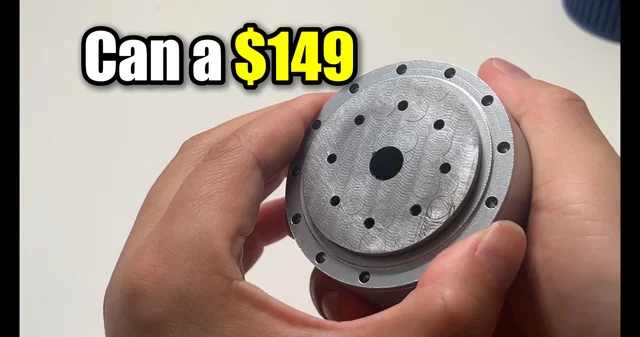
Hey guys. A couple months back I asked this sub for some reality checks on using a 30:1 metal cycloidal to replace 3D printed joints for QDD. The first batch of CNC parts finally showed up. I was honestly expecting the tight machining tolerances to make it bind up, but turning the output flange by hand... the back-drivability is wild. Just for context: we were getting super annoyed with stripping the 3D-printed plastic gears on open-source rigs like the Berkeley Lite and ALOHA. They are awesome projects, but the plastic joints are fragile and a nightmare to maintain. So we designed this as a drop-in replacement (calling it the Starfruit Actuator). Instead of printing two different plastic joint types, we wanted a single unified metal design to simplify the BOM and actually survive dynamic loads. Specs we're rolling with for the final drop: 30:1 ratio (30 teeth, 31 pins) Dual absolute encoders (supports FOC & MIT modes) Fully ODrive-compatible Target price: ~$149 Next up is integrating the motor and driver board, then throwing it on the test bench to see if it survives a 76 Nm torque test without exploding. Fingers crossed lol. Let me know what you think of the machining! All the STEP files, ROS2 nodes, and configs are going to be 100% open source. I'll drop the project link in the comments if anyone wants to track the testing or grab the files when they go live. submitted by /u/External_Wasabi9131 [link] [Kommentare]
R
↗
Hey everyone, I'm looking for a few people who enjoy robotics and might be interested in collaborating on an open-source robot project. I'm mainly looking for help with things like: PCB design 3D printable chassis Firmware/code Electronics planning I'll be sourcing the parts and assembling it myself. The goal is to create a low-cost robot that anyone can build and improve. This isn't a paid project, just something for fun and to learn together. If you've been wanting to work on a community robotics project or have ideas you'd like to contribute, I'd love to hear from you. Feel free to comment or send me a DM if you're interested. submitted by /u/Worried-You-7003 [link] [Kommentare]
R
↗
Google deployed an agentic AI peer-reviewer at two top CS conferences — reviewing ~10,000 papers with 30-minute turnaround — and the new formal research paper shows it catches 34% more mathematical errors than zero-shot prompting; the precedent for AI-automated scientific review at conference scale is set and now formally documented. -- Source: https://arxiv.org/abs/2606.28277 submitted by /u/Justgototheeffinmoon [link] [Kommentare]
R
↗
I submitted one of my NeurIPS review ~6 hrs later than the official deadline. Will this still affect my own submission? Asking because I’m a first time reviewer. I pinged the AC a day before that I might be a few hours late, but didn’t hear back. So wondering if I might have triggered something that’ll now affect my own submission. submitted by /u/confirm-jannati [link] [Kommentare]
R
↗
https://smallpdf.com/file#s=ae2e2f4c-3ca1-4431-8b2f-5e11fc19bcfc This is the link please feel free to use it . Just wanted to know if this is good excercise. Thanks submitted by /u/Vladimir-Lenin420 [link] [Kommentare]