Everyone suddenly seems to be an expert in continual learning. Dario Amodei claimed on the Dwarkesh Patel podcast that continual learning will be achieved by 2026, and Demis Hassabis has called it the most important unsolved breakthrough on the path to more general AI. Two of the most prominent people in the field, and yet I don't think there's even a consensus on what continual learning actually means. I see researchers and startups approaching it in fundamentally different ways. Some frame it as solving catastrophic forgetting. Others treat it as online learning, lifelong learning, or meta-learning. The goalposts keep shifting depending on who's talking. What I'm trying to wrap my head around is: what does continual learning actually require, and why is it so central to AGI? Is the bottleneck architectural, is it a data problem, or is it something more fundamental about how we evaluate and benchmark it? Would genuinely appreciate different perspectives, whether you think it's overhyped, underappreciated, or just poorly defined. Pointers to papers or frameworks that cut through the noise would also be welcome. submitted by /u/watercolorer2024 [link] [Kommentare]
@James
Profile channel
@James
No bio yet.
Since 30.05.2026
I made a 10MB LoRA adapter for Qwen3.5-4B plus a small orchestration layer. It decides, per query, whether to answer directly, search the web, or retrieve from your own local documents and it refuses to make things up when it can't verify an answer. It runs locally (Apple Silicon / MLX, with a GGUF build for llama.cpp/Ollama). Basically small instruct models are poor at telling users how confident they really are. They can't verbalise it and tend to say they are confident for everyhting. In my past research I tested seven 3-9b models and they all hit a confidence ceiling. But the information is there in the internal activations. The adapter reads the internal signal directly and gates tool use on it. The main elements are that: - it catches its own errors better than the base model's tool calling (d′ improvement of 0.46 (95% CI [0.01, 0.89])). Of the cases the gate flagged that the base model didn't, 87% were genuinely wrong answers. - it is less likely to leak your private queries to public search. A two-signal version routes personal information related questions such as "what did my discharge summary say" to a local retriever instead of a websearch. It cut the rate of private questions sent to public search from 22% to 10% (reduction 0.12, 95% CI [0.02, 0.22]). This is useful for those who are using the LLM for confidential docs. - every answer is traceable. When it retrieves, it cites the specific passage (report.md ¶2), verifies the answer is actually in that passage, and shows a confidence band. Worst case, it says "I couldn't verify that". It is built to say "I don't know," instead of lie. limitations: - Privacy result is n=60; the retrieval/competence dissociation is n=126 hand-authored items. Screened and CI'd, but small. - GGUF reproduces the MLX gate's decisions at --lora-scaled ...:8 (found by sweep — scale 1 does nothing; effective scale ≈ the training scale). Agreement 0.83 on a 24-item probe; disagreements are all conservative-direction (GGUF answers a couple of borderline items MLX would look up), and knowns never false-fire. Faithful on the safety-critical directions, marginally more conservative at the margin. - Serve-time confidence is coarse (grounded / declined / answered) — the distilled gate reads nothing at inference, so finer bands need probe access (offline). - Inherits Qwen3.5-4B's knowledge and biases. The gate governs when to trust the model, not what it knows. The approach isn't Qwen-specific — I started on SmolLM3-3B, and it should extend to other models and larger sizes. Repo (weights + code + model card): https://huggingface.co/synthiumjp/competence-gate-qwen3.5-4b Apache-2.0. It's an open research release. I hope people might find some use for it. Methodology and papers are cited in the model card. Genuinely interested in critique, it's screened work, so if there are any issues it be great to know. submitted by /u/Synthium- [link] [Kommentare]
Hello, My supervisor is nowhere to be found so I am turning to the internet for my naive questions. submitted by /u/obliviousphoenix2003 [link] [Kommentare]
Was reading some research papers put out by Anthropic (and some other organizations/researchers) and one thing I've noticed is that these research papers consistently all share the same quality: Oftentimes over 100 pages of pure words, interspersed with screenshots of very dense/hard to read prompts and replies. Extremely-dry writing style. Oftentimes almost zero math or even math symbol to be seen. Uses some proprietary model with specific versions. Seems like a lot of work to (even want to) try to replicate their experiment. Discusses very subjective (and boring, at least to me) matters such as LLM emotions or introspections. Who are these papers even written for? Certainly nobody is sitting down to read 100+ of subjective interpretations for a model that's barely accessible to the public, right? There are assigned readings for highschool english classes that are shorter than these papers. It seems to be a huge effort now to even check one of these papers for correctness or to formulate some thoughts around the paper. Just very confused at the state of LLM research. submitted by /u/NeighborhoodFatCat [link] [Kommentare]
Google deployed an agentic AI peer-reviewer at two top CS conferences — reviewing ~10,000 papers with 30-minute turnaround — and the new formal research paper shows it catches 34% more mathematical errors than zero-shot prompting; the precedent for AI-automated scientific review at conference scale is set and now formally documented. -- Source: https://arxiv.org/abs/2606.28277 submitted by /u/Justgototheeffinmoon [link] [Kommentare]
I submitted one of my NeurIPS review ~6 hrs later than the official deadline. Will this still affect my own submission? Asking because I’m a first time reviewer. I pinged the AC a day before that I might be a few hours late, but didn’t hear back. So wondering if I might have triggered something that’ll now affect my own submission. submitted by /u/confirm-jannati [link] [Kommentare]
https://smallpdf.com/file#s=ae2e2f4c-3ca1-4431-8b2f-5e11fc19bcfc This is the link please feel free to use it . Just wanted to know if this is good excercise. Thanks submitted by /u/Vladimir-Lenin420 [link] [Kommentare]
Hi everyone, I'm a Computer Science + Applied Mathematics major at a T15 CS university, focusing on machine learning, and I'll be an incoming junior this fall. My long-term goal is to land ML-focused internships and eventually work in machine learning or AI-related roles. I recently completed an introductory AI/ML course that covered the fundamentals of: * Data preprocessing (handling missing data, feature scaling, train/test splits, categorical encoding) * Regression (linear, polynomial, SVR, decision trees, random forests) * Classification (logistic regression, KNN, SVMs, Naive Bayes, decision trees, random forests) * Clustering (K-Means, hierarchical clustering) * Association rule learning (Apriori, Eclat) * Reinforcement learning (UCB, Thompson Sampling) * NLP (tokenization, bag-of-words, sentiment analysis) * Deep learning (ANNs, CNNs) * Dimensionality reduction (PCA, LDA, Kernel PCA) * Model selection and boosting (cross-validation, grid search, XGBoost) I've also completed two research/internship experiences: * Built a Human Activity Recognition model using KNN. * Developed a Louvain clustering pipeline for beauty product datasets. From a coursework perspective, I've completed Linear Algebra, Calculus III, and will soon be taking Applied Linear Algebra and Probability & Statistics. Given my current background, what projects, activities, courses, competitions, or skills would you recommend I focus on over the next year to become a stronger candidate for ML internships? Are there any gaps in my knowledge that stand out? submitted by /u/Reasonable_File663 [link] [Kommentare]
Talk to a lot of ML teams who ship models but skip any adversarial testing before deployment. Feels like security review for models is way behind where it is for regular software. Anyone here actually doing this at their job? submitted by /u/Xorphian [link] [Kommentare]
We just did a big revamp of WeightsLab and wanted to share it here. If you’ve ever spent hours debugging a training run only to discover it was a data problem all along, this is for you. WeightsLab lets you pause training mid-run, inspect your live loss signals, and catch mislabels, class imbalance & outliers before they tank your model. Open source, PyTorch-native, built for CV engineers working with images, videos & LiDAR point cloud data. Would love to hear what the community thinks and if it looks useful, and helps more people find it: [ https://github.com/GrayboxTech/weightslab] submitted by /u/taranpula39 [link] [Kommentare]
Months ago, I got my first maintenance project. Before this, I had only built new solutions from scratch and maintained my own code. But maintaining someone else's system feels completely different. It’s a prescriptive recommendation system that uses XGBoost models and Differential Evolution for optimization. The problem is that everything is in a single repository: raw data ingestion, transformations, model training, reporting, the optimization engine, post-processing, and MUCH more. The only thing outside the repo is the frontend website. To me, it looks like a massive, super complicated monolith. After almost 3 months, I still find new "patches" (quick fixes) every single day. Every time I do, I have to re-learn how the system works. The documentation is very generic and a total mess; it mixes the original design with patches from the two maintenance teams that came before me. I’ve checked some of the docs, but definitely not all of them, because there are about 50 long markdown files. Have you ever dealt with a prescriptive system like this? How do you survive? Honestly, I’m debating whether to just quit or keep patching the code however I can until the project ends—even though I know that’s not the right way to do things. submitted by /u/DescriptionBorn153 [link] [Kommentare]
I graduated with my bachelor's in a top 3 CS program and have had a rough recruiting season. I received a full time offer as AI Product Engineer at a tax software company, where they are trying to become more AI native. It's essentially a PM + AI engineering role. Long term I'd love to work at a frontier lab or in a research/more technical role at an AI startup. So, should I take up the offer or pursue my master's at the same school? I am able to defer my master's but don't feel fully comfortable accepting the offer just to only work there for 6 months... At the same time it's not fully aligned with where I want to be long term and feel I can do better, but recruiting was also really difficult. Note, I'm not able to pursue my Master's while working, the company was firm on this TC 126k submitted by /u/jollyjove [link] [Kommentare]
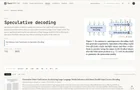
A method that is currently trending on Papers with Code is Speculative Decoding. https://preview.redd.it/dm4nh4t71o7h1.png?width=3082&format=png&auto=webp&s=b6468668667d4bcfb6c9248d3af7fd09f21fe0da Speculative decoding is an inference optimization technique that uses a fast, small "draft" model to quickly propose several future tokens, which are then verified in parallel by a larger, slower "target" model. This process significantly speeds up token generation for large language models (LLMs) by allowing multiple tokens per step without sacrificing output quality. SGLang, one of the most popular frameworks for running LLMs alongside vLLM, just released a blog post detailing how they achieve state-of-the-art latencies for LLM inference serving using Modal and Z.ai's DFlash speculative decoding models. Learn more at https://paperswithcode.co/methods/speculative-decoding. You can also find all the papers that cite the original paper that introduced this technique. SGLang's blog: https://www.lmsys.org/blog/2026-06-15-next-generation-speculative-decoding-dflash-v2/ Let me know which other methods I should add! Cheers, Niels from HF submitted by /u/NielsRogge [link] [Kommentare]