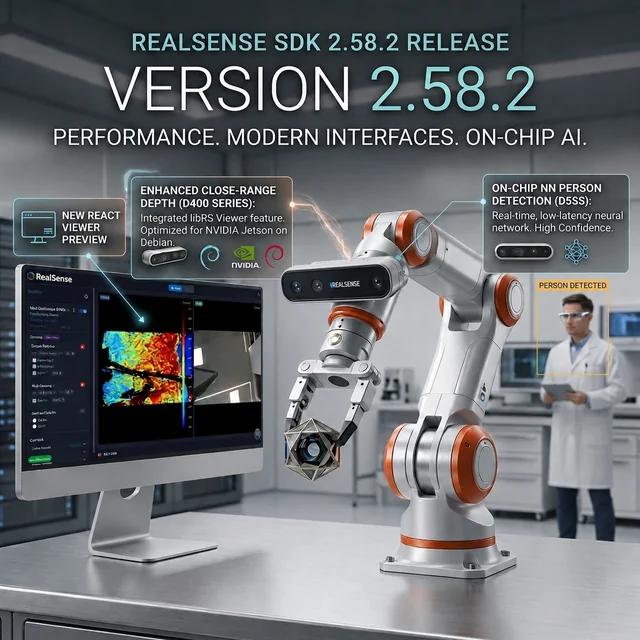
New features include: - on-camera person detection - closer depth perception - new browser based viewer More info: https://github.com/realsenseai/librealsense/releases/tag/v2.58.2 submitted by /u/Chemical-Hunter-5479 [link] [Kommentare]
With NVIDIA Jetson AGX Thor bringing a major jump in AI performance, I've been wondering whether the next bottleneck in embedded vision systems will no longer be compute—but camera architecture. In many real-world deployments, challenges often come from: Multi-camera synchronization Camera bandwidth Sensor interface limitations High-resolution video pipelines System latency Memory throughput As AI compute becomes less of a constraint, do you think future vision systems will be limited more by how cameras are connected and managed than by inference performance itself? For example: Will larger multi-camera systems become more common? Which interfaces are best positioned for next-generation systems: MIPI, GMSL, Ethernet, or something else? What challenges do you see when scaling vision systems for robotics, autonomous machines, or industrial automation? One interesting point I've been seeing is that discussions around AGX Thor are increasingly focused on sensor bandwidth, camera scalability, and system architecture rather than AI performance alone. Curious to hear how others see AGX Thor changing embedded vision system design over the next few years. For anyone interested, I recently came across a discussion on AGX Thor from a vision-system perspective that covers camera integration, multi-camera scalability, and future deployment considerations: 🎧 NVIDIA Jetson AGX Thor Vision Systems: Camera Integration and Deployment Considerations What do you think will be the biggest bottleneck in next-generation vision systems? AI compute, camera architecture, memory bandwidth, or something else? submitted by /u/Wonderful-Brush-2843 [link] [Kommentare]