 N
↗
N
↗
The Forest Service is trying to shut down research hubs because it says it needs to live within its means. But the agency plans to close facilities that cost less than $1 to rent while keeping open one that costs $1 million.
 R
↗
R
↗
Search concerts, festivals, conferences & more by location. Type what you're looking for — see results on a live map. Free, no account needed.
R
↗
I'm running into an issue with an ablation study for a paper I'm preparing. I trained a model. The model achieved my best result, and I saved the trained checkpoint (.pth file). Now my supervisor wants me to perform an ablation study by removing components and how it impacts the accuracy. My concern is that if I retrain from scratch, the accuracies will not exactly match the original run due to randomness, different seeds, etc. is there any way i can do the ablation study without retraining? I'd appreciate hearing how others have handled this situation in publications or thesis work. please help me out submitted by /u/Plane_Stick8394 [link] [Kommentare]
 A
↗
A
↗
For health hackers, the risk is not experimenting.
 I
↗
I
↗
In this post we look under the hood of BrightData's SDK and how it turns ordinary consumer TVs into exit nodes of an enormous commercial, residential proxy network leveraged by the AI industry to scrape web data and train language learning models.
 O
↗
O
↗
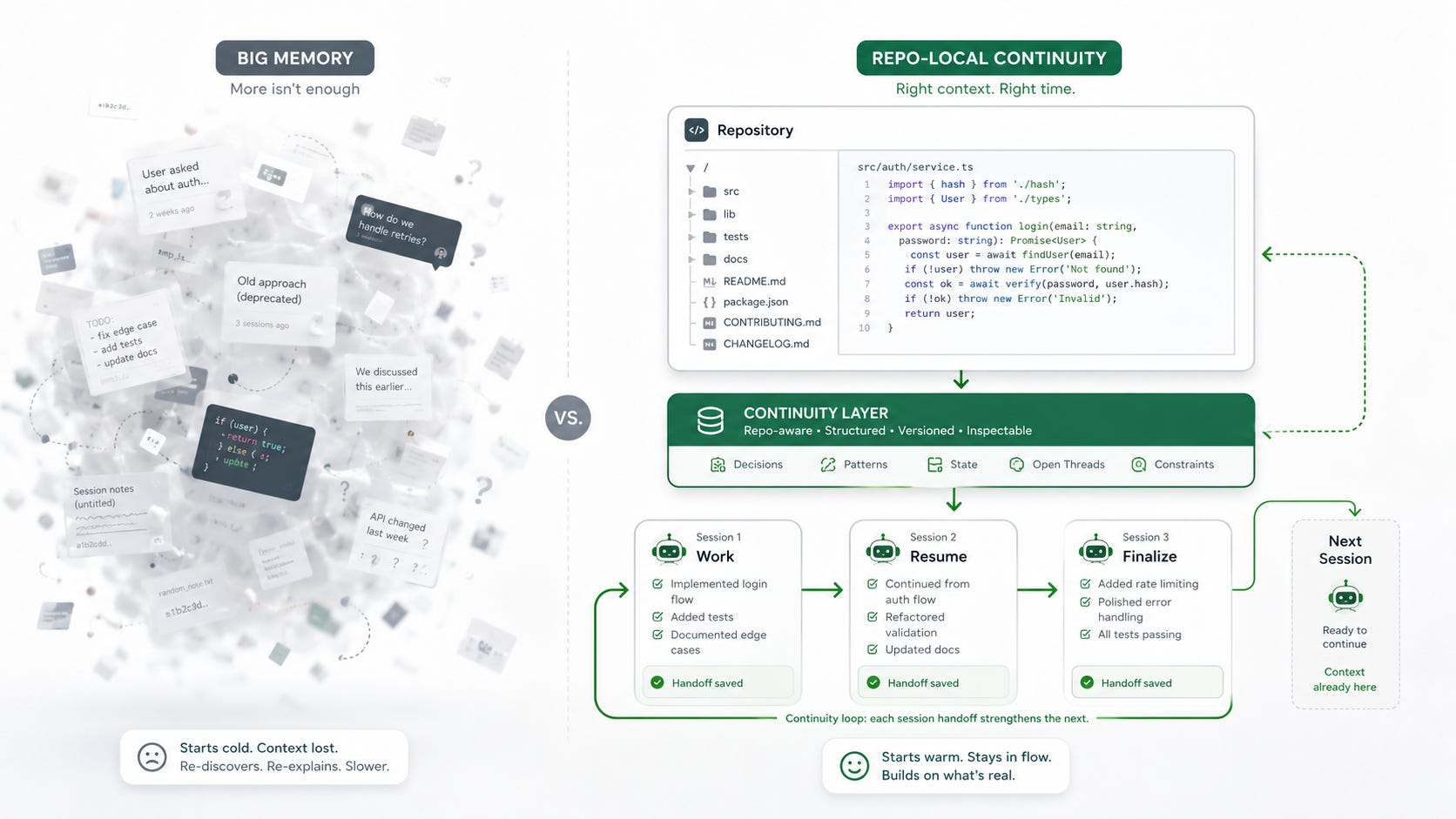
A practical reflection on why coding agents lose the thread between sessions, and why the repository itself is the right place to preserve it.
T
↗
Free browser-based developer toolkit: JSON validator, Code minifier, Code beautifier & formatter (JS/CSS/HTML/JSON/SQL/XML), Base64 encoder, Regex tester and more. Everything runs in your browser — no data sent to any server.
 F
↗
F
↗
Hey IH 👋 Creators spend hours making content, then post it blind — hoping the algorithm picks it up. Most of the time, it doesn't. Not because the cont...
 C
↗
C
↗
Inspired by the role of sleep in biological continual learning, we introduce RVW, a trans- former architecture for online continual adaptation of pretrained models. RVW maintains a small pool of per-layer experts that grow and prune in response to distribution shift, with no replay buffer and no explicit task identifier. Applied to TinyLlama-1.1B on a 15,000- chunk six-domain stream, RVW reaches 40 average held-out PPL, substantially better than EWC (158), fine-tuning (164), and LoRA (448) on the same parameter-matched base, while preserving prior-domain performance. Threshold sweeps suggest a combinatorial encoding reading: domain knowledge appears to be carried by routing patterns across layers rather than by individual specialized experts.
 A
↗
A
↗
Aviation Herald - News, Incidents and Accidents in Aviation
 A
↗
A
↗
A blog about markets, finance and all things money related.
 T
↗
T
↗
Conversations, turns, rounds, tools, agents and more!