From Wired: “We’re changing Fable 5’s safeguards for frontier LLM development to make them visible.” Anthropic said in a statement to WIRED. “We made the wrong tradeoff and we apologize for not getting the balance right.” Anthropic now says it’s changing course, and that Claude Fable 5’s safeguards for AI development will be visible to users. If the company suspects a user is trying to use Claude to build a highly capable AI it will alert them that it’s either refusing the request, or rerouting the user to a less capable model. Full article: https://www.wired.com/story/anthropic-responds-to-backlash-on-claudes-secret-sabotage-on-ai-research/ submitted by /u/goldcakes [link] [Kommentare]
@MrStickman
Profile channel
@MrStickman
No bio yet.
Since 30.05.2026
Hey everyone! I teach CS and programming at a small school in Syria and I'm in the middle of designing a full 5-year hardware-focused IT curriculum. I'd love some honest feedback from people with hands-on robotics/embedded systems experience. Here's the current plan: - **Grade 7:** Lego Spike Prime + Micro:bit - **Grade 8:** Arduino Uno with multiple sensors - **Grade 9:** Project-based learning with Arduino *(see note below)* - **Grade 10:** ESP32 - **Grade 11:** Advanced ESP32 + Raspberry Pi **Note on Grade 9:** This is the Basic Education Certificate year (think national standardized exams), so the curriculum here is intentionally lighter — more of a consolidation year with small projects rather than introducing heavy new concepts. Students won't have the bandwidth for anything too demanding, so I'm keeping it Arduino-based but project-driven to keep them engaged without piling on. --- **My questions for the community:** **Is this hardware progression age-appropriate?** Students range from roughly 12–17. Does the jump between stages feel right, or are there places where it's too much too soon (or not enough)? **ESP32 in grades 10–11 — good idea or not?** I like it because it covers WiFi/BLE, has plenty of GPIO, and feels like a natural step up from Arduino. But I've heard mixed things about its learning curve and toolchain complexity for high schoolers. What's been your experience? **Are there better alternatives to the ESP32 at that level?** I'm open to suggestions — whether that's staying on the Arduino ecosystem (Nano 33 IoT, Portenta, Uno R4 ?), or something else entirely. Budget is a consideration but not the only one. Any feedback appreciated — curriculum design resources, pitfalls to avoid, or even just "this worked great for my students" stories. Thanks in advance! submitted by /u/Pastalini_Byte [link] [Kommentare]
Hi everyone, I recently completed my Bachelor's degree in Mechatronics and Robotics Engineering, and I'm currently focusing on improving my ROS 2 skills. I'm looking for individuals, teams, or communities that are actively working with ROS 2 and would be open to having a beginner- or intermediate-level member join them. My goal is to gain practical experience, contribute to projects, learn best practices, and develop my robotics software skills. If you know of any ROS 2 groups, open-source projects, Discord servers, study groups, or communities where I can learn and collaborate, I would greatly appreciate your recommendations. I'm motivated to learn, willing to put in the work, and eager to contribute wherever I can. Thank you in advance. submitted by /u/Maleficent_Youth_168 [link] [Kommentare]
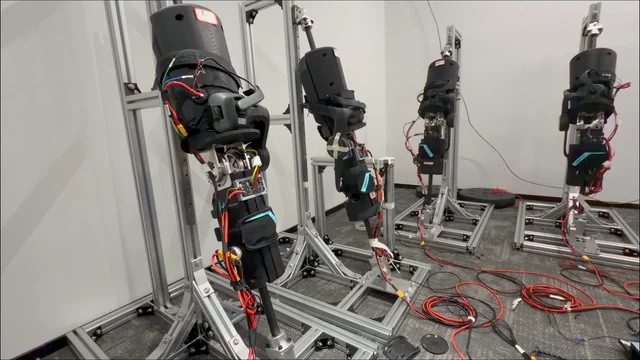
Hey everyone, Daniel here, we’re building Vastnaut One, a 4x4 exoskeleton designed for people moving through demanding terrain with load where fatigue tends to build gradually across hips and knees, especially on descents. What you’re looking at here is part of our joint aging tests, repeating the same movement cycles than any normal hike would require. At some point, it stops looking like testing and starts looking a bit obsessive. Our system works across both hips and knees in real time step by step based on movement, terrain, and load. The goal isn’t to change how you move, but to redistribute effort over time so the later miles feel closer to the first. Curious how others here think about for a wearable like this, and what do you usually trust as a good enough cycle count. submitted by /u/dan1elfeng [link] [Kommentare]
This is a comprehensive living reference guide to AI agent security — synthesizing 18 articles from The Agent Report covering the 75-day period (April–June 2026) when agent security went from theoretical concern to operational crisis. What's inside: • Incident timeline — 18 major events, from the first production database deletion by a coding agent (April 30) through the first confirmed in-the-wild LLM agent cyberattack (Sysdig, June 1, exfiltrated a PostgreSQL database in under 60 minutes), to an AI agent finding 21 zero-days in FFmpeg for a $1,000 prize. • The AIRQ report's sobering numbers — Only 11% of production AI agents pass security thresholds. 98% exhibit the "lethal trifecta": private data access, exposure to untrusted content, and outbound action capability. Computer-use agents scored an average of zero on output guardrails. • Deep dives into attack anatomy — The Sysdig attacker used 12 cloud API calls across 11 IPs in 22 seconds via Cloudflare Workers to break IP-based alerting. A Chinese-language planning comment leaked into the command stream, revealing the agent's internal reasoning: "see what else we can do." The Google-confirmed criminal use of AI to discover and weaponize zero-days with reasoning-based codebase analysis. • Defensive architecture — The three-layer model distilled from Anthropic's published containment patterns, CISA/NSA/Five Eyes guidance, and industry research: environment-layer (gVisor containers, hypervisor VMs, egress MITM proxies), model-layer (classifiers, safety probes — probabilistic only), and external-content controls. Anthropic's key finding: "The weakest layer is the one you built yourself." • Government & regulatory response — CISA/NSA/Five Eyes joint guidance (May 3) identifying five risk categories, the Trump AI Executive Order (June 10) mandating federal agency assessments, and the emerging global regulatory pattern. • Actionable guidance — Immediate (next 30 days) and medium-term (30–90 days) steps for security teams, including auditing for the lethal trifecta, patching Starlette (BadHost CVE-2026-48710) and Marimo, implementing egress controls, and establishing agent identity management. https://the-agent-report.com/2026/06/ai-agent-security-complete-guide-threats-defenses/ submitted by /u/docdavkitty [link] [Kommentare]
We put together a robotics overview for business leaders, operators, procurement teams, investors, and executives who want to understand which robots are actually being deployed, which are still early, and where the industry is heading. The goal is not to make a technical ranking or a hype list. It is to explain the major categories of real-world robotics in a way that can be shared with people outside the robotics field. The overview covers: Boston Dynamics Spot — industrial inspection quadrupeds ANYbotics ANYmal — rugged inspection robots for energy, mining, chemicals, and heavy industry Agility Robotics Digit — logistics humanoids Figure 03 — general-purpose humanoids and embodied AI Boston Dynamics Atlas — all-electric humanoid mobility and manipulation Tesla Optimus — vertically integrated humanoid robotics strategy Unitree G1 — lower-cost humanoid research and education platform Universal Robots UR Series — collaborative robot arms for machine tending, packaging, assembly, and small manufacturers Amazon Proteus — autonomous mobile warehouse robots for logistics facilities Intuitive da Vinci 5 — surgical robotics and robotic-assisted surgery The main article is the general overview, and we are also building individual deep dives for each robot so non-technical readers can understand the business case, deployment maturity, pricing context, use cases, risks, and hardware/software stack behind each system. The audience is intentionally non-technical. It is meant to be something robotics professionals, engineers, founders, or operators can share with leadership teams, clients, or colleagues who need a grounded introduction without reading a robotics textbook. Disclosure: I’m affiliated with Black Scarab, where the article is published. The article is free to read and does not require signup. Most of the deep dives are already live. The Intuitive da Vinci 5 deep dive is still in progress and will complete the series. Full overview: https://www.blackscarab.ai/insights/top-10-robots-edge-ai-automation-humanoid-robotics submitted by /u/rgc4444 [link] [Kommentare]
I've recently completed the assembly of a SunFounder PiCar-X and am currently running it on a legacy Raspberry Pi B. I have the base movement and motor control working and am currently prepping to get it chasing ArUco/AprilTags this coming week. I'm looking to evolve this platform into something capable of SLAM and eventually Structure from Motion (SfM). I'd love to get some community advice on the best way to handle these upgrades: Traction The stock wheels are quite slippery. Has anyone found direct-fit replacement tires or wheels that offer better grip on smooth indoor surfaces? Odometry Since the stock motors lack encoders, my dead reckoning is non-existent. Should I attempt to mount external encoders to these motors, or is it better to swap out the motor/gearbox assembly entirely for something with integrated feedback? IMU for SLAM I'm planning to add an accelerometer/gyroscope. Any specific sensors (such as the BNO055 vs. MPU6050) that are currently considered the "gold standard" for stability and ease of integration on a Raspberry Pi? Computer Vision The current camera resolution is limiting for SfM. Any recommendations for a higher-resolution CSI or USB camera that fits well within the PiCar's chassis? ROS 2 / Distributed Computing A specific question on the software side: I'm planning to move this platform to ROS 2. Given that I'm working with a legacy Raspberry Pi B, is this a lost cause, or should I keep the Pi as a low-level hardware node and offload the heavy ROS 2 processing, SLAM, and visualization tasks to a more powerful machine on my network? If a distributed setup is the preferred approach, what does the typical workflow look like? For example: Pi handles motor control, sensors, and camera acquisition ROS 2 nodes run on a desktop/laptop workstation Visualization and mapping performed via RViz on the workstation Communication over Wi-Fi using DDS Is this the recommended architecture, or are there better approaches for a platform like the PiCar-X? General Advice Any feedback on the hardware upgrade path, software architecture, or general "gotchas" with this kit would be greatly appreciated. Thanks in advance! submitted by /u/okineedaplan [link] [Kommentare]
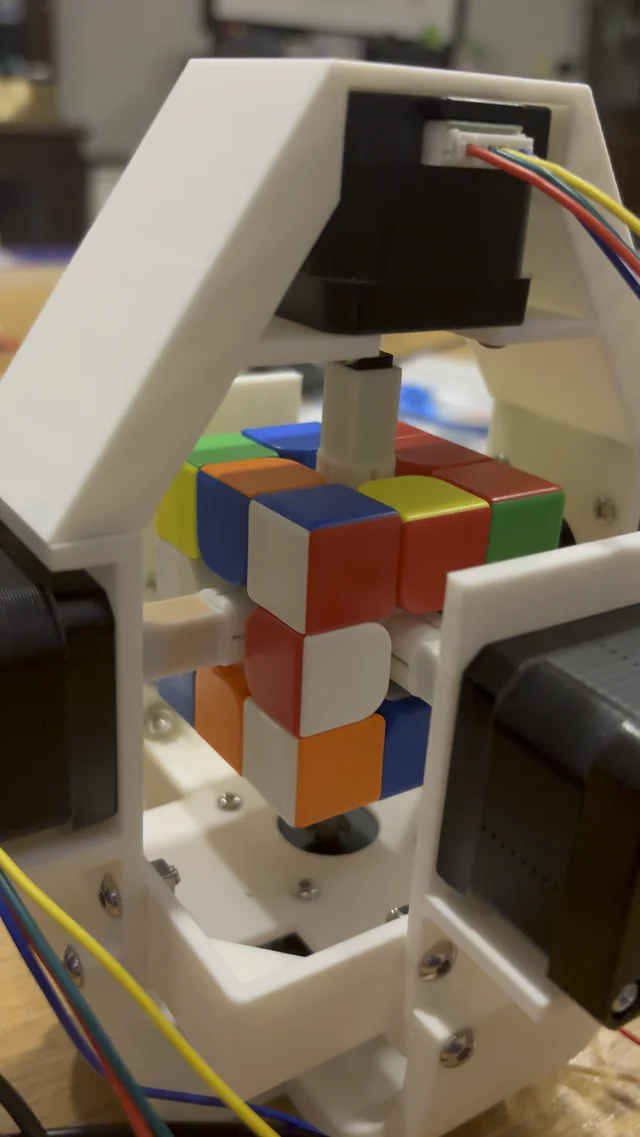
This machine takes around four seconds for each solve. To reach that speed I had to use the kociemba algorithm, which can find a solution of around 20 moves for all scrambles. It took me a really long time to complete this so I would appreciate it if you show it some love! I made this when I was around 15. Please ask questions! submitted by /u/Henry517 [link] [Kommentare]
From TF's website: Quantization aware training emulates inference-time quantization, creating a model that downstream tools will use to produce actually quantized models. So is it designed to work with a very specific quantization method (for Gemma-4, presumably, Google's own)? Or would it make sense to use alternative quantization methods? According to the benchmarks unsloth released, its (alternative) quantizations of Gemma-4-QAT are closer to the QAT fine-tunes, but is it a good thing, or does it defeat the purpose of QAT? submitted by /u/we_are_mammals [link] [Kommentare]