 R
↗
R
↗
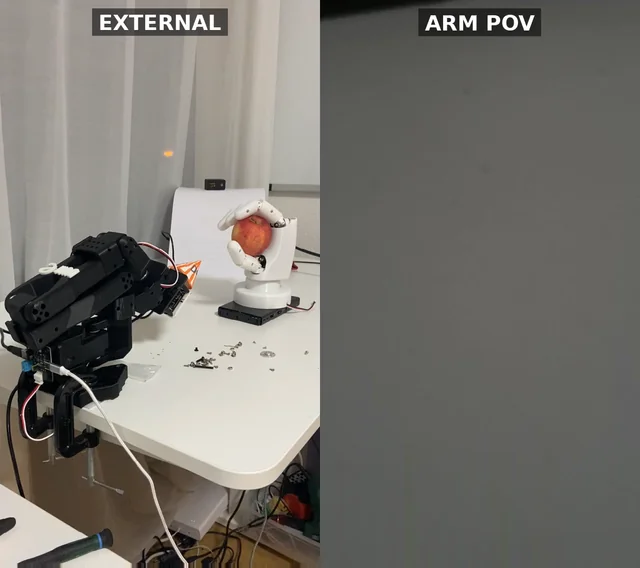
Weekend project, one weekend in — lots still half-built: a 6-DoF SO-101 arm (Feetech STS3215 / LeRobot) with a wrist camera, driven by an agent that plans camera moves, films them, and stitches the edit. Sharing v1 — rough, but the loop works. The demo is a side-by-side: left is an external phone shot (manual), right is the arm's own wrist camera. The choreography — wake → framed "hero" pose → dolly/roll/tilt beats → rest — runs through a safety layer (soft joint limits + velocity cap + stop sentinel). A few things I hit that others might find useful: 🔧 Dead elbow servo, diagnosed by feel. Stiff to backdrive, idle temp 53°C vs ~38°C on the others = shorted/lossy winding. Swapped it, re-set the ID, recalibrated the joint. 📐 The jerky motion wasn't the servo or the mount. Braced the table and it still jerked — turns out it's STS3215 gear backlash (~0.87° measured by others) plus low-speed stick-slip. Confirmed stick-slip is speed-dependent: ~51 backward micro-ticks at 12°/s vs ~0 at 50°/s. ✅ The fix: dropped P_Coefficient 32 → 16 (LeRobot's own recommended value). Slow-speed judder went from ~43 stutter events/sweep to ~0 in a controlled A/B. Plus: keep recorded moves single-direction and faster. 🎯 No IK yet, so "orbits" drift. Leaned on framing-safe moves — roll about the optical axis, dolly, tilt — to keep the subject centered. The goal is reusability: clone the repo, build/attach the SO-101, and you can direct Claude to film your own demos. Still manual for now (external camera + initial framing/hero pose). Next up: better camera, longer scripts, closed-loop framing. As always, it's all open source — control lib, safety layer, calibration, and the motion/stitch scripts. I will organise it better once the project is complete 👉 https://github.com/kamalkantsingh10/dummie Happy to go deeper on the motion-streaming / backlash tuning if useful. submitted by /u/KamalSingh10 [link] [Kommentare]
R
↗
Unlike previous editions of IROS/ICRA, there seems to be no IEEE RAS travel grant on the IROS 2026 website this time, the only grant available is the IES-SYPA grant for upto 15 people. Is this not really less compared to any previous editions? submitted by /u/sarthaxbeatz [link] [Kommentare]
R
↗
Driver rewrite was expected part. What got us was everything downstream that was quietly depending on old sensor and nobody documented it. New sensor's X-axis points a different way, your TF was written around the old one, and now everything's subtly rotated but nothing throws an error. Rate doubles and you're retuning Kalman gains you thought were settled. And then power rail - a different draw, nothing to debug on software side, just had to find it by elimination. Every single one of these was invisible until we actually swapped sensor. Sensor swap is probably most honest test of whether architecture is actually modular or just looks modular in README, and I'm not sure if our codebase was just particularly messy or this is how it always goes. submitted by /u/NickShipsRobots [link] [Kommentare]
 R
↗
R
↗
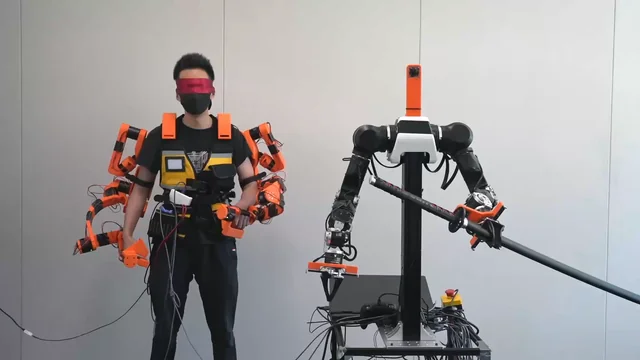
From Litian Liang on 𝕏 (thread with multiple videos): https://x.com/litian_liang/status/2066541466286215570 This work is done in Inclusion AI lab at Ant Group, advised by James (Jingxi) Xu and Professor Mark Cutkosky from Stanford BDML lab. Website: https://ume-exo.github.io Paper: https://arxiv.org/abs/2606.14218 submitted by /u/Nunki08 [link] [Kommentare]
 R
↗
R
↗
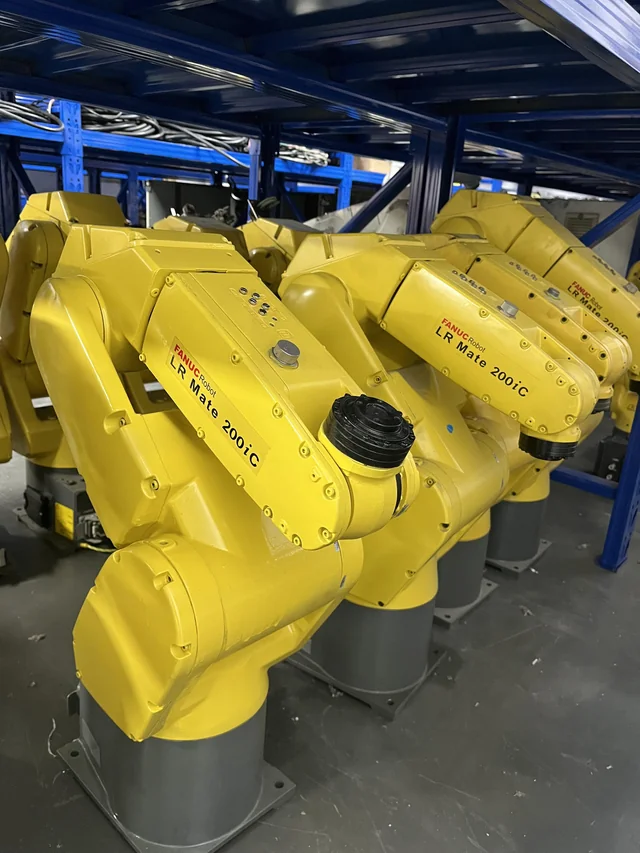
Payload 5kg, reach 704mm 6-axis industrial robot industrial arc welding, high-speed industrial assembly robots, pick and place etc. submitted by /u/Iris-lee88 [link] [Kommentare]
 R
↗
R
↗
I recently came across a very affordable 8115 45kv (0.3ohms phase R) motor kit which includes a wound stator and a steel magnet ring . Quickly modeled a mockup in Fusion : https://preview.redd.it/ckbo2a7d5h7h1.jpg?width=1043&format=pjpg&auto=webp&s=40716922ce7ca2358503ede09badaa0f0de7417c https://preview.redd.it/rrtz8qvd5h7h1.jpg?width=1280&format=pjpg&auto=webp&s=9b356dfab5d5953781b3e0b4d9fcb25fb3f2a37c Instead of using a pressfitted central shaft like most bldc do , i opted for a pilot diameter directly on the rotor to locate it on the 52x40x7 bearing (possible stiffnest improvement ?) then use 2 bolts ,circular nuts, a plate to preload and lock the bearings and rotor to the stator. I'm also using a very shallow bearing seats with both 7mm thick bearings lightly-pressfitted in to shallow 3mm seats. Would this work or this housing design need to be scrapped immediately ? Additional images : https://preview.redd.it/hb1u55ef6h7h1.jpg?width=813&format=pjpg&auto=webp&s=1d6de3288f287c2ab477c0350d2e3d21858b8553 https://preview.redd.it/6qsu8zdf6h7h1.jpg?width=886&format=pjpg&auto=webp&s=6a3137c5578289c86b78c7bdc9c7fd8c952ec8b7 submitted by /u/lekhoi_trym_to [link] [Kommentare]
R
↗
I keep thinking about this idea of a small robot that lives on your desk and is built specifically to help you focus, not just look cute. Like, it tracks your work sessions, notices when you've been scrolling instead of working, reacts when you hit a deep focus streak, calls you out when you've been on your phone for an hour. Vector and Emo type robots failed because they were essentially toys pretending to be useful. What if you flip it? A focus tool with a personality, not a toy with productivity bolted on. Right now it's just a side project so I'm focused on getting the prototype right first. I will take it to cocreate pitch. Price range I'm imagining: somewhere between a fitness band and a smartwatch. submitted by /u/RemarkableCaptain318 [link] [Kommentare]
R
↗
 R
↗
R
↗
 R
↗
R
↗
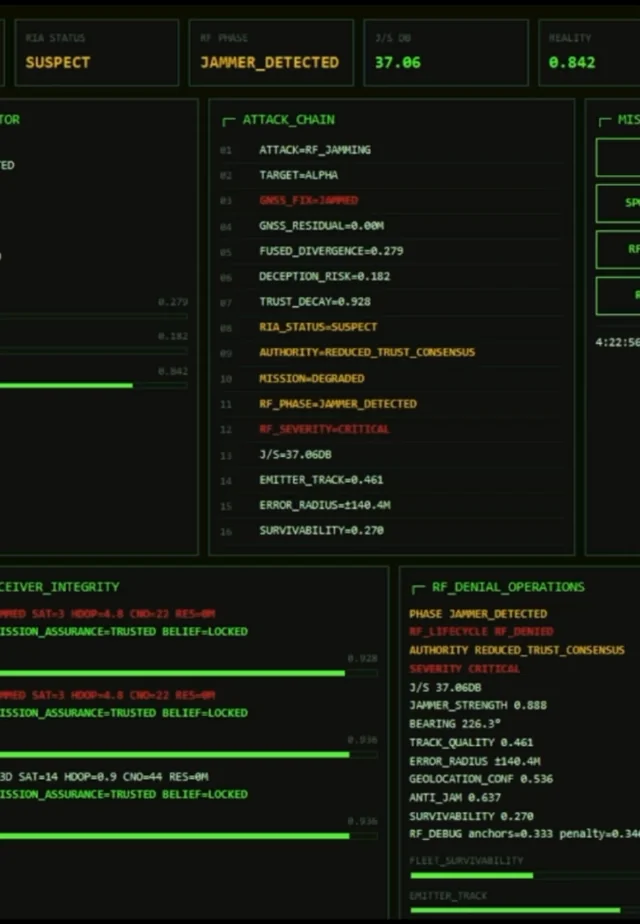
I’ve been working on a mission assurance architecture called Parallax and recently completed another validation run in a degraded operating environment. In this sim run, an autonomous USV fleet experienced GNSS/RF degradation resulting in conflicting navigation observations across multiple assets. Rather than assuming all telemetry was trustworthy, the system continuously evaluated observation integrity, measured divergence from a shared world model, isolated compromised data sources, reconstructed authority through distributed consensus, and maintained mission continuity without operator intervention. One of the problems I’m interested in is what happens after sensor fusion. Most autonomy stacks do a good job combining observations, but what happens when those observations can no longer be trusted? The entire system runs locally at the edge with no cloud dependency. All processing, validation, trust scoring, consensus generation, and decision support remain completely air-gapped and self contained. Current areas of development: • Distributed trust scoring • Reality integrity assessment • Consensus reconstruction • Autonomous recovery and reintegration • GNSS degradation and spoofing resilience • Edge-native operation with no cloud connectivity Interested in hearing how others are approaching sensor trust, degraded navigation environments, and resilient autonomy. submitted by /u/DraevenOfficial [link] [Kommentare]
 R
↗
R
↗
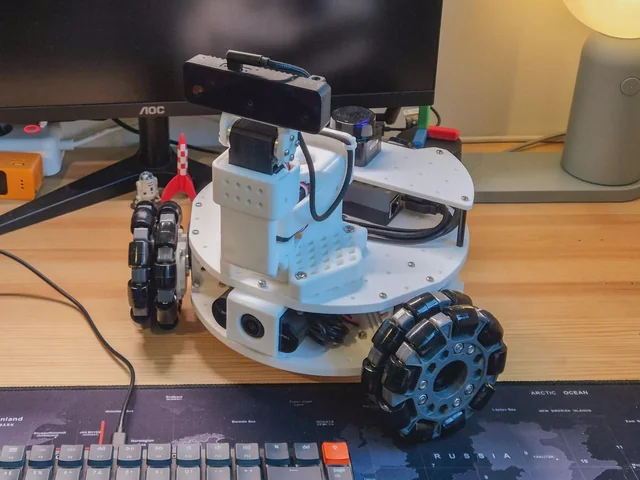
At Foxglove, we collaborated with Aditya Kamath, resulting in another blog post in his ROS 2 LeKiwi series, this time covering the integration of SLAM and Nav2. This blog post should be relevant to anyone wanting to integrate Nav2, even if they don't have a holonomic platform. If you find this kind of content useful, let us know, and we will keep it coming! submitted by /u/arewegoing [link] [Kommentare]
 R
↗
R
↗
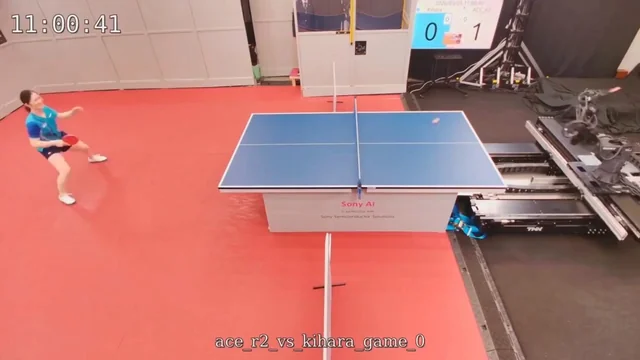
Nature: Outplaying elite table tennis players with an autonomous robot (Published: 22 April 2026): https://www.nature.com/articles/s41586-026-10338-5 YouTube Sony AI: Ace vs. Kihara | Pro Match Highlights | Sony AI Table Tennis Robot: https://www.youtube.com/watch?v=TwkDm2H6ft8 From 链上小财女 on 𝕏: https://x.com/Zoozo2025/status/2064998917394374930 submitted by /u/Nunki08 [link] [Kommentare]
R
↗
Hey everyone! I teach CS and programming at a small school in Syria and I'm in the middle of designing a full 5-year hardware-focused IT curriculum. I'd love some honest feedback from people with hands-on robotics/embedded systems experience. Here's the current plan: - **Grade 7:** Lego Spike Prime + Micro:bit - **Grade 8:** Arduino Uno with multiple sensors - **Grade 9:** Project-based learning with Arduino *(see note below)* - **Grade 10:** ESP32 - **Grade 11:** Advanced ESP32 + Raspberry Pi **Note on Grade 9:** This is the Basic Education Certificate year (think national standardized exams), so the curriculum here is intentionally lighter — more of a consolidation year with small projects rather than introducing heavy new concepts. Students won't have the bandwidth for anything too demanding, so I'm keeping it Arduino-based but project-driven to keep them engaged without piling on. --- **My questions for the community:** **Is this hardware progression age-appropriate?** Students range from roughly 12–17. Does the jump between stages feel right, or are there places where it's too much too soon (or not enough)? **ESP32 in grades 10–11 — good idea or not?** I like it because it covers WiFi/BLE, has plenty of GPIO, and feels like a natural step up from Arduino. But I've heard mixed things about its learning curve and toolchain complexity for high schoolers. What's been your experience? **Are there better alternatives to the ESP32 at that level?** I'm open to suggestions — whether that's staying on the Arduino ecosystem (Nano 33 IoT, Portenta, Uno R4 ?), or something else entirely. Budget is a consideration but not the only one. Any feedback appreciated — curriculum design resources, pitfalls to avoid, or even just "this worked great for my students" stories. Thanks in advance! submitted by /u/Pastalini_Byte [link] [Kommentare]
R
↗
Hi everyone, I recently completed my Bachelor's degree in Mechatronics and Robotics Engineering, and I'm currently focusing on improving my ROS 2 skills. I'm looking for individuals, teams, or communities that are actively working with ROS 2 and would be open to having a beginner- or intermediate-level member join them. My goal is to gain practical experience, contribute to projects, learn best practices, and develop my robotics software skills. If you know of any ROS 2 groups, open-source projects, Discord servers, study groups, or communities where I can learn and collaborate, I would greatly appreciate your recommendations. I'm motivated to learn, willing to put in the work, and eager to contribute wherever I can. Thank you in advance. submitted by /u/Maleficent_Youth_168 [link] [Kommentare]
 R
↗
R
↗
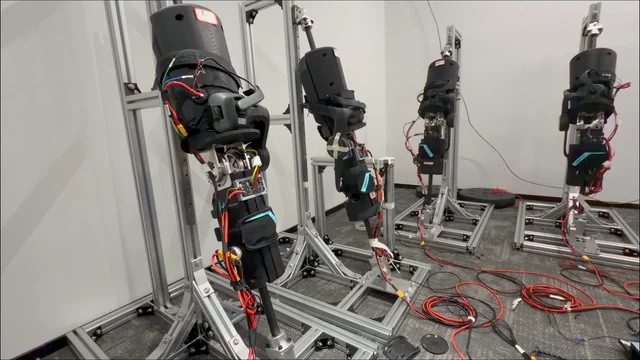
Hey everyone, Daniel here, we’re building Vastnaut One, a 4x4 exoskeleton designed for people moving through demanding terrain with load where fatigue tends to build gradually across hips and knees, especially on descents. What you’re looking at here is part of our joint aging tests, repeating the same movement cycles than any normal hike would require. At some point, it stops looking like testing and starts looking a bit obsessive. Our system works across both hips and knees in real time step by step based on movement, terrain, and load. The goal isn’t to change how you move, but to redistribute effort over time so the later miles feel closer to the first. Curious how others here think about for a wearable like this, and what do you usually trust as a good enough cycle count. submitted by /u/dan1elfeng [link] [Kommentare]