@MrStickman
Profile channel
@MrStickman
No bio yet.
Since 30.05.2026

Paste an X post and ToCarousel turns it into a clean, ready-to-post carousel you can download and publish to Instagram, TikTok, or LinkedIn. Pay per carousel, no subscription.
Well, I made my first deposit of $50 and I’m on-track to get rich from my strategy I have carefully formulated over 3 years. That took a lot of work, but I am a crypto person now. SO. REDDIT. Let’s hear your best advice, but make it funny please - we all could use a bit of humor (Yes my pfp is a pudgy, no I don’t own an ethereum one, yes I am proud I spent $2 on it on solana) submitted by /u/pxlmastr [link] [Kommentare]
The modern company won’t have bullshit jobs. The upside case for AI is that this is a freeing and joyful thing.



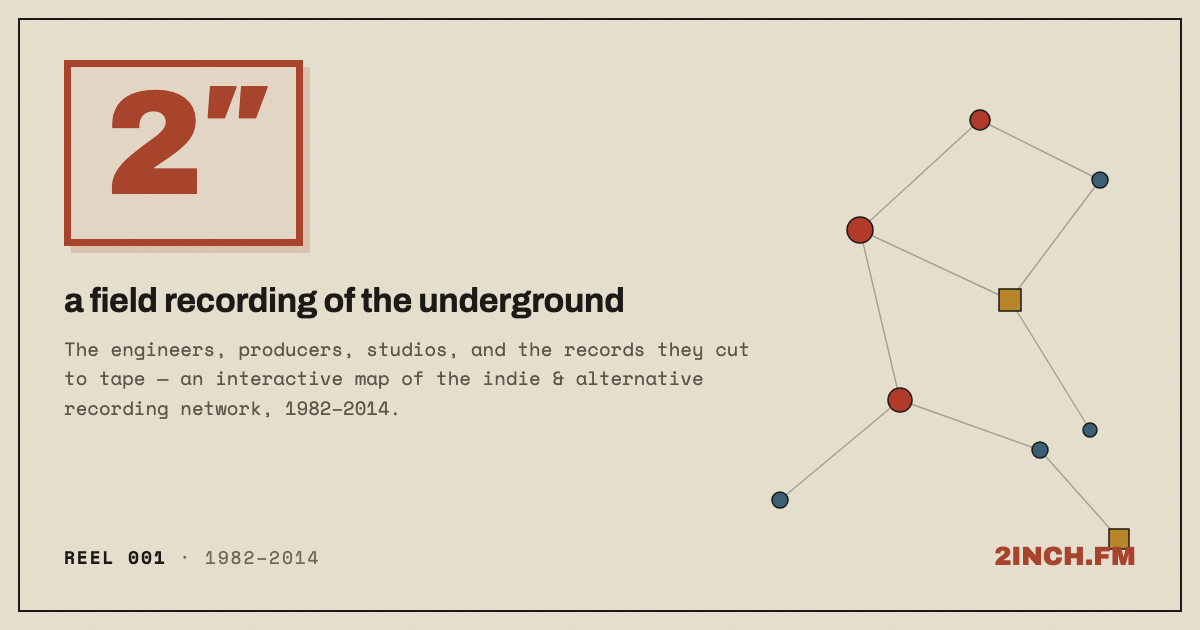
A map of the indie & alternative recording network — the engineers, producers, studios, and the records they cut to tape, 1982–2014.
This may be a dumb question, but I’m having trouble resolving this. Primarily I’m looking at a Solana gaming project, the gist of it is: - token gates playing said game - the token acts as an in-game economy - in game efforts are rewarded with the token - there’s a gambling mechanic where you use said tokens to get items, half is burned, half is sent to treasury - the token is being openly framed as appreciating with growth This entire game is essentially an unregistered investment contract. Now my issue is, theres a lot of these games being openly developed and being speculated on X. No one is talking about the fact that this is illegal. I couldn’t find a single post reflecting said sentiment on X. Instead, people are speculating on these games and more of them are coming out. Why is this the case? Where is the enforcement? Is there some sort of loophole these games are using? submitted by /u/oneoffv [link] [Kommentare]

Hello, I'm currently working on my dissertation and feel like I could really use some advice from someone who looks at the problem with fresh eyes. I appreciate all input. The Problem: Multi Agent Path Finding is the problem of finding paths for several agents to their destinations. Lifelong MAPF is the same, but upon task completion an agent is assigned a new task. For my dissertation (and usually in research) agents move on a grid-like graph and time is discrete. Each timestep an agent can move to an adjacent tile or wait. A good LMAPF algorithm creates paths which maximise average jobs completed per timestep. Some LMAPF algorithms can also work on weighted graphs where each edge to an adjacent node (or itself) has its own cost. Such a graph is called guidance graph and the choice of edge weights can influence which paths the LMAPF algorithm creates also impacting throughput. My supervisor wanted to explore whether Evolutionary algorithms can be suitable for finding a guidance graph that improves throughput without changing the underlying LMAPF algorithm. A guidance graph is scenario specific meaning it is optimised for a specific LMAPF algorithm, map, and agent count. My algorithm so far: So far I've implemented a very basic evolutionary algorithm. An initial population of guidance graphs is randomly initialized (Limited to 10 at the moment). Then each candidate is plugged into the LMAPF algorithm for a certain amount of time steps and the completed jobs are counted to create that candidates fitness score. The top (2) candidates are selected and the rest are discarded. The top candidates are used to make a new set of candidates (no crossover). These step are repeated indefinitely. Issues I've has so far: The simulation can use a seed and is deterministic. The seed determines which nodes the jobs appear on. Using the same guidance graph but different seeds yields random fitness scores. The higher the simulation time the lower the coefficient of variation (standard deviation/mean). For 5000 steps the CV is 0.006. Using guidance graphs with the same parent graph and on different seeds should yield throughputs that have a much higher CV than 0.006 in order for the selection of the best candidates to be somewhat reliable. You could make the argument that given enough time statistically speaking the best candidate will tend towards a better guidance graph but if 9/10 of the candidates I create are worse than the best of the last generation then the solution will tend towards getting worse with each generation. It seems there are so many ingredients for a working evolutionary algorithm that I am missing: I need a mutation strategy that creates solutions with high enough amount of variation but that don't create better offspring once in a blue moon. Also simulating 5000 time steps takes roughly 30 seconds so 300 seconds for one tiny generation of 10 candidates. If my guidance graph is a 25x25 grid -> 625 tiles -> 3125 weights. If my mutation strategy changes 10 weights at a time it will take years to go through enough iterations to even tough every weight once. If the mutation strategy changes more than 10 weights at a time the change of good changes cancelling out bad ones increases. Mutation strategies I've tried are: 1. Iterate through each weight. Each has a certain chance of getting mutated by a random amount. 2. Select n amount of tiles. Mutate the 3x3 area around that tile. Each tile gets the same changes. 3. Create n pair of nodes. Calculate the shortest path connecting the nodes of each pair and lower the weight of the edges along that path in one direction while increasing the weights against the direction. The third method has worked best yet decreasing throughput for low agent counts but increasing throughput for high agent counts by avoiding congestion. However I can't attribute this "success" at all to the evolutionary algorithm but only to the mutation strategy. The other strategies have only produces worse results than a guidance graph with uniform weights. My supervisor is convinced that there is a way to make this work but I have doubts. Any advice would be very appreciated. submitted by /u/Michi122211 [link] [Kommentare]