Hey r/robotics, I've been working with tactile sensor data for a while, and there's a problem that kept bugging me: every tactile dataset has its own format, its own sensor, and its own way of labeling things. Want to compare your material classification model on GelSight vs DIGIT vs DMA? Good luck — the annotations don't line up, the schemas are different, and there's no standard way to even represent a "tactile label" across sensors. So we built two things to fix this: **TLabel** — an open-source sensor-agnostic tactile data labeling toolkit (Python + Panel UI). It supports annotation, quality scoring, batch processing, and exports to HDF5/CSV/JSON. Think of it as LabelImg but for touch data. **TLabel-Bench** — the first cross-sensor tactile annotation benchmark. It provides: - Unified JSON annotation schema that works across GelSight, DIGIT, and DMA sensors - Standardized evaluation scripts for material classification, episode segmentation, and cross-sensor transfer - Compatible with existing datasets (Touch and Go, SSVTP, ObjTac, Daimon-Infinity, CLAMP) The key idea: we only distribute annotation files + download scripts, not the raw data itself. This respects the original datasets' licenses while still letting researchers work with standardized labels. Why this matters: tactile sensing is moving fast (GelSight, DIGIT, DMA, Xense, etc.), but the tooling for *labeling and comparing* across sensors basically doesn't exist. Every paper re-implements their own annotation pipeline. We're trying to fix that. Would love feedback from anyone working with tactile data. What sensors are you using? What labeling tasks do you need? GitHub: - https://github.com/liesliy/tlabel (labeling toolkit, pip install tlabel) - https://github.com/liesliy/tlabel-bench (benchmark + evaluation) submitted by /u/ImmediateArm7942 [link] [Kommentare]
Hey guys We are a group of people working on QDD actuators and we want to know the demand for these and required specifications. Too blunt of a sentence but yeah, we are trying to build low cost QDD actuators ( < 30k INR, 300USD ) with good reliability, integration and support. Based in India. We are trying to do market validation. Keeping everything aside, if you're working in any company or a lab anywhere in the world which uses QDDs (preferred to be in India). Please let us know what are the required specs and how many can we expect an entity to need/order per year. submitted by /u/VisualDry7848 [link] [Kommentare]
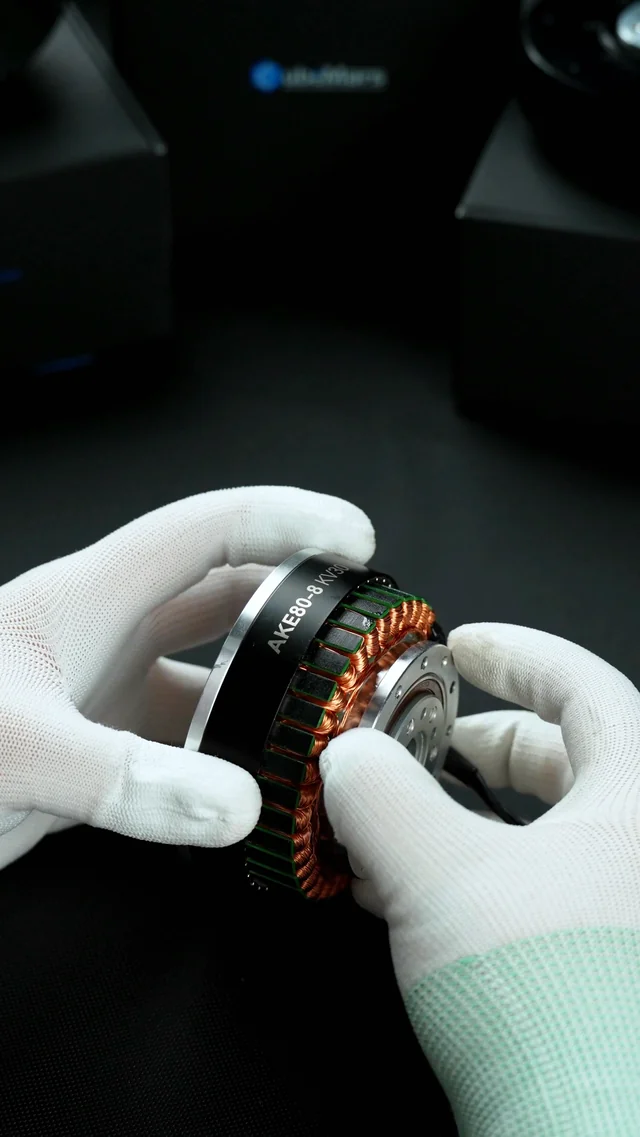
Took apart an industrial QDD actuator today and found the internals interesting. It's a different feeling when you can actually look at how they are integrated. submitted by /u/Cubemars [link] [Kommentare]
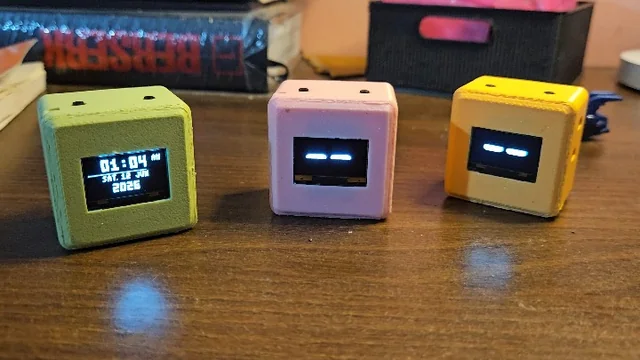
This was my first time using ESP32, I used S3 Supermini because of its compact size which I needed to make this small pocket sized/keychain robot. I am calling it MiniSoul, as it is smaller version of a robot that I am working on called SoulBot. At its core it uses a behaviour engine I built which dictates it's behaviour based on the past interaction which affects different personality factors like Fear, Joy, Curiosity,Desire,Sadness and Anger. The interaction is using touch plate on the top by measuring capacitance and it differentiates between tap, aggression and caress based on small kNN model. I am also using seperate RTC module to give clock functionality like alarm/reminder and also the EEPROM on the RTC module is used to store personality states, storing personality on external EEPROM means it survives OTA firmware updates, not just power cycles. Also this would not damage the storage after multiple write cycles like it would to the flash memory. For touch classification I have used KNN model also on device data collection for touch tuning as every casing varies slightly. The whole MiniSoul OS is built on top of micropython which also allows OTA updates. submitted by /u/SobyDamn [link] [Kommentare]
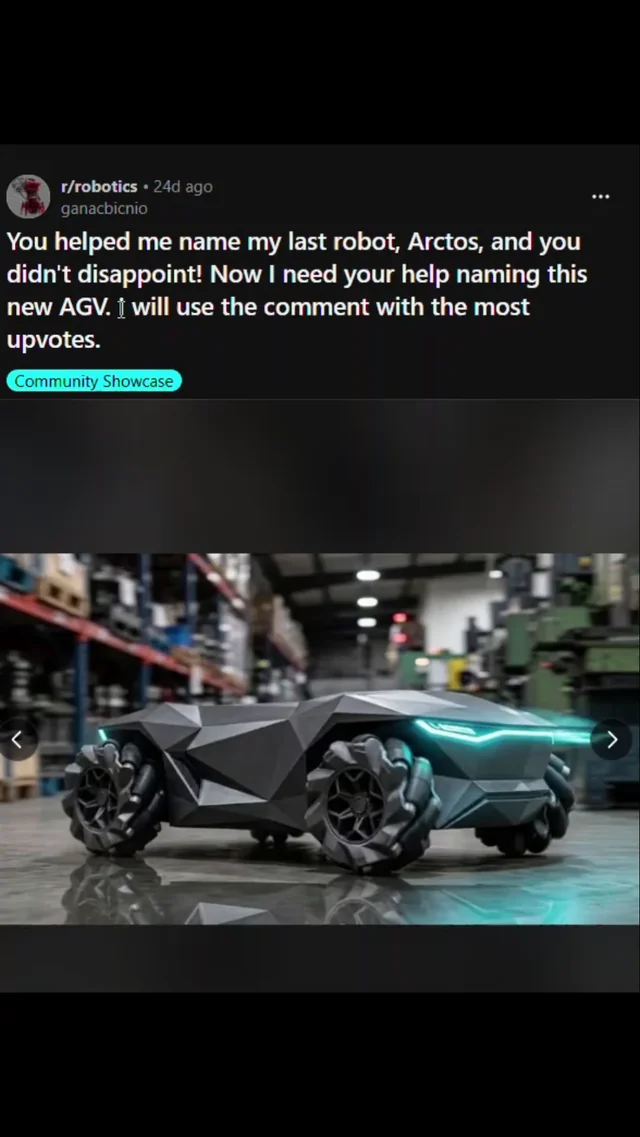
Hey r/robotics, A while back I posted asking for name suggestions for my new mobile robot platform. Last time around, you guys gave me Arctos for the 6-DOF arm. This time, the top upvoted comment was Cary McCarface. So, officially, the robot is designated Arctos CMC. The "CMC" stands exactly for what you think it does. I finally finished the full build and just put together a quick video showing it driving around and doing its thing. Despite the ridiculous name, a lot of engineering went into making this thing work on a budget. If anyone wants to build one of these themselves, I’ve made the CAD files available. I’m also working on putting together a hardware kit that will be coming soon, but until that's ready, the full Bill of Materials (BOM) is available so you can source the parts yourself. submitted by /u/ganacbicnio [link] [Kommentare]
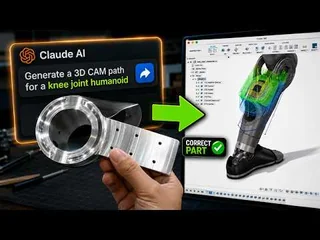
I wanted to see how far AI could actually help with CAM programming, so I ran an experiment. I gave Claude AI a humanoid robot knee joint and asked it to generate the machining strategy for Fusion 360. Then I took those recommendations, built the CAM setup, and machined the actual aluminum part. The result surprised me. It wasn't perfect, and I definitely wouldn't run AI-generated toolpaths without reviewing them, but it got much closer than I expected. A few things I'm curious about: Where do you think AI helps most: setup planning, tool selection, workholding, feeds/speeds, or actual toolpaths? What would it need to do before you'd trust it on your machine? Video here if anyone is interested: https://www.youtube.com/watch?v=L1HeTR-Eawg For context, this part is for an asimov open-source humanoid robot I'm building in my garage. submitted by /u/e-mando [link] [Kommentare]
I made a chapter in my Advanced Robotics course about swarm robotics, focusing on the main ideas behind multi-robot coordination rather than treating it as just a buzzword. The video covers topics like: what makes a robot group a “swarm” decentralized vs. centralized coordination local rules and emergent global behavior examples inspired by ants, birds, and collective systems why scalability and robustness are important in swarm robotics I’m sharing it as a learning resource for students or beginners who are trying to understand where swarm robotics fits inside robotics and multi-agent systems. Video: https://www.youtube.com/watch?v=EXH3NpsKtUc I also keep the related course materials and source codes here, for anyone who prefers to learn by reading or experimenting with code: https://github.com/mohammadijoo/Control_and_Robotics_Tutorials For people working in robotics/control: what topics do you think should be added to make a swarm robotics lecture more useful — communication models, formation control, task allocation, path planning, or real hardware examples? submitted by /u/abolfazl1363 [link] [Kommentare]
Hey everyone, I'm deep into robotics simulation, specifically focusing on Reinforcement Learning (RL) and Deep Learning (DL) workflows. My hardware setup is an M4 MacBook Air (16GB unified memory). Initially, I wanted to use NVIDIA Isaac Sim/Isaac Lab because of its photorealistic graphics, advanced sensor simulation, and massive parallelized RL support. However, since Isaac Sim relies heavily on NVIDIA RTX hardware and CUDA, running it locally on Apple Silicon isn't feasible. I really want a local development environment rather than constantly relying on cloud instances. I need a simulation software that satisfies these core requirements: High-Quality Graphics: Clean rendering, realistic physics-based lighting, and solid sensor noise modeling for computer vision/DL perception models. Robust RL/DL Support: Seamless integration with Python ML ecosystems (like PyTorch, Stable-Baselines3, or JAX), OpenAI Gym/Gymnasium wrappers, and fast parallel simulation stepping. Apple Silicon friendly: Runs natively or optimized on macOS, making good use of the M4 chip and unified memory architecture without hitting x86_64 or CUDA bottlenecks. What are the best alternatives for this exact setup? I’ve looked into MuJoCo (especially with its native macOS build and the JAX-based MuJoCo XLA / MJX for acceleration, though I'm curious how well XLA handles Apple Silicon for parallel envs). I've also considered Unity with ML-Agents, which utilizes Apple's Metal API for incredible graphics and handles RL workflows beautifully on Mac. Has anyone successfully built a high-graphics RL/DL robotics pipeline on an M4 Mac? Which simulator did you choose, and what did your Python bridge look like? submitted by /u/Risheyyy [link] [Kommentare]
TL;DR struggling in finding a meaningful research contribution on top of existing big foundation models. (edit: please note it's my first post on reddit,I'm not a bot) Context: I'm working on FM applied to robotics: VLAs, world models, WAMs. Lately I'm mostly reading papers, and implementing small adds on. Those topic are really exiting but I’m wondering where modest researchers (like me) can make meaningful contributions, given that training competitive foundation models from scratch is a big-lab game. For people working on fondation models in academy and R&D, that asked themself similar questions: Do you have some honest suggestions or feedback? If starting from a pretrained fondation model, main things that come to my mind are eg: - architecture changes (don't you lose all the pre training warmup)? - fine tune (not much new science if one runs lora...) - froze the model and build add-on like uncertaintyquant , world-model lookahead, inference guidance, safety constraints - something big I'm not seeing? Also happy to hear paper/project recommendations that are good examples of this. Thank you all. submitted by /u/Amazing-Coat5160 [link] [Kommentare]
Hello, I am a 19-year-old dropout developing robots. I started with servo motors and have finally built a quadruped robot using the BLDC + FOC method. I have adopted a 20:1 backdriving reduction system. Currently, I am printing with PLA for testing purposes, and I plan to build it later using Pa12 or a more reinforced material. Also, are there any companies interested in spon1soring me? My development 💸 have run low😢😢, Please feel free to message me! My IG: IMAKEROBOTS__ submitted by /u/p0tato___ [link] [Kommentare]
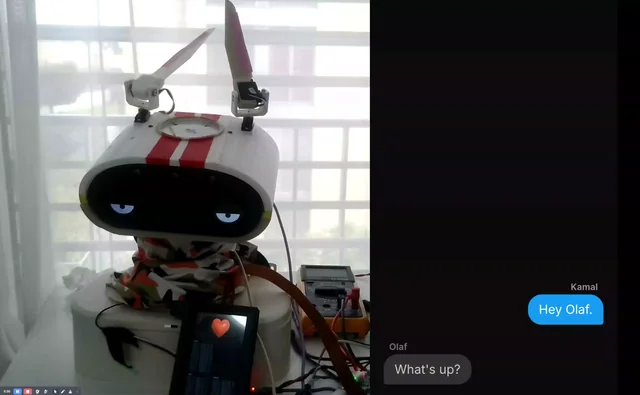
Been building Olaf, a companion robot, in the open for a while now and just closed out the phase focused entirely on making him expressive instead of just functional. Sharing the demo + what changed: Voice: swapped Cartesia for Google TTS — noticeably more expressive and natural. Head motion: tuned so movement tracks the words and tone of speech rather than firing randomly. Ears: redesigned the ear movement — surprisingly big impact on how readable his "mood" is. Heart: added a small display on the body that renders a beating heart. Multilingual: he can switch languages mid-conversation (in the demo he answers in Hindi). Still tuning the audio side. That's the expression engine done bar some fine-tuning. Next phase is the body — getting him mobile so he can move around the apartment. Everything's open source if you want to dig in. Would appreciate a star: Hardware: https://github.com/kamalkantsingh10/OLAF Voice agent / pipeline: https://github.com/kamalkantsingh10/olaf_companion Happy to answer anything about the build. Feedback very welcome — especially on the motion-to-speech syncing: right now I'm driving head/ear motion off the LLM output, and I'd love to hear how others have approached tying gesture to prosody. submitted by /u/KamalSingh10 [link] [Kommentare]
The Seeed team will be in Garching-Hochbrück near Munich tomorrow for a hands-on workshop with reBot Arm, our fully open-source robotic arm. Try it in person, ask technical questions, meet robotics folks, and grab some pizza with us. Limited spots: https://www.eventbrite.co.uk/e/robotics-builders-meetup-hands-on-with-rebot-arm-tickets-1990578698472 submitted by /u/MiuoChar [link] [Kommentare]