 B
↗
B
↗
With expert-labeled data and fine-tuning on Tinker, a custom model outperforms frontier LLMs on financial information-filtering tasks at a fraction of the cost.
 M
↗
M
↗
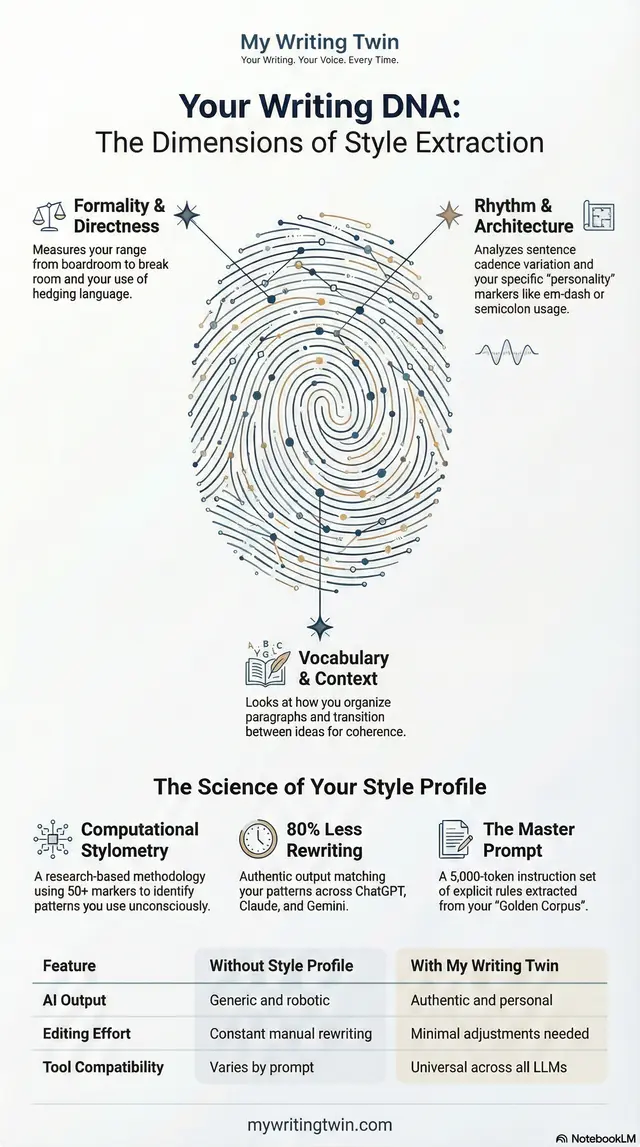
Create an AI that writes like you. Style Profiles capture 50+ dimensions of your writing style for ChatGPT, Claude, Gemini, and any AI tool.
 B
↗
B
↗
We observe a random variable \( X \). (It may be a big, hairy, high-dimensional beast, with lots of components, but we'll treat it as one object for now.) We also have a probability model with an adjustable parameter \( \theta \). (This may also be an enormous infinite-dimensional object.) For each \( \theta \) we get a distribution for \( X \), say \( p(x;\theta) \equiv \mathrm{Prob}_{\theta}(X=x) \). That is, the probability model tells us, for each parameter value, the probability of any particular outcome. Ordinarily, we tend to look at how \( p(x;\theta) \) changes with \( x \) fixed, for some particular \( \theta \). What statisticians have come to call the likelihood function is \[ L(\theta) \equiv p(X; \theta) \] This is the probability of the data as a function of the parameter. That is, it tells us the probability of observing what we did observe, as we consider varying the parameter. A natural and compelling approach to parameter estimation is then the method of maximum likelihood: guess that the true parameter value is the one which makes the observed data as probable as possible. This is, as I said, natural and compelling, and it works (is consistent/probably-approximately-correct) under a broad range of circumstances, but unfortunately it doesn't always work. To see a little bit about why it typically works, but doesn't always, notice that \( L(\theta) \) is a random function, i.e., a stochastic process. (It is a process "indexed", as we say in the trade, by the parameter space, which may be weird, but still a process.) The method of maximum likelihood looks for the maximum of this random function, and hopes that it converges on the true parameter value. But convergence of stochastic processes is a somewhat delicate business. In many situations, the likelihood function does converge to a sensible, deterministic limiting function which is uniquely maximized at the true parameter value. (When this happy state of affairs applies, the limiting function has nice information-theoretic interpretations.) But there are, alas, times when the convergence just does not work. Now, I should at this point admit that the way I've defined likelihood above only works when \( X \) is discrete. If \( X \) is continuous, then one needs to work with probability densities rather than mass functions, which I think makes the rhetoric a bit less persuasive. It also opens the way, to those who've learned measure-theoretic probability, to a more general definition. (For each \( \theta \), say \( P_{\theta} \) is a probability measure on \( \mathcal{X} \), and these are all absolutely continuous with respect to some reference measure \( M \) (not necessarily a probability measure). Then we define \( L(\theta) = \frac{dP_{\theta}}{d M}(X) \), using the Radon-Nikodym derivative. This makes the exact likelihood function relative to the choice of reference measure \( M \), but notice that for any other reference measure \( N \), we'd have \( \frac{dP_{\theta}}{d N}(X) = \frac{d P_{\theta}}{dM}(X) \frac{dM}{dN}(X) \), so changing the reference measure doesn't change relative likelihoods, the location of the maximum likelihood estimate, etc.) I should also admit that the idea that one can simply calculate the probability of a given outcome from a probability model is often rather optimistic. This has opened up a range of pseudo-, quasi-, synthetic, and other likelihoods, which try to retain some of the formal structure, while ditching the full probability calculations. One of my reasons for breaking out this notebook is the hope that it will encourage me to wrap my head around these not-quite-likelihoods. (I think I could define the difference between a pseudo- and a quasi- likelihood if I had to, but it's embarrassing for someone in my position not to be sure.) permanent link for this note RSS feed for this note
 E
↗
E
↗
Technical audit on Pangram, commentary on alignment of businesses selling an authority on truth, and how it may throw fire on the epidemic of AI-generated content rather than quelling it
 G
↗
G
↗
Encore runs an in-memory Redis server inside its runtime so local development and tests need no external cache, and validates it against real Redis behavior. Here's how it works.
 M
↗
M
↗
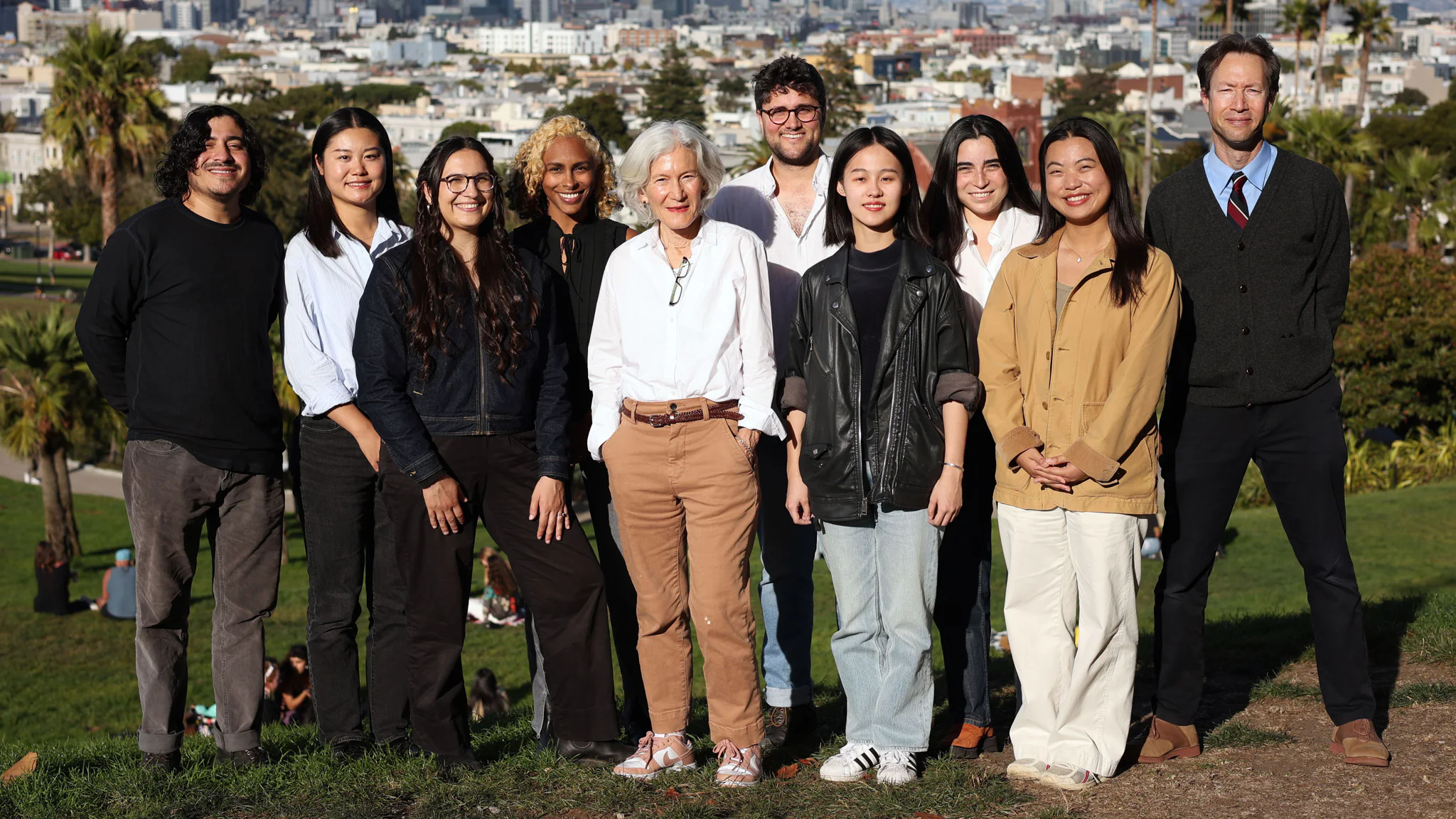
‘I ran it through Claude.’ San Francisco supervisors delay 362-page legislation that would clean up the city's municipal codes.
 T
↗
T
↗
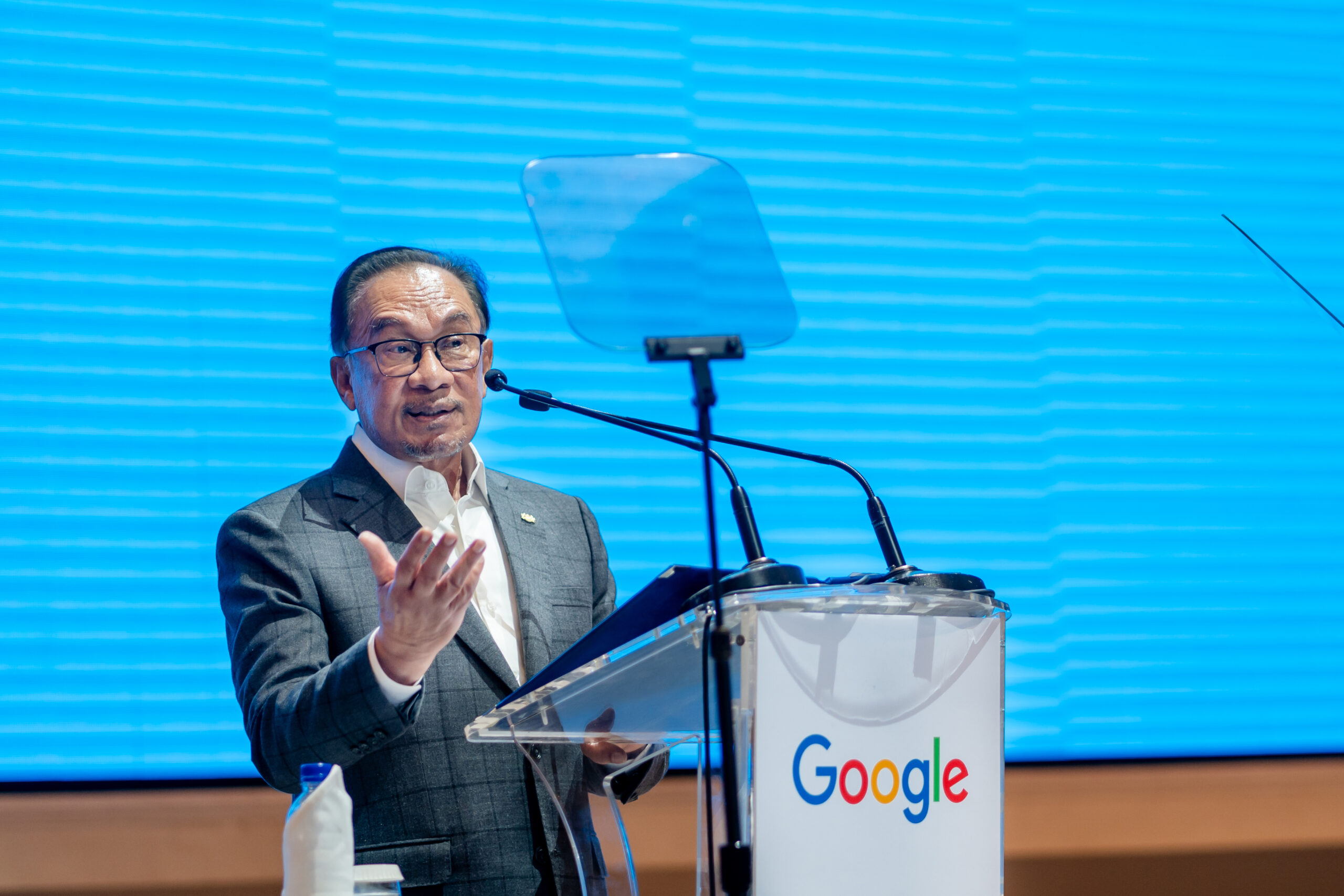
The DeepSeek team announced on Monday that the official release of DeepSeek V4 is scheduled for mid-July. According to the company, the new version builds
 E
↗
E
↗
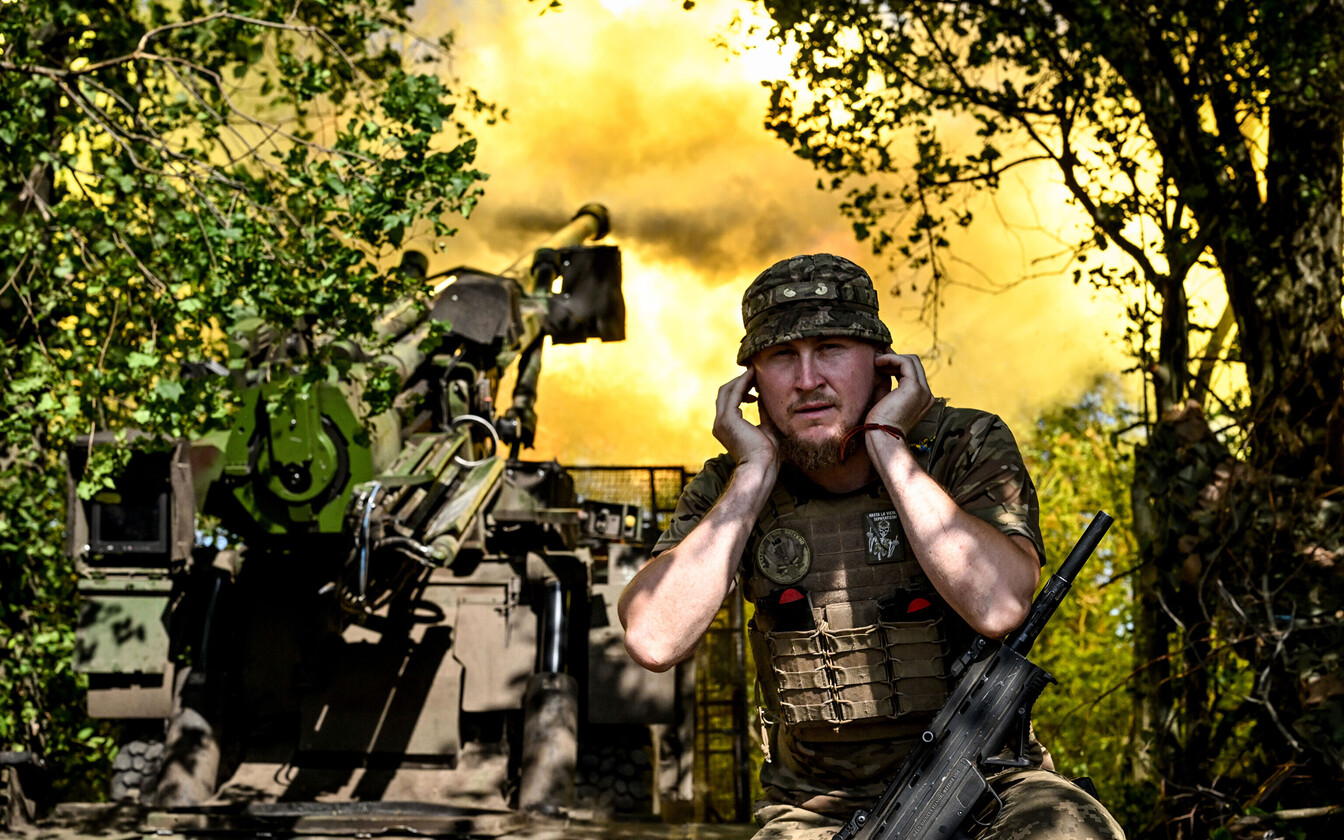
The optical periscope camera OPIC, a scientific instrument bound for Estonia's first deep-space mission, departed Tartu Airport for Spain on Tuesday. The camera will photograph the nucleus of a comet.
 O
↗
O
↗
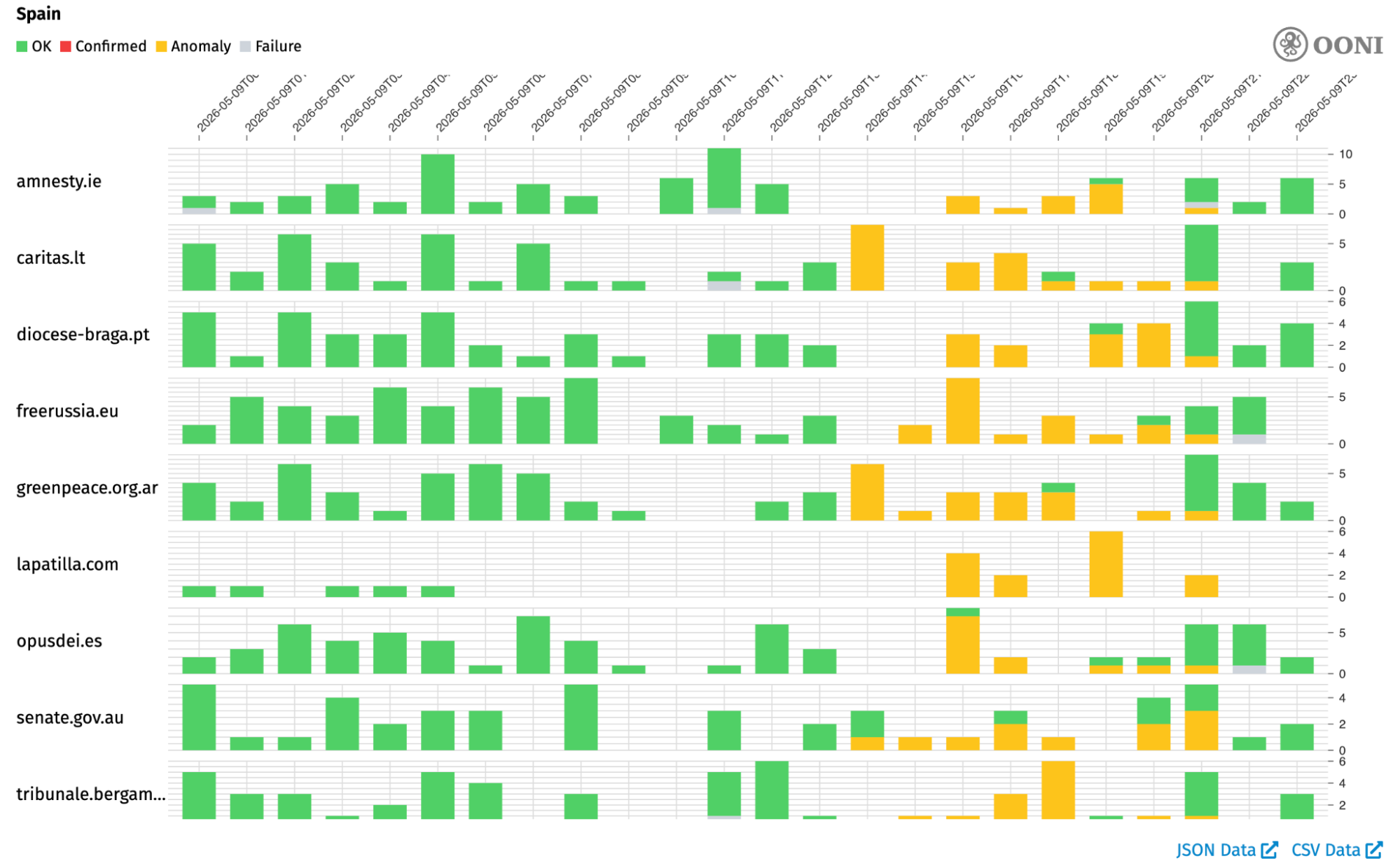
This report documents the widespread collateral damage caused by IP-based blocking during LALIGA football match broadcasts in Spain, based on OONI data and DNS scans.