 T
↗
T
↗
Drop your URL. Karmy finds the Reddit threads where people ask for what you do.
 V
↗
V
↗
The AI agent circuit breaker. Govern every tool call before it executes.
 R
↗
R
↗
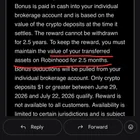
I received a promotional email from robinhood offering 3% bonus on crypto deposit. In the email they said the transferred assets only need to be kept on Robinhood for 2.5 months. However, when I clicked the link and got to the App, the fine print says that you must maintain the crypto assets for 2.5 YEARS. What a convenient mistake to make in the promotional email… submitted by /u/Lala-dc [link] [Kommentare]
 X
↗
X
↗
Real work, done with AI. Every action leaves a record you can check.
 A
↗
A
↗
Parkinson's disease (PD) affects millions worldwide and causes severe motor symptoms. Adaptive deep brain stimulation (aDBS) delivers physiologically informed stimulation that can track fluctuations in PD motor symptoms, enabling more intelligent DBS control. However, most existing aDBS approaches are primarily algorithm- and software-driven, with limited efforts toward circuit realization, particularly low-power and implantable integrated circuits. This paper presents the Silicon Leaky Integrate-and-Fire Deep Brain Stimulation (SiLIF-DBS) controller, a neuromorphic silicon neuron stimulator implemented with metal-oxide-semiconductor (CMOS) technology. For system-level evaluation, a simplified computational model of the SiLIF-DBS controller is derived and embedded within a Parkinsonian cortico-basal ganglia framework for closed-loop validation. The system is driven by beta-band subthalamic nucleus local field potentials (STN-LFPs), with their average rectified value (Beta ARV) used as the control biomarker. Our SiLIF-DBS controller for aDBS suppresses pathological beta activity while consuming only 25% of the power required by open-loop stimulation and achieving a suppression efficiency of $5.85\%$/$μ$W. Overall, our SiLIF-DBS controller achieves strong beta suppression at substantially reduced power, delivering high suppression efficiency that demonstrates it is a viable foundation for low-power implantable aDBS.
A
↗
Why does contrastive learning with simple images and augmentations yield useful representations for downstream tasks? We address this question by analytically computing the optimal representation in terms of a contrastive loss for a range of basic augmentations and any image dataset with stationary statistics. We show that for certain augmentations the optimum can be attained by a CNN whose first layer filters are sinusoids, followed by a pointwise nonlinearity, global average pooling, and a final linear layer that performs partial whitening. We also show that the optimal weights in such CNNs for more complicated augmentations are still sinusoids. The frequencies of the sinusoids and their weights can be computed using a simple waterfilling algorithm given the dataset's expected power spectrum. Experiments with different image datasets and augmentations show that such CNNs trained with SGD empirically learn sinusoids in their first layer and to perform partial whitening
 A
↗
A
↗
Open source platform for X.509 certificate based service authentication and fine grained access control in dynamic infrastructures
 X
↗
X
↗
Bull Bitcoin, a MiCA-licensed non-custodial exchange, has filed a landmark legal challenge before France's Conseil d'État to annul Decree No. 2025-1276, which implements the EU's DAC8 crypto tax reporting directive. The exchange argues the rules create a mass surveillance database linking identities and crypto activity, endangering holders' physical safety.
R
↗
We submitted our first paper to ARR, intending to commit to IJCNLP-AACL. Area: Multilingualism and Cross-Lingual NLP Scores: (3,4) (2.5,3) (3,3) - average 2.83 for reviews, 3.33 for confidence 3 for soundness on all, 4 for reproducibility, and 2,3,3 for excitement. The reviewer who gave us 2.5 has a very short review. They only list one weakness in two sentences and give the paper 2.5. They also give 1,2 for the datasets and software while the other reviewers both give 3 or 4 for these. The (3,4) review gave us 3 weaknesses, with two being writing issues. The (3,3) review has a very nice and very thourough review with many weaknesses and strengths. Questions Is the score good for IJCNLP-AACL findings in the Multilingualism and Cross-Lingual NLP area? How will each review be weighted in the meta-review? Will the shorter outlier review be weighted less in this? How much will rebuttals help? Should we expect the reviewers to respond or change their scores because of the rebuttals? Is there a specific format for rebuttals or any tips you have for rebuttals in ARR? submitted by /u/hepiga [link] [Kommentare]
 R
↗
R
↗
First real drive outside. Before this it only ran on the bench. Build: four 10.5" hoverboard hub motors, 2x ODrive (ODESC 3.6), Raspberry Pi 5, aluminium profile frame. Control is fully manual right now, from a laptop over 4G: live camera, per-motor telemetry, ARM / E-STOP. Main thing I learned: skid-steer turning depends heavily on surface grip, so that has to go into the control logic rather than being tuned by feel. Next step is autonomous A-to-B: 3D lidar, ODrive on CAN with closed-loop wheel control, ROS2/Nav2 for planning. Still early. Happy to answer anything about the build. submitted by /u/NiamorroMilky [link] [Kommentare]

![[OC] The word umpire comes from Old French 'non-per' which means 'not equal' – Image](https://infeeo.com/m/4483/oc-the-word-umpire-comes-from-old-french-non-per-which-means-not-equal-image.webp "[OC] The word umpire comes from Old French 'non-per' which means 'not equal' – Image")