


A different take on what has become a trite comparison to previous step-changes in the history of technology and the dominion of humanity

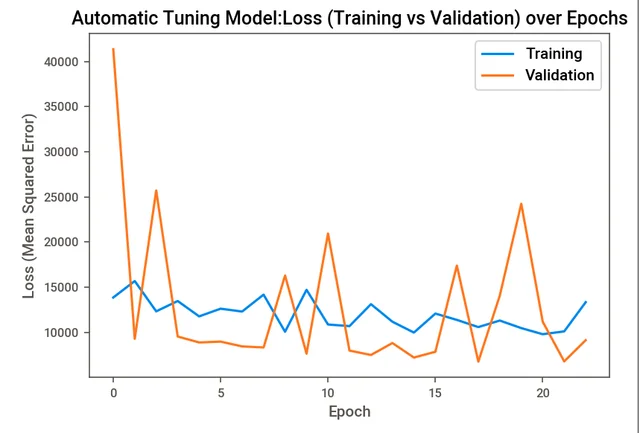
I have used Hyperband automatic tuning for an ANN model to predict price. After running HyberBand automatic tuning to get the 'best' architecture, I am obtaining a strange Val/Training loss learning curve. I cannot figure out if this is due to an error within the code or just a case of me not understanding the graph and not be able to interpret why the graph is showing as it is. I am also obtaining an R2 score of 1.00 which may suggest overfitting. I've not come across a learning curve (only shown the most basic learning curves at Uni) such as this as of yet so any advice would be greatly appreciated! Here is the code for the actual tuning, in case it is due to a coding error but I am not sure that is the case. def model_builder(hp): model = tf.keras.Sequential() model.add(tf.keras.layers.Flatten(input_dim = (train_final.shape[1]))) #creating activation choices - choosing betweeen relu and tanh hp_activation = hp.Choice('activation', values = ['relu', 'tanh']) #creating node choices - maxing unit amounts to 500 hp_layer_1 = hp.Int('layer_1', min_value=1, max_value=500, step=100) hp_layer_2 = hp.Int('layer_2', min_value=1, max_value=500, step=100) #creating learning rate choice - choice between 0.01, 0.001, 0.0001 hp_learning_rate = hp.Choice('learning_rate', values = [1e-2, 1e-3, 1e-4]) #specifies first layer after the flatten layer model.add(tf.keras.layers.Dense(units = hp_layer_1, activation = hp_activation)) #creating the second layer model.add(tf.keras.layers.Dense(units = hp_layer_2, activation = hp_activation)) model.add(tf.keras.layers.Dense(1, activation='linear')) model.compile(optimizer=tf.keras.optimizers.Adam(learning_rate = hp_learning_rate), loss tf.keras.losses.MeanSquaredError(), metrics = ['mean_absolute_error']) return model import keras_tuner as kt #creating the tuner tuner = kt.Hyperband(model_builder, objective = 'val_loss', max_epochs = 50, factor = 3, directory = 'dir', project_name = 'x', overwrite = True) # makes tuner rewrite over old tuning experiments #adding early stopping - stops each model from running too long stop_early = tf.keras.callbacks.EarlyStopping(monitor = 'val_loss', patience = 5) tuner.search(train_final, y_train, epochs = 50, validation_split = 0.2, callbacks = [stop_early]) best_hp = tuner.get_best_hyperparameters(num_trials=1)[0] best_hp.values #obtaining the best model best_model = tuner.get_best_models(num_models = 1)[0] history = best_model.fit(train_final, y_train, epochs = 50, validation_split = 0.2, callbacks=[stop_early]) tuned_df = pd.DataFrame(history.history) #running epoch loss visual def epoch_loss_visual(tuned_df, model_name = 'Automatic Tuning Model') Could it be an issue with the code itself causing the issue or is it simply the way the model is? If it's a case of it's just a bad model, I do not need to improve at the moment, but do need to understand the results, especially that of the learning curve representation. submitted by /u/Grouchy-Archer3034 [link] [Kommentare]




After more than 900 years in France, the Bayeux Tapestry—one of medieval Europe’s most fragile, priceless treasures—slipped back into England in a controversial overnight operation. Here’s what transporting a 225-foot-long masterwork actually takes.


Reflections on a broken system

The Seattle Seahawks will be sold to billionaire Vinod Khosla. The Sun Microsystems co-founder will buy the team from Paul Allen's estate.

Plus: The Pentagon is training amateurs to become part of its hacker army, a Flock license plate reader error led to cops surrounding a car reviewer, and more.