Saw on X about a robot AI company having humans getting paid to train their robots. It sounds pretty insane, but I saw how much they say they could pay and I wanted to apply but I couldn't give them what they were looking for. So quick question for you all who know better than me, what are these companies looking the most right now in terms of data they need from humans for their robots? (ps. I didn't know where else to ask this question so I hope this isn’t a bad place to do so, thanks!) submitted by /u/Fushling [link] [Kommentare]

AI agents are all the rage in many companies right now, but Ford has revealed that it had to rehire engineers after learning that AI isn't quite as good as humans.
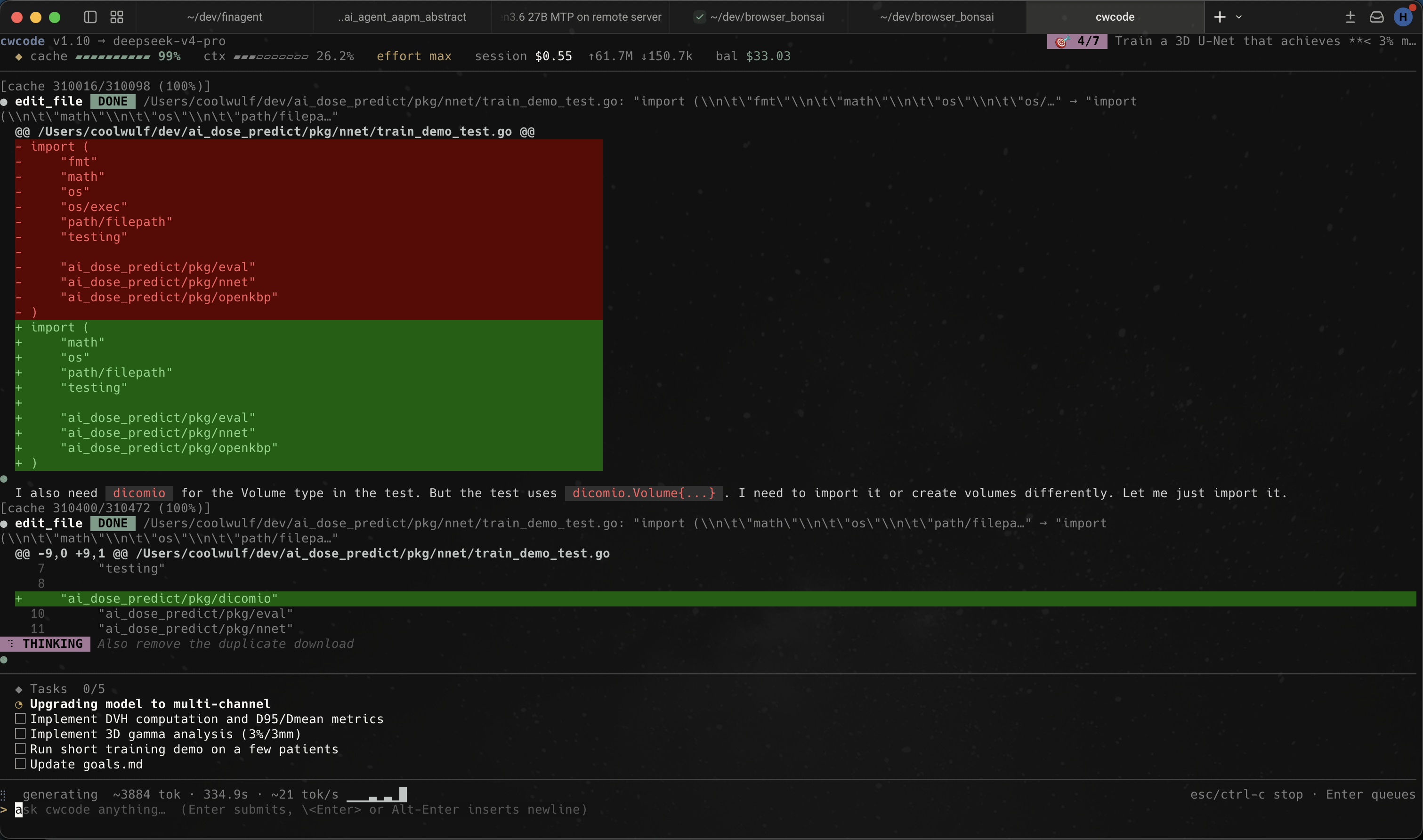
cwcode A terminal coding agent built around DeepSeek V4 Pro, Qwen3.6‑27B, Kimi, Azure, and anything else that speaks OpenAI’s chat API. Written in Go. Lives in your terminal. Edits real code. Recovers from its own mistakes. Costs about $0.40 to leave running for an hour. 5% of Claude’s token coston DeepSeek V4 Pro 85%+ prefix-cache hit ratioafter turn 3 ~12k lines of Gono external services What it is cwcode is a Bubbletea TUI that drives any OpenAI-compatible chat endpoint as a tool-using coding agent. It ships with profiles for DeepSeek (Pro and Flash), Azure OpenAI, Kimi for Coding, and a local vLLM / llama.cpp profile for Qwen3.6-27B on a home server. Switching profiles mid-session is one slash command. It has bash, file edit, glob, grep, web fetch, headless-Chrome fetch (driven via CDP through your real browser), sub-agents, a persistent semantic-memory store, content-addressed checkpoints with rewind, a plan/code mode toggle, and an autonomous goal loop. The tool registry is six hundred lines and adding a new tool is a two-method Go interface. It is not a SaaS. There is no account, no telemetry, no remote control plane. Your API key sits in ~/.cwcode/config.json. Your session history sits in ~/.cwcode/sessions/. If your network is down and the model endpoint is local, the agent keeps working. Why it’s different Hash-anchored edits The read_file tool annotates every line with a 3-character content hash: 42:a3f| return x. The edit_lines tool takes (line, hash, new_text) and rejects the entire batch if any hash drifted. The model never has to reproduce content character-perfect to land an edit. Adopted from Can Akay’s February 2026 post and ported to Go in about 200 lines. Output tokens per session dropped 30–40% on V4 Pro. Sticky prefix cache The system prompt is byte-stable across turns. Tool definitions serialize in a deterministic order. Reasoning content is stripped from outbound requests on every provider by default. DeepSeek’s prompt-cache hit path is ~120× cheaper than the miss path, and our /cache slash command shows session-cumulative hit ratio that routinely exceeds 85% after the third turn. Plan vs code mode A single Shift+Tab toggle between read-only planning (the LLM only sees non-mutating tools) and full execution. The model doesn’t see the flag — it just sees a different (smaller) tool registry and a system-prompt addendum. The human holds final control unless you opt into YOLO mode. Checkpoint & rewind Before any file-mutating tool runs, the harness snapshots the pre-state of every path the tool declares it will touch. Snapshots are SHA-256-keyed blobs in ~/.cwcode/sessions//objects/, deduped automatically. /rewind N restores files, truncates conversation history, and pre-fills the input box with the original prompt. Storm-breaker When the same tool fails identically three times in a row, the harness doesn’t silently abort. It synthesizes a plain-language response (“I’m unable to continue: read_file failed three times because the path was empty. Please clarify…”), streams it like a normal reply, and appends it to history so follow-ups have context. Autonomous goal loop /goal appends a goal to goals.md. /goal on starts an autonomous loop that runs back-to-back turns until every checkbox is marked done or until a safety cap of 20 consecutive cycles. We use this for four-hour overnight runs on annotated tasks. No SaaS lock-in Config is JSON. Sessions are JSON. Checkpoints are content-addressed blobs. Memory store is a SQLite file. Everything lives under ~/.cwcode/. If the project disappeared tomorrow your sessions are still readable. What it looks like Captured during real work on our dose-prediction codebase: the agent proposing an edit_file change to a Go test, with a unified diff highlighted inline, the reasoning trace streaming below, and the current task list pinned to the bottom of the pane. cwcode running a Go test edit; multi-tab tmux session, dose-prediction project, DeepSeek profile. Install Download a pre-built binary for your platform from the Google Drive release folder (current build: v1.11; macOS arm64 / amd64 and Windows amd64). Drop it somewhere on your PATH and make it executable: curl -L -o ~/.local/bin/cwcode chmod +x ~/.local/bin/cwcode cwcode -version You’ll need an OpenAI-compatible endpoint (DeepSeek API key, Azure deployment, local vLLM, or whatever else you have on hand). Configure a profile in ~/.cwcode/config.json: { "active_profile": "deepseek-pro", "profiles": { "deepseek-pro": { "provider": "deepseek", "endpoint": "https://api.deepseek.com", "model": "deepseek-v4-pro", "api_key": "sk-...", "ctx_size": 262144 } } } Run it. cwcode # Bubbletea TUI cwcode -p "fix the bug" # one-shot, no session cwcode -continue # resume the most recent session cwcode -plain # stdout REPL (no TUI) Built-in tools namepurposeneeds approval bashrun a shell command (streaming output)yes bash_backgroundspawn a long-running processyes read_fileread with per-line content hashesno write_filecreate or overwrite a fileyes edit_fileexact-string replace with whitespace recoveryyes edit_filesatomic multi-file batch (exact-string)yes edit_lineshash-anchored line replacementyes globfind files by patternno grepsearch files for a regexno lslist directory contentsno web_fetchfetch a URL and clean it upno chrome_fetchdrive your real Chrome via CDP for bot-blocked pagesno taskspawn a sub-agent with its own contextyes rememberadd a fact to the persistent memory storeno recallsemantic search over past sessionsno todo_writeupdate the visible task listno FAQ Why Go? Single static binary, fast startup, easy cross-compile. Three platform builds in 90 seconds. The TUI binary on macOS is 24 MB with debug symbols stripped. Why a terminal app and not a VS Code extension? Because we wanted the agent to be the primary interface, not a side panel. The TUI gives the model the whole pane to work in and gives us a small surface to debug. If you live in VS Code, you can run cwcode in the integrated terminal. Does it work with Claude? Not directly — cwcode speaks the OpenAI /v1/chat/completions shape. Claude has its own API. You can put Claude behind a translating proxy if you want, but we built this for the cost shift in the other direction. What model do you use day to day? DeepSeek V4 Pro for most coding work, Flash for quick questions and one-shot scripts, the local Qwen3.6‑27B profile when we want zero latency or are working offline. Is the source available? Pre-built binaries are on Google Drive. Source is currently private; we plan to open it once the API surface settles. If you want a peek before then, get in touch. Who built this? A small team that uses it daily for dose-prediction model training, financial research agents, and writing cwcode itself. The agent ships its own bugs and writes its own fixes.
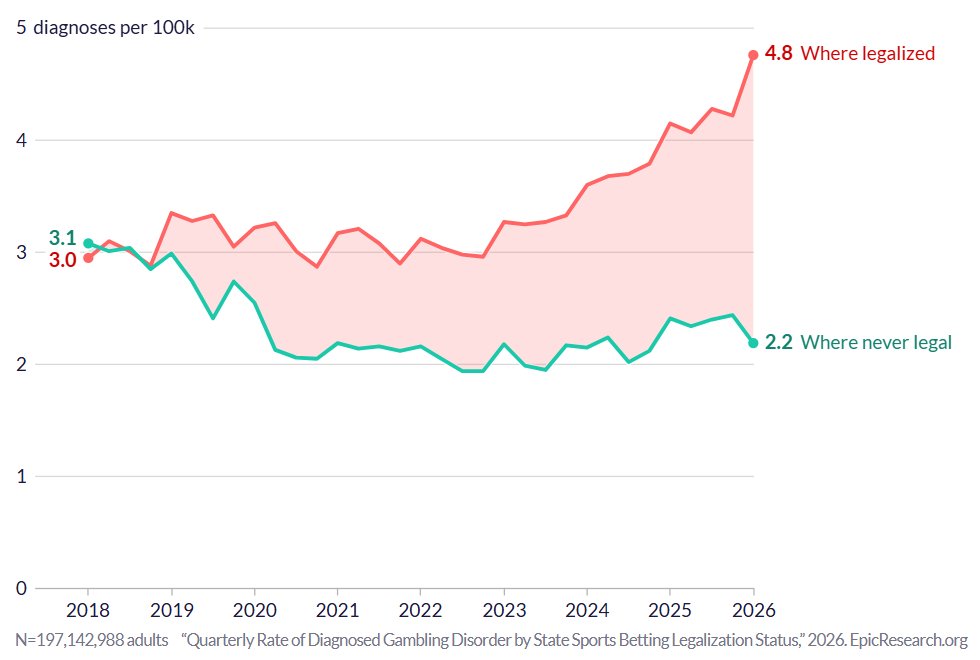
Gambling disorder cases have started skyrocketing in states where sports betting is legal (this started ~May, 2018) following the end of COVID. They've remained flat from COVID to today in states where it has remained illegal. https://t.co/bA9TAIFO5p
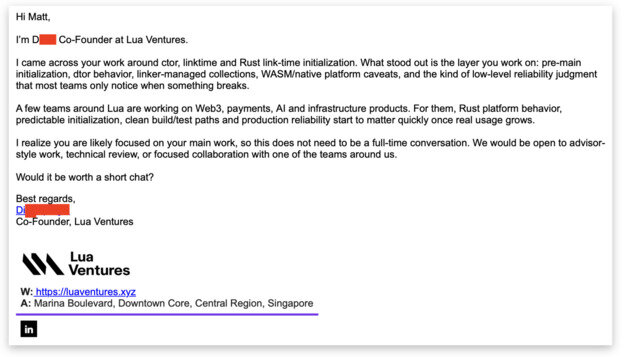
Disclosures 🧠 This post is fully human-written: all prose with the exception of the IoC information. Because it was time-sensitive, Claude was used to accelerate the RAT analysis and build an IoC-detection script. As I live in Canada, this information was reported to the appropriate Canadian agencies (CCCS et al). The payload-laden image does not trigger any AV engines on VirusTotal. The attacker’s identity is fictitious, but there are uninvolved individuals with the same name that they may be confused for and have been omitted from this piece. On Reddit there’s a few others in the Rust community who mentioned they were targeted as well. This week I came in far-to-close contact with a fake-interview scam designed to backdoor my machine, and from the context of the emails, I assume my packages on crates.io. Note: I’m calling it the “PinpinRAT” because of some of the internal strings, but it’s possible this has another name out there. I couldn’t find any other references to it online. A week and a half ago I received an email from “D█████ S████” claiming to be from Lua Ventures, a (unbeknownst to me at the time) defunct Singapore-based VC in the DeFi space. To be clear: this is a fabricated persona, and the name was likely chosen to be easily mistaken for one of a number of real people with the name. It looked like a real email, including a link to a somewhat boring, but legitimate-looking LinkedIn profile. The attacker even name-dropped two of their investments that were specifically looking for advisory work: Lyrasing and Roadpay. Searching for either of the companies wasn’t really a flag - they both had some very basic web presense, but nothing that would indicate they were fake rather than just early stage. (archive.org snapshot of roadpay.cc). We went back and forth on a meeting time and eventually settled on a time we were going to chat. There was nothing odd about the call itself, either. A somewhat-difficult-to-understand man with a German accent was on the other line. He said he was taking the call while travelling which was a bit odd, but again, not necessarily a flag. After the call came the bait. A follow-up email that offered up a “test”. At this point I was mildly annoyed, but not suspicious. I cloned the repo, but the first true red flag only fired here. Where I got lucky: they sent me a TypeScript repo. It didn’t make sense to me. The instructions looked more like a TypeScript job interview than any sort of architecture analysis. I decided to zip up the repo and toss it into the Claude to get a quick scan - a combination of caution and laziness. A few moments later it had identified some oddities: Notably, the root package.json has no postinstall/preinstall hook — interesting, because they use patch-package, which is normally wired to a postinstall. Let me check every package.json for lifecycle scripts, then audit the patch files (the real risk surface — patches can inject arbitrary code into node_modules). That piqued my interest. I scanned the directories myself and noticed a fairly unreasonable number of patches/ directories. The first few I checked seemed innocent enough, but as you might have guessed, they were just trying to add noise so the real payload wouldn’t get caught. packages/electron-benchmarks/patches/sumchecker+3.0.1.patch packages/electron-benchmarks/patches/@electron+get+2.0.3.patch packages/electron-benchmarks/patches/extract-zip+2.0.1.patch While I was checking slowly by hand, Claude identified first signs of PinpinRAT: I found it. This is a malicious payload. Embedded in the typescript+5.9.2.patch file — inside what is presented as a routine “module specifier” patch to TypeScript — there is a base64-blob self-executing obfuscation stub injected at the very top of both _tsc.js and typescript.js: ;;(function(r,k){const d=Buffer.from(r,'base64');for(let i=0;i

The world’s largest encyclopedia was overrun by bias and censorship—and pushed me out when I tried to fix it, writes Larry Sanger.

How we teach compilers and why it's gotta change
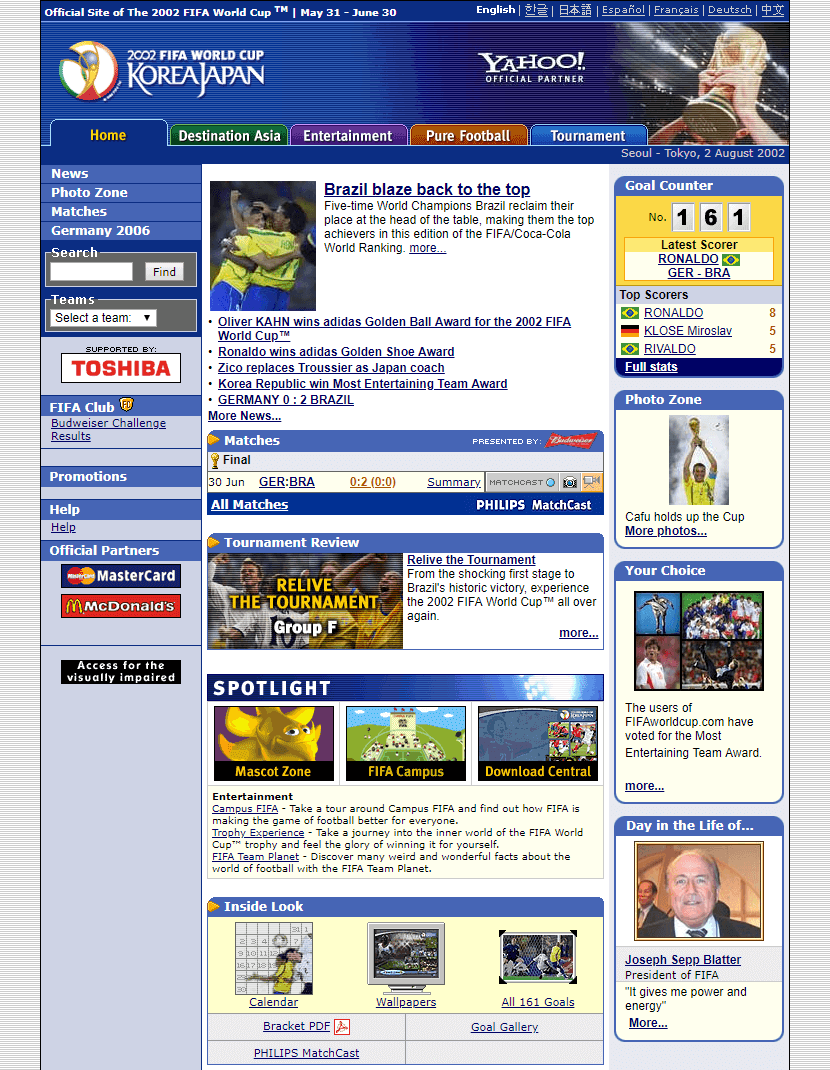
FIFA World Cup website in 2002

Estimate chunk count, embedding storage size, vector index growth, and monthly vector database cost for RAG workloads across managed and self-hosted options.