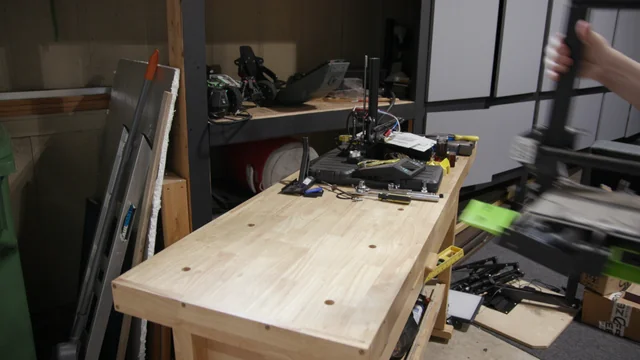
We recently open-sourced our implementation of obstacle overtaking using GPMP2 (Gaussian Process Motion Planning). The project demonstrates trajectory optimization for autonomous overtaking by representing robot trajectories as continuous-time Gaussian Processes and optimizing them as a factor graph. Instead of sampling-based planning, the approach jointly minimizes smoothness and obstacle costs while satisfying vehicle dynamics constraints, producing collision-free and dynamically feasible trajectories. Some highlights: GPMP2-based trajectory optimization using factor graphs Integration with robotics simulation for reproducible experiments Clear codebase that can serve as a starting point for researchers and students working on motion planning If you're working on motion planning, trajectory optimization, autonomous driving, or robotics, I'd love to hear your thoughts, suggestions, or ideas for extending it. Repository: https://github.com/AutonomousVehicleLaboratory/obstacle-overtaking-gpmp2 submitted by /u/Turbulent_Leek8446 [link] [Kommentare]
Stack-chan’s birthday is July 2. It all started with this first post on July 2, 2021: https://x.com/meganetaaan/status/1410631124045291521?s=20 Since then, we have celebrated Stack-chan’s birthday every year with the community. This year, we held “Stack-chan Birthday Party 2026” in Tokyo, Japan. https://preview.redd.it/bhaewzjw6bbh1.jpg?width=4096&format=pjpg&auto=webp&s=1b9d50e2071ffcf838ac8770ac51e6c1735f0664 More than 80 people joined us on-site, making it one of the liveliest Stack-chan gatherings yet. Many community members shared their projects, updates, and ideas, and we were also very happy to welcome the M5Stack team from Shenzhen, which made this year’s event even more special. Stack-chan is an open-source palm-sized communication robot, but more than that, it has grown through the creativity and continuous participation of its community. Over the past five years, people have built new mods, applications, faces, voices, hardware variations, and many other experiments around Stack-chan. Thank you to everyone who joined, presented, supported the event, or has contributed to Stack-chan in any way. Event page: https://stack-chan.connpass.com/event/394846/ YouTube archive: https://www.youtube.com/live/7sIlyWFUqsw?si=Qg_RtoDIF2dEoZFe Happy birthday, Stack-chan! submitted by /u/Few_Competition6685 [link] [Kommentare]
I’m working on a hardware graduation project where I want to build several small wheeled robots for a chess-related system. The idea is that each robot has two driven wheels, and one main controller coordinates all the robots. I’m new to multi-robot systems and differential-drive kinematics, so I’m trying to understand what I should learn first. My main questions are: - Is a central “master controller” architecture reasonable for coordinating multiple small robots, or should each robot handle more decisions locally? - For two-wheel robots, should I start by learning differential-drive kinematics, odometry, PID motor control, or something else first? - What sensors would be realistic for tracking robot positions on a chessboard or flat surface? - Are there beginner-friendly resources, papers, or open-source projects I should study before designing the system? submitted by /u/qwerty102q [link] [Kommentare]
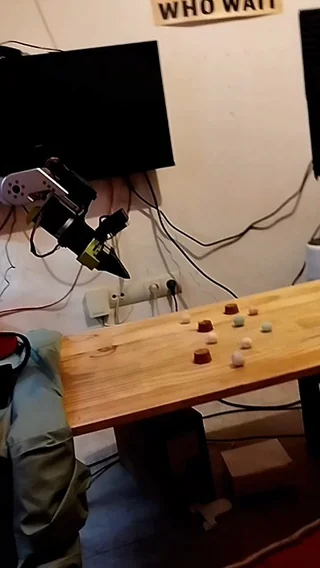
Any one in New York City that wants to build robot let me know you have to be a super nerd and a hobbyist Thank you submitted by /u/BirdAccording7249 [link] [Kommentare]
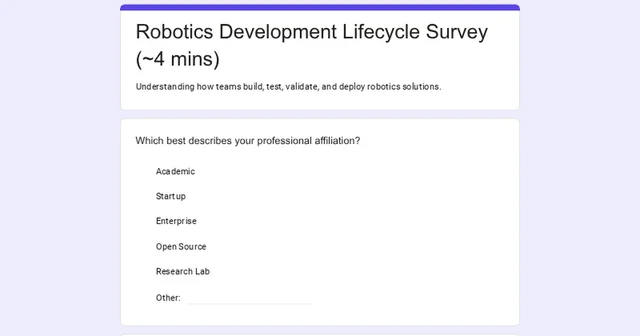
I’ve been talking to people building robots and keep hearing the same things: sim-to-real issues, hardware availability, debugging deployment failures, and testing taking way longer than expected. I’m doing a Cornell Master’s project to understand where robotics teams actually spend their time and what slows them down. The survey covers things like: - simulation tools (Isaac, Gazebo, MuJoCo, etc.) - ROS/ROS2 and middleware - RL, VLA, and classical stacks - testing and validation - deployment failures - world modeling and sim-to-real It takes about 4 minutes. If you’re working on real robots, your responses would be especially helpful. There’s also an optional follow-up interview with a $25 Amazon gift card :) submitted by /u/Realistic-Ganache446 [link] [Kommentare]
Saw on X about a robot AI company having humans getting paid to train their robots. It sounds pretty insane, but I saw how much they say they could pay and I wanted to apply but I couldn't give them what they were looking for. So quick question for you all who know better than me, what are these companies looking the most right now in terms of data they need from humans for their robots? (ps. I didn't know where else to ask this question so I hope this isn’t a bad place to do so, thanks!) submitted by /u/Fushling [link] [Kommentare]
I just wanted to share my C++ implementation of GM-PHD filter: https://github.com/borodziejciesla/gm-phd For now only point objects implementation is working, but I am working on extended objects implementation. submitted by /u/Competitive-Dress696 [link] [Kommentare]
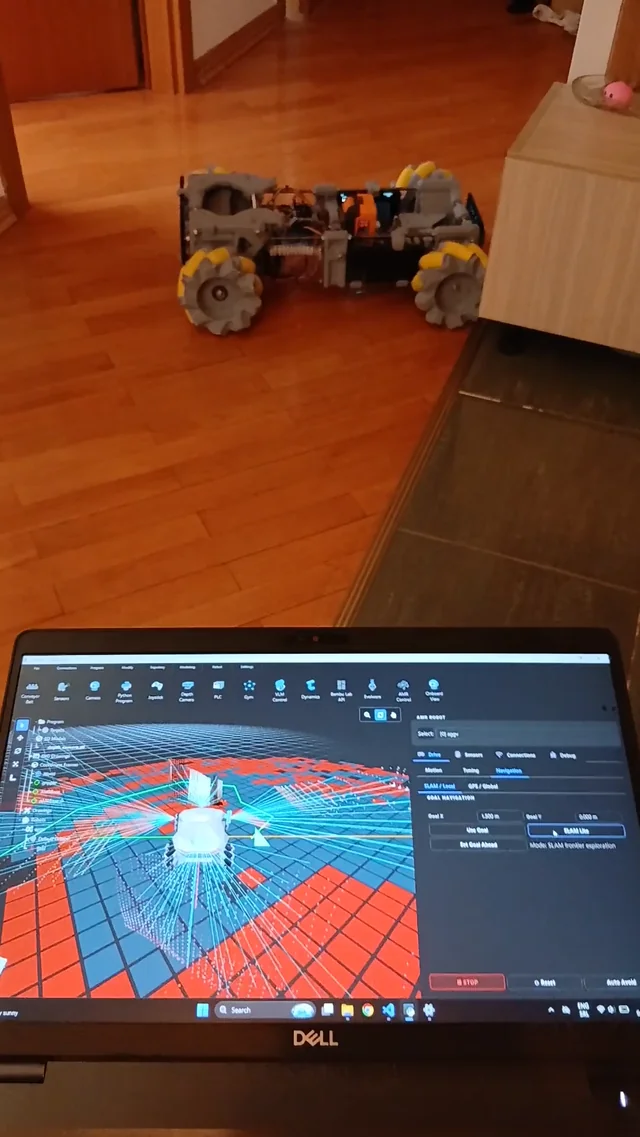
Hey r/robotics, Wanted to share my latest budget mobile robot build. The goal was to keep it under $250, so instead of buying an expensive LiDAR setup or dedicated depth cameras, I rigged up 4 cheap smartphones to stream video data. I’m running the streams through Depth Anything v3 (DA3) to estimate the depth maps, and honestly, for a "poor man's LiDAR," it’s going incredibly strong. The issue I'm running into: Since DA3 outputs relative/monocular depth maps, I’m struggling with absolute scale calibration. Right now, the robot thinks walls are further away than they actually are. It knows where the obstacles are, but the metric distance is skewed because DA3 doesn't have real-world depth data. I want to fix this by adding a hardware sensor to act as a "ground truth" anchor to correct and scale the DA3 depth data in real-time. Has anyone here tried using a ToF (Time-of-Flight) sensor or an Ultrasonic sensor to handle this kind of depth correction? Would a single-point distance reading be enough to dynamically scale the relative map, or is there a better way to do it? If anyone is curious about the hardware or wants to check out the setup, I put the specs and documentation here and the chassis CAD files here. Looking forward to hearing your thoughts on how to fix the depth scaling! submitted by /u/ganacbicnio [link] [Kommentare]

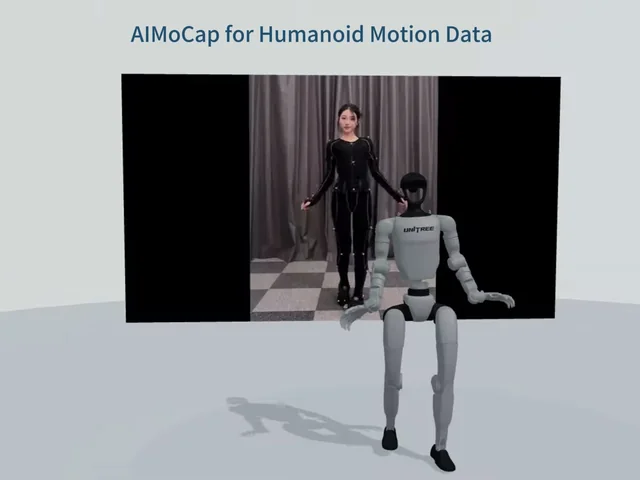
I've been experimenting with converting ordinary third-person videos into humanoid motion data. This demo includes several motion categories: • Acting • Sports • Combat • Dance The motivation is not animation alone. Recent humanoid robotics work increasingly relies on large-scale motion datasets and motion priors to improve movement quality, robustness, and generalization. Projects such as NVIDIA KIMODO also show the value of scaling high-quality motion data for downstream humanoid motion generation and control. This made me wonder whether ordinary videos could become a low-cost source of motion data for humanoid systems. There is already a massive amount of human motion available in online videos. If useful motion can be extracted reliably, it may help expand humanoid motion datasets beyond traditional mocap pipelines. For this experiment, I focused on: • Foot contact stability • Reduced foot sliding • Natural balance and movement dynamics • Consistency across different motion styles The long-term idea is: Video → Motion Data → Motion Models → Humanoid Control For anyone interested in testing their own clips, I made a public demo available here: huggingface demo I'd love to hear thoughts from people working on humanoid robotics, motion generation, imitation learning, or robot locomotion. submitted by /u/AIMoCap [link] [Kommentare]
I'm considering building the Toolbox Robotics EB15 or EB300 3D-printed robotic arm and would love to hear from people who have actually built one. I'm particularly interested in: - Overall build experience, assembly difficulty, and total filament usage. - Motion performance: Is the arm smooth or jerky? How much backlash, vibration, or missed steps do you experience? - Real-world performance: accuracy, repeatability, payload, and long-term reliability. - Software experience (ROS, MoveIt, control software, etc.) and any modifications or upgrades you would recommend. Photos, videos, build logs, or GitHub repositories would be greatly appreciated. Links:- https://toolboxrobotics.com/robotic-arm-eb15 https://toolboxrobotics.com/robotic-arm-eb300 submitted by /u/Fals3_ [link] [Kommentare]