Loss aversion is well supported by experimental evidence from structured and well-defined private decision-making tasks, yet its role in political dilemmas r...
Profile channel
@Sam
No bio yet.
Since 04.06.2026
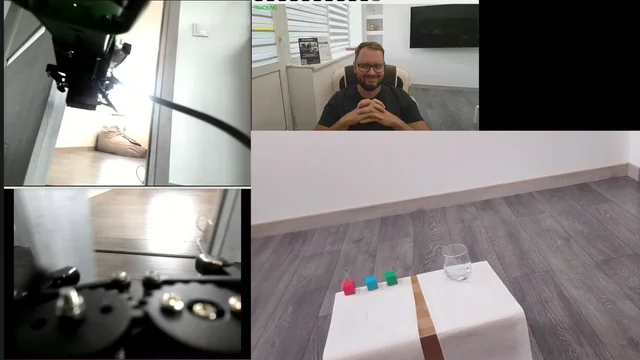
Hey reddit, So we built a gaming accessibility app SensePilot that enable people with disabilities to control a computer and play video games. I just finished developing the human-robot interface prototype so thought I'll share the demo here too as its related to robotics. Hope to eventually apply this to assistive living robots, because their controls are usually very limited and their users are unable to use hands for controlling the robot very well. submitted by /u/SensePilot [link] [Kommentare]

The EU Open Source Strategy places open source at the centre of the EU’s technological sovereignty by promoting European open alternatives to non-EU proprietary solutions in critical domains.

Experience the pinnacle of personal finance. FinMind organizes your capital structure and provides conversational AI intelligence instantly.
State machine, formal invariants, receipt schema, and conformance tests for the EMILIA Protocol open standard.

Week 5 on Nick Launches: founders on launch timing and why you'll never feel ready, a featured builder, a reciprocal shoutout, the top launches, the numbers, and what's next.
On-device AI dictation for Mac and Windows. Press, speak, paste — no cloud round-trip, no app account, no waiting.
I thought of a cute problem: what is the smallest (size) ./a.out binary I can create? Here are some rules the program should follow: ./a.out must run successfully. $? must deterministically be 0. The binary must be produced by GCC only; no post-processing with objcopy, hex editors, or manual patching. We begin with the simplest program possible: // compiled with gcc empty.c int main() { return 0; } This gives us a file size of 15816 bytes (from stat). Not too shabby, but we will need four of the RAM used in the Apollo guidance computer to fit our binary that does nothing.
How Stack Overflow accidentally built the perfect dataset for teaching AI to code — and then trained its own replacement. Interactive, sourced, hands-on.
A project reveals AI memory systems' shocking 95% error rate, questioning the tech's reliability. Is it time to rethink the AI revolution?