 R
↗
R
↗
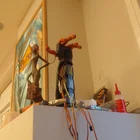
So this is my 2nd project and final project in high school, quite ambitious i gotta say. I was trying to make a anthropomorphic robotic hand . So i grabbed the palm and finger design from here. But i wanted to make my own thingys where the strings are attached , and add adduction ( fingers get clamped together). I learned how to use fusion and how to 3d print , i didnt know what was clearance. I learned that quickly . I dont have a 3d printer at home so i needed to pay for everything , i spent all my budget for this project , and i was so close to finishing everything but , my strings lacked tension and some 3d printed parts broke and i really dont want to spend more money. I finally decided to postpone the project until september because i got in an engineering school and i hope they have a 3d printer i can use freely. On top of that i think its better to try out some new stuff throughout the summer like i want to make those plasma ball thingys with the glass surrounding it and you can touch it. I am a little disappointed cause i was so close but let's see. I left you some pics too submitted by /u/MINII_man [link] [Kommentare]
 X
↗
X
↗
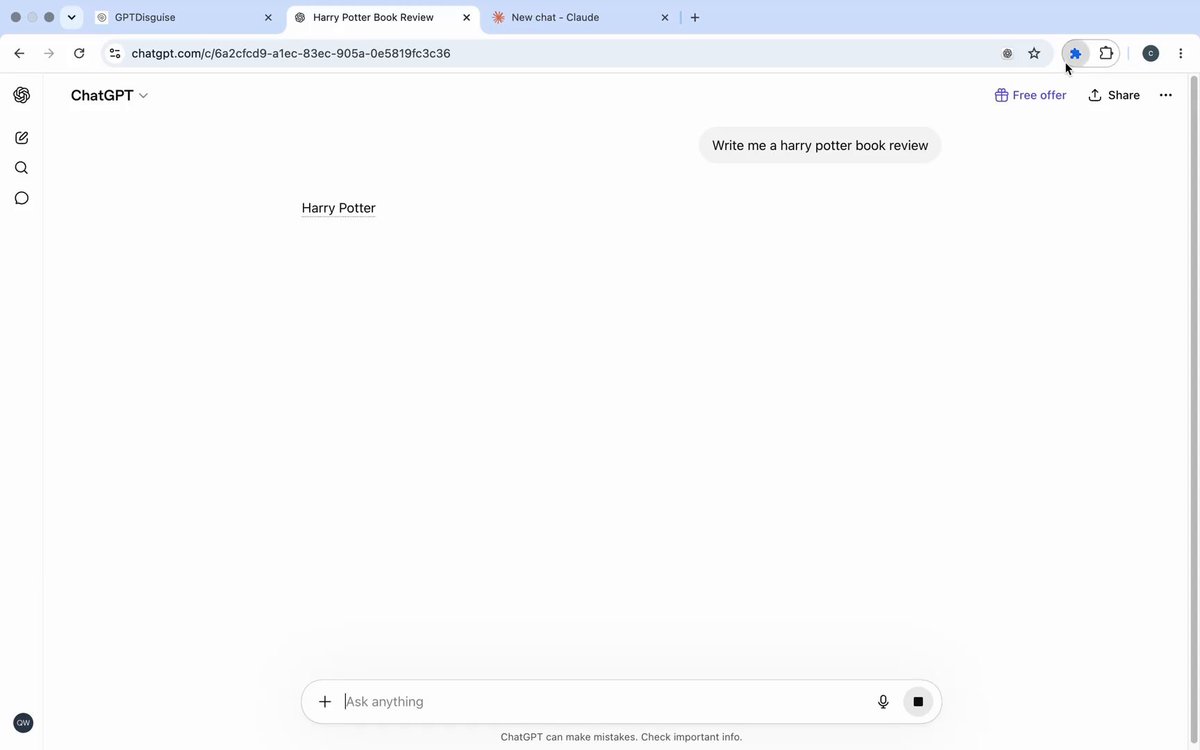
SOMEONE VIBE CODED A CHROME EXTENSION THAT DISGUISES CLAUDE AS A GOOGLE DOC SO YOU CAN USE AI IN PUBLIC it wraps ai in a fake google docs interface, so on your screen it just looks like youre typing a document, not prompting a chatbot what it does: > works with chatgpt and https://t.co/sZYkKOzvCG
 T
↗
T
↗
Discover the town of Greenville, TX through our iconic "Welcome Sign". Explore our attractions and experience hospitality at its finest.
 X
↗
X
↗
Let me show you how you can win $2.5M to fund your dream film. I originally made this trailer for the XPRIZE competition. Making this actually led to my film 'Nexus' being funded! You can steal my entire playbook to get your optimistic sci-fi film greenlit via XPRIZE 👇🧵 https://t.co/Ram8L7Zlk2
 L
↗
L
↗
AB 2015 Department of Transportation: third-party navigation applications: study and report.
 M
↗
M
↗
Published on April 1, 2026 In October 2025, California’s Digital Age Assurance Act (AB 1043) was signed into law by Governor Gavin Newsom. The Act requires operating systems to collect users’ age information and expose an API to apps indicating whether the user is a minor or an adult. At MONOLITH, we believe in inclusivity. We aim to provide equal access to our project regardless of your race, identity, religion, ideology, or which particular patch of the continental United States you happen to reside in. That said, leaving our California-based peers in regulatory purgatory would violate our core principles. So, in full compliance with the letter of AB 1043, we are proud to introduce MAGE: the MONOLITH AGE verification system. MAGE is a robust, enterprise-grade, government-mandated subsystem that is fully compliant with AB 1043. For userspace apps that wish to participate in this, we expose the following API: typedef enum { MAGE_UNAVAILABLE = -1, MAGE_MINOR = 0, MAGE_ADULT = 1, } mage_response_t; mage_response_t mage_verify(void); Apps are encouraged to use this information responsibly. Please be advised that MONOLITH will not accept any liability for users who provide false information.
 A
↗
A
↗
Download Fog: On-Device AI Notes by Akshat Saladi on the App Store. See screenshots, ratings and reviews, user tips, and more apps like Fog: On-Device AI Notes.
 B
↗
B
↗
Discover the most fun, interesting and cool websites on the internet. Hundreds of hand-picked sites, free games and things to do when you're bored.
 C
↗
C
↗
The successor to vibe coding is ultracoding: let agents programmatically spawn copies of themselves via code execution. Dynamically spin up multi-agent hierarchies in a task-dependent manner and, in doing so, scale up to previously unheard of tasks. Ride the dragon of exponential productivity. It feels the like the jump from single-threaded scripts to MapReduce and Spark: fan-out across many, reduce/verify steps, and capable of orders of magnitude higher throughput. This is what the future of building software is going to look like. Meta-harnesses like Claude workflows are the path to scaling up to massive multi-agent hierarchies capable of a fundamentally new category of tasks, in software and beyond. #Operating at a new scale This pattern of LLMs recursively invoking themselves has previously demonstrated impressive results on academic benchmarks - see RLMs. Recently however we've seen several impressive demonstrations in the wild in rapid succession, specifically for large code refactors and 0-1 projects. Recent massive refactors demonstrated in the wild: Bun's refactor from Zig to Rust Monty refactor to subprocess pool Cursor building a browser from scratch with a swarm of agents Exact implementation details for the above are light, but we can infer that each was accomplished via a swarm of agents working in parallel, managed by a small number of humans in a custom harness. The commonality is that each task has high test coverage and therefore lends itself to horizontally-scalable "ralph-loops" (now a first-class primitive in tools like Codex's /goal) and human verification. #Code Mode as a Multi-agent Substrate A key enabler for this emerging pattern is agent proficiency at "code mode" - programmatically invoking tools via code execution. The latest generation of LLMs are RL'd to operate specifically in this manner. It's a more efficient way to act on the world - it can compose bespoke bulk actions at runtime instead of one tool call at a time and enables agents to effectively assemble their own tools. Voyager (2023) had GPT-4 write, invoke, and store its own code as the action space, accumulating a library of reusable skills. Read more. This pattern was introduced by Voyager, and Perplexity/Cloudflare/many others have since introduced code mode-oriented interfaces. OpenAI and Anthropic even expose this tool calling method in their APIs via simple config (1, 2). Historically, multi-agent harnesses have been hard-coded and established an explicit heirarchy of agents with different roles and communication patterns. Ultracoding, like workflows, cedes this territory to the bitter lesson and acknowledges that agents can dynamically determine the best meta-harness at runtime. Infra-wise, this only requires the addition of a "spawn agent" tool within an existing (persistent) code mode execution environment. This ability, to spin up a harness in a task-dependent manner at runtime, has radically reduced the barrier to entry and means you can realistically chat your way to a massive refactor or ambitious 0-1 project. #Scaling Human-Agent Hierarchies: The UX Massive multi-agent hierarchies are unlocked from a capabilities perspective - now, the major barrier to widespread adoption is better UX for human in the loop. As Swyx has noted, the UX patterns for ultracoding are nascent. There's no established way to view/triage incremental outputs; The two patterns that have dominated thus far have been agent lists and Kanban boards, however this is clearly not a terminal state. Devin Desktop shows a kanban board, Claude is just a list of agents. I think we will imminently move towards a model where the agent expresses a UI for human oversight as part of the meta-harness. This may look like hooking into an existing UI like ClickUp or Linear, or alternatively writing bare HTML in a completely bespoke workflow in case bulk approvals or triage is necessary for the human. In the fullness of time, agents will effectively dynamically code oversight applications for human orchestrators, directly hooked up to "workflows" and with with bespoke approval and triage flows baked in. A slice of the meta-harness writes its own oversight UI: a code block queries the run's SQLite results and renders a bespoke triage panel, then blocks on human approval before control returns to the workflow. #Ultrawork I think about agents for general-purpose knowledge work and the analogies to code. From what I know of our customers at ClickUp it's obvious: this same pattern applies to many workstreams that emerge in recruiting, sales, project management, legal services, accounting, etc. This pattern of dynamic multi-agent hierarchies will wash out over knowledge work more generally. Instead of babysitting chat loops, you spin up a bespoke app for the task on the spot, with a UI built to verify the task in aggregate. The stuff that lives in a spreadsheet today becomes an application the agent assembles for you. Knowledge work time-lags code, so adoption will be incremental for everyone rather than a sudden flip. But the payoff is steep: the efficiencies are large, and once it works at scale you can take on a fundamentally new scope of work, not just the same tasks done faster. The shift: from babysitting a single chat loop to verifying a large-scale job in a bespoke app the agent assembled for the task. The unlock is that UI. Give a human the right way to participate in and verify a large-scale job and the horizon of what an LLM can take on extends dramatically, not just inside code where the review flow is obvious, but everywhere. Excited to see conventions established for this in the back half of 2026.
 G
↗
G
↗
Suppose that you have a configuration file in JSON. Something like this: { "width": 1920, "height": 1080, "fullscreen": true, "title": "My Game", "volume": 0.8 } Normally you ship this file alongside your program, open it at startup, read it, and parse it. That is a lot of work for data that never changes. What if … Continue reading Parsing JSON at compile time with C++26 static reflection
 D
↗
D
↗
G# is a modern .NET language that brings Go, Kotlin, and Swift ergonomics to the CLR.
R
↗
Hey r/robotics, I’ve been playing around with bridging AI and simple, accessible hardware. The goal is to avoid buying expensive robotics gear, starting instead with a basic