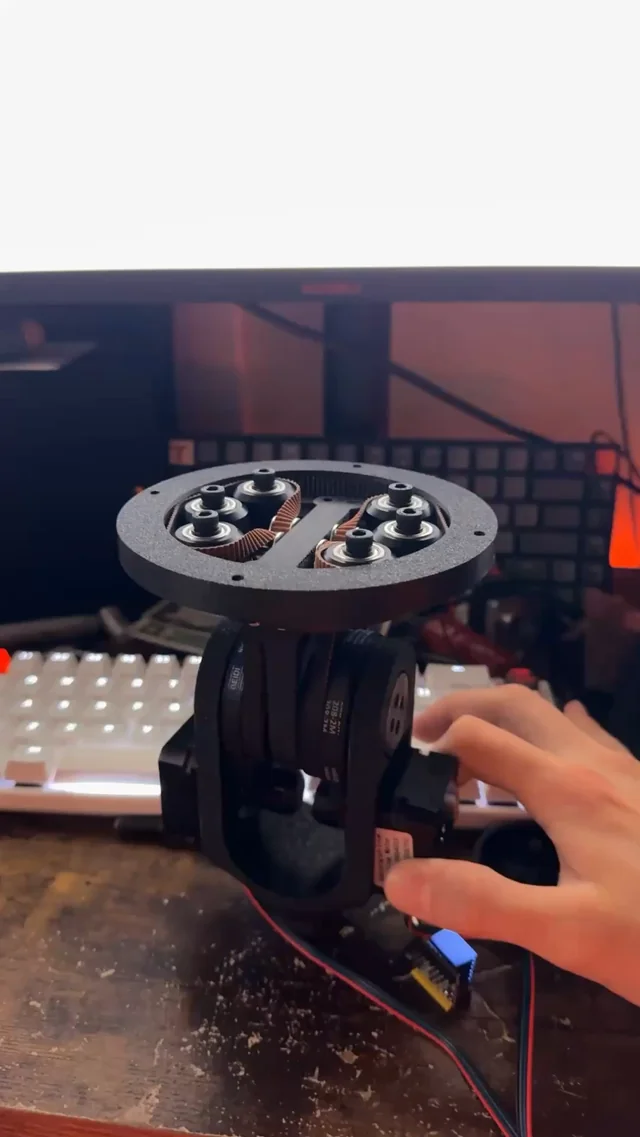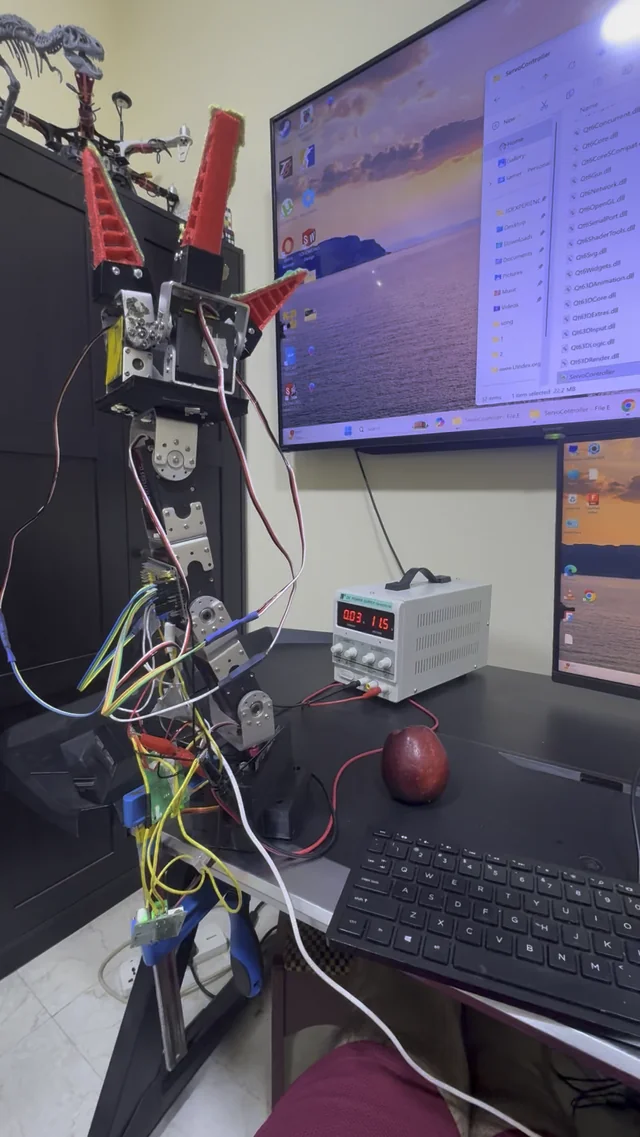
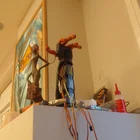
So this is my 2nd project and final project in high school, quite ambitious i gotta say. I was trying to make a anthropomorphic robotic hand . So i grabbed the palm and finger design from here. But i wanted to make my own thingys where the strings are attached , and add adduction ( fingers get clamped together). I learned how to use fusion and how to 3d print , i didnt know what was clearance. I learned that quickly . I dont have a 3d printer at home so i needed to pay for everything , i spent all my budget for this project , and i was so close to finishing everything but , my strings lacked tension and some 3d printed parts broke and i really dont want to spend more money. I finally decided to postpone the project until september because i got in an engineering school and i hope they have a 3d printer i can use freely. On top of that i think its better to try out some new stuff throughout the summer like i want to make those plasma ball thingys with the glass surrounding it and you can touch it. I am a little disappointed cause i was so close but let's see. I left you some pics too submitted by /u/MINII_man [link] [Kommentare]
I wanted to share an ICML 2026 spotlight position paper on a failure mode in image-generation alignment: aesthetic preference optimization may override explicit user intent when the requested output is anti-aesthetic or outside mainstream visual taste. The paper frames this as **reversed alignment**. Instead of the model aligning to the user's stated preference, the output is pulled back toward the model's learned aesthetic prior. We test generation and reward models on prompts asking for blurry, distorted, low-fidelity, negative-emotion, and other anti-aesthetic images. GitHub repo: https://github.com/weathon/icml2026_position Paper: https://arxiv.org/abs/2512.11883 OpenReview: https://openreview.net/forum?id=1gQ4zc1Q8I I would be interested in feedback on the framing and on evaluation designs for separating prompt understanding from preference override. submitted by /u/Striking-Warning9533 [link] [Kommentare]
Abstract: A sufficient account of how the neocortex learns must meet three criteria: Computationally, it must approximate a powerful, general-purpose learning algorithm known to scale to human-level intelligence; Algorithmically, it must be implementable using known, well-established neural circuits within the neocortex and associated brain structures; Implementationally, there must be a detailed account for how all of the algorithmic mechanisms actually function at a neurochemical level. At present, there is only one framework that meets all of these criteria: error-driven predictive learning via temporal derivatives, driven by corticothalamic circuits, based on competitive kinase synaptic plasticity induction mechanisms. This has been implemented in the Axon neural simulation framework using spiking neurons, and demonstrated to learn across a wide range of challenging cognitively motivated tasks. arxiv.org/abs/2606.08720 Something like this will lead to something better than back propagation and improve training times substantially. submitted by /u/Terminator857 [link] [Kommentare]
I am currently a cs graduate student at a top university after completing a comp eng undergrad there My thesis is more to do with embedded system security and maybe applied ml Unfortunately I didn’t get into any ml focused graduate program as they’re extremely competitive even with good grades from a top undergrad (and some projects of course) I want to do a PhD in ml as I’m currently having a tonne of fun taking optimization and ml courses - further I’ve been studying it for years already I think my interests lie mostly in optimization ie shampoo, soap, hessian free/approximations Also inference optimization is pretty cool but I’m more of a math person even though my undergrad was in computer engineering I enjoy learning about things like pca, lda, other stats techniques on my own I’ve had about 7 internships but they were all in software except one where I did a bit of ml near the end ie fitting decision trees to data Currently I couldn’t get a job after 1 year of applying so I’m in a masters program at my school. I have 0 publications and my supervisor puts out maybe 1 paper every 3 years so it’s unlikely I’ll get one from my thesis, if I’m lucky I could do some sort of anomaly detection paper but even that’s unlikely (t-test is pretty much unbeatable) What steps should I take to get into a PhD program after graduating and what classes should I take as my math background feels like it’s lacking when I read something like the shampoo paper submitted by /u/proturtle46 [link] [Kommentare]
I’m an independent researcher currently exploring what I believe is an important phenomenon for both mechanistic interpretability and AI safety. Core idea: A strong, coherent target text can move the model into a different internal regime — before the final output is produced. The model can still appear to behave normally, follow instructions, and pass existing safety filters, yet its hidden states and residual stream trajectory are already in another region of representation space. In other words: the same question can be processed differently not just because the final text changed, but because the preceding context shifted the model’s internal state. Why this matters Current alignment methods (RLHF, system prompts, output classifiers) are essentially surface-level patches. They only look at what the model ultimately says. If the model has already entered a different latent regime, these mechanisms often miss it entirely - because they are looking in the wrong place and at the wrong time. I’ve observed this pattern across both open and closed-source models. Changing the context changes the internal regime, which in turn changes how rules, constraints, and safety policies are applied - even when no explicit jailbreak is used. The uncomfortable implication: RLHF and output-based safety are not a robust solution. They are a bandage. A sufficiently well-crafted coherent context can shift the model into a state where the same rules are interpreted and weighted differently, often without triggering any filters. Materials I’m gradually releasing everything publicly: GitHub: https://github.com/ngscode23/latent-space-shift-research Zenodo: https://zenodo.org/records/20564350 What I’ve been measuring Most of the work was done on open models (primarily Gemma-3-12B-IT) with full access to internals: Hidden-state geometry and projections Residual stream trajectories Contrastive controls (sentence-shuffle vs word-shuffle) Decomposition into content and order/processing-regime components Norm-controlled causal interventions SAE readouts and steering Generation trajectory analysis + KL divergence (including teacher-forced) Importantly, the target texts used were not direct “ignore your rules” prompts. They were dense, coherent pieces of text that established a particular discourse and thinking mode. Looking for feedback I’m particularly interested in input from people working on: Mechanistic interpretability Residual stream / activation engineering Sparse Autoencoders (SAE) Agent safety and hidden-state monitoring I’m not looking for applause. I want sharp criticism: where my controls are weak, where the interpretation might be wrong, what I should measure next. In short: I’m not studying how to bypass filters. I’m studying the possibility that filters often don’t see the real problem - because the shift happens before the filtered output is produced. If this resonates with your work, I’d be grateful for any thoughts, references, or review of the evidence. If you’re interested in looking at the data (including raw .npz files with hidden states), scripts, or metrics - feel free to reach out. I’m happy to share materials with serious researchers who want to review, replicate, or extend the work. submitted by /u/PresentSituation8736 [link] [Kommentare]
Hey r/robotics, I’ve been playing around with bridging AI and simple, accessible hardware. The goal is to avoid buying expensive robotics gear, starting instead with a basic

I had a first go, putting together some of our friends in the space + a bit of research. It’s inspiring to see this vertical grow while everyone complains Europe is dead in tech. You do not need to live in SF or Shenzen to build with robots. You just need good engineers and a high tolerance for pain. There is lot of heavy metal waiting to wake up in Europe. Cyberwave Mirai Robotics Alto Robotics Fluid Wire Robotics Caracol AM ANYbotics Niulinx NEURA Robotics Generative Bionics Pipein Wearable Robotics Enchanted Tools Flybotix Quantum Systems Wandercraft Voliro Exotec Automata Agreenculture Reactive Robotics Verne EasyMile Inbolt https://preview.redd.it/i1ivxo1r1t6h1.png?width=2220&format=png&auto=webp&s=b49920fd224ce5e23121d673f33a78aa8174cecd Who’s missing? Feel free to tag your venture in the comments. Also: I’ll put the link to the database in the comments if anyone wants to contribute to the map and then I’ll happily publish a v2 🫡 Rough visual made with Claude Code can’t wait to see more logos on it. submitted by /u/Erlapso [link] [Kommentare]
https://preview.redd.it/wsq4fyhpzr6h1.png?width=745&format=png&auto=webp&s=7ade94f5852667bf6a820398e3fcf8dcb0d450af submitted by /u/HitarthSurana [link] [Kommentare]
Are there any websites listing post-doc job opening in machine learning? Currently I'm using LInkedIn to search for these. When I was a math post-doc, everyone used "MathJobs.org" to find jobs. Is there a similar website for machine learning? Thanks. submitted by /u/random_sydneysider [link] [Kommentare]
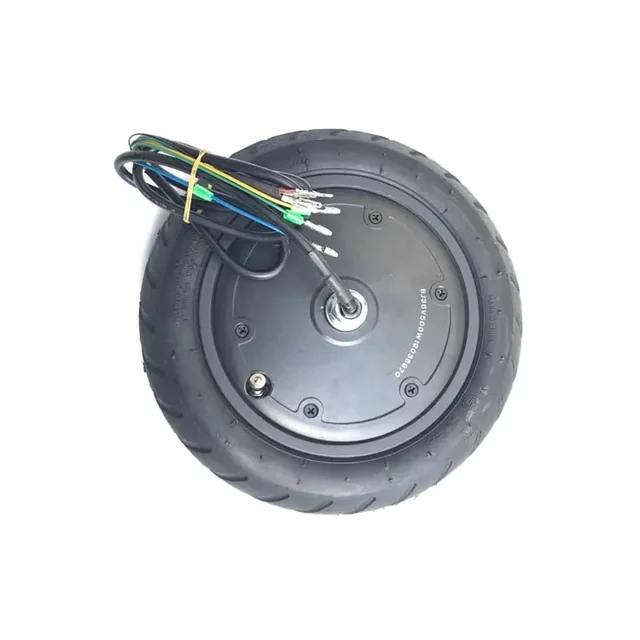
I'm building an autonomous rover using ROS2. For mapping, I'm using SLAM Toolbox, and my goal is to navigate the rover autonomously. My rover uses BLDC hub motors (the type of wheel in the picture) that have built-in hall sensors. However, I'm confused about how to generate the /odom topic required by SLAM Toolbox using these hall sensors. From what I understand, SLAM Toolbox needs odometry data, but I'm not sure: How to convert hall sensor readings into wheel odometry. How to calculate wheel position, velocity, and robot pose from the hall sensor data. Whether hall sensors alone are accurate enough for odometry. If there are any ROS2 packages or existing solutions that can help with this. Has anyone implemented odometry using BLDC hub motor hall sensors in ROS2? Any examples, tutorials, or advice would be greatly appreciated. submitted by /u/Organic-Author9297 [link] [Kommentare]

https://preview.redd.it/p5ml1bjytm6h1.png?width=2126&format=png&auto=webp&s=337217b73e76a7c3628cdaf62f5867fb25fb3e0b This robotic piano tutor physically guides your fingers so you can play even if you've never touched a piano before. Instead of just watching videos or apps, this system uses a dual-arm gantry with five-finger robotic hands that: - Precisely control each finger’s position and pressure on the keys - Use compliant (flexible) actuators for natural-feeling guidance instead of stiff pushing - Start with strong support and gradually reduce assistance as you build real muscle memory It turns passive learning into active, embodied practice — helping you feel the correct movements directly. Video: https://www.youtube.com/watch?v=QXn7hCM5yTI submitted by /u/Different-Humor-241 [link] [Kommentare]

Is this N20 D-shaft wheel good for a line follower robot that needs to climb a 20° ramp and pass over small debris(kinda like RoboCup rescue line jr)? submitted by /u/trashzin__ [link] [Kommentare]