

One real item every day. Guess what it costs in 6 tries.

Llamatik Code is a local-first AI coding assistant for IntelliJ-based IDEs, designed to help you understand, modify, and generate code directly inside your project...

Changes are coming soon to a taskbar near you


Hello everyone! I'm posting our research work as you might be interested in how we used ML to map part of the brain cells of the human hippocampus :) We used various human brain slices at high resolution (1 micrometer per pixel) and developed a custom segmentation pipeline that uses SoTA whole slice cell segmentation networks, like CellPoseSAM with good zero shot performances. We then refined semi-automatically those annotations and ensembled more finetuned models within the pipeline, adding a merging algorithm and a cell classification for 3 classes (excitatory and inhibitory neurons, and glial cells). But the high-res slices covered only a few parts of the hippocampus with respect to other slices scanned at 20x less the resolution where the cell nuclei are only 1 pixel wide. So we tried to map the high-res annotations we obtained to the low-res corresponding slices, and used a small UNet to supervise a density estimation task for 3 classes. We obtained a network that outputs a density map that can be sampled to obtain a probabilistic map of the cellular positions. Finally, to reconstruct the volume, we stacked together all the low-resolution density maps from all the slices that covered the hippocampus and obtained a point cloud, which you can see in the GIF along the corresponding anatomical CA (Cornus Ammonis) areas. The performances are still limited by the quantity of data and low-resolution slices, but we showed that the results were biologically plausible given previous estimates by other researchers. The paper was accepted at MICCAI 2026 a few weeks ago! Feedback is very welcome, especially on the density-estimation formulation and possible uses of the generated point cloud. submitted by /u/V_ector [link] [Kommentare]
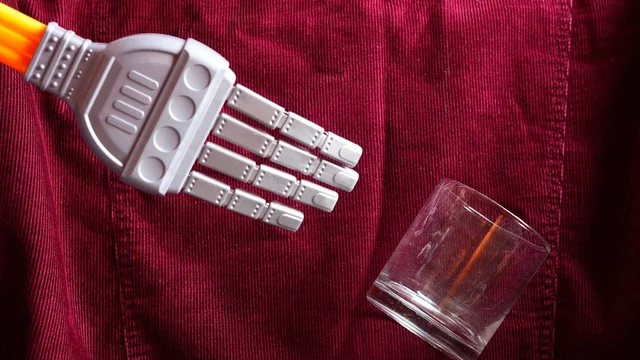




Hi everyone, I'm building the original InMoov v1 robotic hand . The mechanical assembly and servo control are working well, but I'm currently stuck with the sensor integration. My goal is to add: Hall Effect sensors for finger position/feedback. FSR (Force Sensitive Resistor) sensors on the fingertips for touch and grip force detection. Ultimately, I want to implement closed-loop gripping, where the hand can detect contact with an object and adjust the grip force instead of simply moving the servos to fixed positions. The problem is that I can't find a proper guide explaining how to do this. I've spent a lot of time searching through YouTube, Google, GitHub, forums, and other online resources, but I still haven't found a complete tutorial that covers the entire process. I'm specifically looking for help with: Where to mount the Hall sensors and magnets. How to mount the FSR sensors on the fingertips. Wiring diagrams. Arduino code/examples. Sensor calibration. How to combine the Hall sensors, FSRs, and servo control into one working system. If anyone has: YouTube videos GitHub repositories Research papers Wiring diagrams Build logs Arduino examples Personal experience integrating these sensors into an InMoov hand (or any tendon-driven robotic hand) I would really appreciate your help. I've been stuck on this for quite some time, so any guidance or resources would mean a lot. Thank you! submitted by /u/Odd-Bell1718 [link] [Kommentare]