
Research shows that private equity portfolios skew toward smaller, lower-quality companies, increasing downside risk. Ben Inker and John Pease explain how to hedge the resulting bias more effectively.


A real bug, a three-line fix, and a one-line rejection: what reaching for ‘AI slop’ as a reflex gets wrong about verification, scale, and trust in open source.

In the summer of 2020, I took a 3 months sabbatical in order to finish an album. The experience deeply transformed how I make music – I now know I can make ...

Apple AirDrop and Google/Samsung Quick Share are proximity file-transfer protocols used by over five billion devices, yet their application-layer security properties remain largely unstudied because both stacks are proprietary and undocumented. Both protocols are reachable from wireless proximity without any prior pairing and process complex serialized content (binary plists, CPIO archives, Protocol Buffers, UKEY2 handshakes) inside privileged daemons, making them attractive zero-click targets across multiple operating systems. We perform the first cross-platform reverse engineering and protocol-aware fuzzing study of both stacks. We reconstruct AirDrop's seven-layer state machine and DVZip adaptive compression from binary analysis, build AIRFUZZ, a protocol-aware fuzzer that mutates pre-compression representations, and complement it with targeted hand-written analyses of Samsung's Quick Share service and Google's Quick Share for Windows. We discover six vulnerabilities (V1-V6): three pre-authentication issues in macOS/iOS AirDrop (V1: Swift fatalError DoS in the HTTP path router; V2: unbounded XML plist recursion in Foundation; V3: NULL dereference in Network.framework's HTTP/1.1 parser), two protocol-layer flaws in Samsung Quick Share (V4: pre-authentication OfflineFrame dispatch; V5: D2D encryption bypass for three frame types), and a heap use-after-free in Google Quick Share for Windows (V6) for which Google awarded a bounty. We responsibly disclosed all findings, and Apple, Samsung, and Google have acknowledged the reports.
automates the entire process of creating a bootable OpenCore hackintosh USB. No manual config.plist editing, no hunting down kexts, no macrecovery commands. - riftaway7-code/hackmate


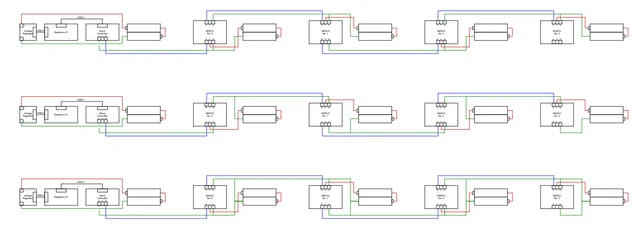
So basically I'm using: Feetech SCS-15 Serial Servo motors Feetech FE-URT-2 USB to TTL Controller Voltage Regulator Module (5V output) Raspberry Pi 3.7v 18650 Batteries to control the servo motors in the daisy chain ish way. For some reason I need to power servos using batteries individually, and I am not sure how I could do the wirings. Like, are they even different from one another and which way is the most adequate? In my poor understandings the ground seems all connected regardless of which way of these 3. submitted by /u/Dangerous_Break5656 [link] [Kommentare]