Please post your personal projects, startups, product placements, collaboration needs, blogs etc. Please mention the payment and pricing requirements for products and services. Please do not post link shorteners, link aggregator websites , or auto-subscribe links. -- Any abuse of trust will lead to bans. Encourage others who create new posts for questions to post here instead! Thread will stay alive until next one so keep posting after the date in the title. -- Meta: This is an experiment. If the community doesnt like this, we will cancel it. This is to encourage those in the community to promote their work by not spamming the main threads. submitted by /u/AutoModerator [link] [Kommentare]
I do not exactly have a photo as of now, and I was still kind of anxious to post this but I had built this CLI tool that creates a ROS workspace but only with a single .toml file(yes like Pixi, y'all need to stop ffs!) which contains ur entire launch pipelines, nodes, setup etc to essentially eliminate the need of Cmakelists, launch.py, etc. and a hot reloader to eliminate colcon build etc., reach build if you wanna build it into a ros2 package, reach doctor and trace for diagnostics, debugging, etc. I finally tested it today to see if it can even move my OpenArm robot properly or not and it did. For a minute or two I felt really happy that it's finally working but yeh now I'm moving forward to cross compilation management and reducing the setup overhead for the robots. Here's the link incase anyone wants to check it out: https://github.com/ascii-robotics/ros-config-reduction P.S: built it in rust submitted by /u/Aromatic-Dig9997 [link] [Kommentare]
Attending ICML for the first time (virtually) next week as a 3rd year PhD student in the US. I want to get into industry after finishing and have heard a lot about the benefits of networking at conferences to build industry connections. How do you actually go about doing this? Are there gonna be industry reps at the conference who you just go up to and talk to, send LinkedIn connections, and get to know them? Previously only been to one domain-specific conference and had more students/academic people than industry. TLDR: What's the best way to network at these big AI/ML conferences, especially since I'm gonna be attending virtually, with the goal of working in industry as a RE/RS in a couple of years? Would really appreciate any insights or helpful advice. Thanks! submitted by /u/IronBlowers [link] [Kommentare]
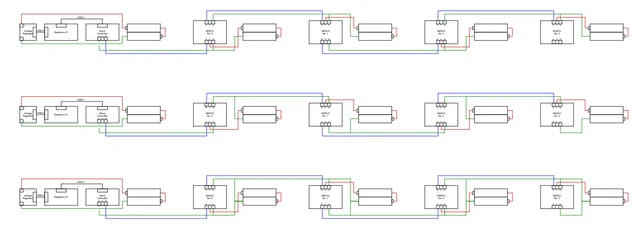
So basically I'm using: Feetech SCS-15 Serial Servo motors Feetech FE-URT-2 USB to TTL Controller Voltage Regulator Module (5V output) Raspberry Pi 3.7v 18650 Batteries to control the servo motors in the daisy chain ish way. For some reason I need to power servos using batteries individually, and I am not sure how I could do the wirings. Like, are they even different from one another and which way is the most adequate? In my poor understandings the ground seems all connected regardless of which way of these 3. submitted by /u/Dangerous_Break5656 [link] [Kommentare]

Hello everyone! I'm posting our research work as you might be interested in how we used ML to map part of the brain cells of the human hippocampus :) We used various human brain slices at high resolution (1 micrometer per pixel) and developed a custom segmentation pipeline that uses SoTA whole slice cell segmentation networks, like CellPoseSAM with good zero shot performances. We then refined semi-automatically those annotations and ensembled more finetuned models within the pipeline, adding a merging algorithm and a cell classification for 3 classes (excitatory and inhibitory neurons, and glial cells). But the high-res slices covered only a few parts of the hippocampus with respect to other slices scanned at 20x less the resolution where the cell nuclei are only 1 pixel wide. So we tried to map the high-res annotations we obtained to the low-res corresponding slices, and used a small UNet to supervise a density estimation task for 3 classes. We obtained a network that outputs a density map that can be sampled to obtain a probabilistic map of the cellular positions. Finally, to reconstruct the volume, we stacked together all the low-resolution density maps from all the slices that covered the hippocampus and obtained a point cloud, which you can see in the GIF along the corresponding anatomical CA (Cornus Ammonis) areas. The performances are still limited by the quantity of data and low-resolution slices, but we showed that the results were biologically plausible given previous estimates by other researchers. The paper was accepted at MICCAI 2026 a few weeks ago! Feedback is very welcome, especially on the density-estimation formulation and possible uses of the generated point cloud. submitted by /u/V_ector [link] [Kommentare]

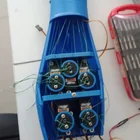
Hi everyone, I'm building the original InMoov v1 robotic hand . The mechanical assembly and servo control are working well, but I'm currently stuck with the sensor integration. My goal is to add: Hall Effect sensors for finger position/feedback. FSR (Force Sensitive Resistor) sensors on the fingertips for touch and grip force detection. Ultimately, I want to implement closed-loop gripping, where the hand can detect contact with an object and adjust the grip force instead of simply moving the servos to fixed positions. The problem is that I can't find a proper guide explaining how to do this. I've spent a lot of time searching through YouTube, Google, GitHub, forums, and other online resources, but I still haven't found a complete tutorial that covers the entire process. I'm specifically looking for help with: Where to mount the Hall sensors and magnets. How to mount the FSR sensors on the fingertips. Wiring diagrams. Arduino code/examples. Sensor calibration. How to combine the Hall sensors, FSRs, and servo control into one working system. If anyone has: YouTube videos GitHub repositories Research papers Wiring diagrams Build logs Arduino examples Personal experience integrating these sensors into an InMoov hand (or any tendon-driven robotic hand) I would really appreciate your help. I've been stuck on this for quite some time, so any guidance or resources would mean a lot. Thank you! submitted by /u/Odd-Bell1718 [link] [Kommentare]

The Setlur et al result that scaling test time compute without verification or RL is provably suboptimal keeps showing up in my reading and I think it deserves more weight than the "yet another scaling paper" treatment it got. The core claim is that verifier based methods, RL or search guided by a verifier, dominate verifier free methods like distilling successful traces, given a fixed compute budget, and the gap widens as the test time budget grows. What I find underappreciated is how cleanly this maps onto what the deployed systems are now converging on. The single agent ReAct loop is the verifier free extreme, you sample a trace and keep it, maybe with some self reflection that is still the same model grading itself. The multi agent setups that actually move numbers split the verifier off into a separate process. Apodex is the most explicit example I have seen, they train the team behavior in and run a verification team, conflict reviewer, fact checker, draft reviewer, that does not share the reasoning trace, and the reported lift is coming from the verifier not from added parameters. Same trained model, heavy duty mode adds double digits on BrowseComp and FrontierScience-Research. That is exactly the regime the theory predicts, the verifier is where the gain lives. The reason I think this matters beyond benchmark watching is that it reframes where the next chunk of capability comes from. If you believe the VB over VF result, then the path is not just bigger models or longer traces, it is better verifiers that are structurally independent of the generator. The pseudo correctness framing fits here too. The failure mode the verifier has to catch is not the obvious hallucination, it is the answer that passes every self check but is still wrong, and that failure mode is invisible to any verifier that shares context with the generator. What I want to hear from others is the open questions. My list. How much of the verifier gain is transferable to domains without clean reward signals, since the math proof case is the easy one. Whether the independence has to be architectural, separate agents, or whether a sufficiently disciplined prompt separation on one model gets you most of the way. And whether the VB advantage keeps widening or saturates once the verifier itself becomes the bottleneck. The practical version of this for anyone building. If your agent loop has the same model reviewing its own work, you are in the VF regime and the theory says you are leaving capability on the table. The cheapest structural change is to make the verifier a different process with denied context, even if it is the same weights. submitted by /u/Mysterious_Sign_9501 [link] [Kommentare]
I'm looking for human-in-the-loop platforms that allow you to automatically transcribe audio followed by manually fixing the transcriptions and fine tuning the model. Is there a local (not an online service) installable platform for doing this? submitted by /u/neuralbeans [link] [Kommentare]
Hi, I'm thinking of building a small community of 10-15 people where we can help each other to learn something new. The primary focus will be on ML research and open-source projects. If you're interested, DM me. knowledge of machine learning is a plus, as want to keep this a high-impact, collaborative group. Only for the moderators, since my last post was removed and I was asked to post in the monthly hiring thread: This post is not related to hiring. If I post it in the monthly hiring thread, hardly anyone will see it, so it defeats the purpose. My last post was removed very quickly, but in the mean time I've received 3 comments and 3 DMs. This clearly shows that people are interested, so I kindly request that you don't remove this post. submitted by /u/Tall-Gold-3553 [link] [Kommentare]
Hello I'm currently 26 I have 3 years of experience doing general IT help desk work and web development. I want to move on to having a deeper understanding of things and securing them. I have a undergrad in IT. I want to work with security but not only apps and networks yes this interests me but I'm also interested in the system or device itself how that's secured. Alternatively I am also interested in how a computer works, how to solve real problems with it, how a computer processes and sends data physically and then through a network and how to build computers themselves and as well as computers in bigger devices like robotics and how build bigger systems like a robotic arm. So I'm a little confused on if I should do my masters in computer engineering and add on cybersecurity electives or should I do computer science and on hardware or embedded systems electives. I do have the option at my school of double majoring as well but I think that would be to much work especially because if I do CE i have a big foundation to cover. https://catalog.uhcl.edu/preview\\\_program.php?catoid=25&poid=7072 https://catalog.uhcl.edu/preview\\\_program.php?catoid=25&poid=7074 submitted by /u/Colfuzi0 [link] [Kommentare]
I apologize for such an amateur question if someone is offended I just finished my 2nd year of degree. Well, the degree was a bit slow and I did the ML course this semester as well but being a Third World Country and stuff, it doesn't really matter cause I didn't learn antg of value from them I've been studying ML myself for 5-6 months, but I skipped the last 2 months cause of some issues and I've failed to get that motion back so I need a little bit of advices as where to continue I know python of course and I've learned many ML algorithms, all supervised and what you'd call easy. I have understood their general concepts and maths but never went in deep. I did them in practical as well. Made a very few projects. Now, I'm confused what should I learn next, I feel unsupervised learning isn't really my thing or I wouldn't be able to do it so can I just skip that? And idk what's next, so what is it? I've thought of learning Agentic AI as well but I can't do that until I'm satisfied with myself that I completely know ML and I can work on professional level. And if you've any resources to learn from, certifications etc as well. I'd really appreciate it. Again I apologize for really rookie questions. submitted by /u/Negative-Guard-4487 [link] [Kommentare]