
The hardest part of building an LLM scoring tool isn't the model — it's the rubric. HackerRank open-sourced theirs. I read it, ran it, and faked a few resumes to test it.
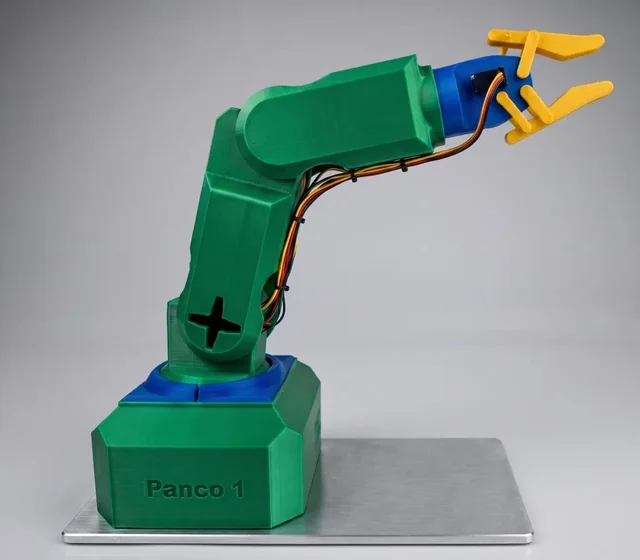
Hey r/robotics ! After months of design and testing, I finally have a working 5-axis robot arm fully printable in PLA or PETG — no CNC, no laser cutter, just your printer. Here's what makes it different: - 5 axes (shoulder, elbow, wrist, gripper + base stepper motor) - ESP32 brain — totally open-source firmware - Electronics BOM under $100 sourcing parts yourself - Full wiring diagrams, assembly guide, and source code included The V1 is already fully operational and tested. I just launched a Kickstarter pre-launch page to fund the V2 (better rigidity, internal cable routing, improved gripper). Happy to answer any questions about the design choices, print settings, or the electronics. AMA! https://www.kickstarter.com/projects/pancoarmmk01/panco-arm-mk-01 submitted by /u/ConferenceFew7697 [link] [Kommentare]

BAT Roadmap 4.0 evolves the Basic Attention Token, Brave Rewards, and Brave Creators for the transactional attention economy, introducing agentic payments, a unified Brave Wallet, the BravePay stablecoin protocol, a Brave Rewards Card, and a Creator Contribution Protocol.
One problem with building things using state-of-the-art techniques is that sometimes those that look like they will be “the next big thing” turn out to be dead ends. Next thing you know…

Weekly Physical AI Roundup.

It's underappreciated how close to perfect the performance of a robot needs to be to be profitable, and getting there takes an enormous amount of experimentation across data, hardware, and machine learning. In CV or LLMs, the same test set can be used forever. However in robotics, each test needs to be manually reset and evaluated for success. This does not scale, especially when success is measured as the difference between 98% and 99% success. Here's what that scaling problem costs in practice. Measuring a policy at 90%+ level with any confidence takes 40-50 rollouts per checkpoint (

The company reportedly stopped the car until police could arrive, and told the teens there was a mechanical problem with the vehicle.

Fable came back last week, and Anthropic already moved its own leaving date once. Meanwhile GitHub, Google, and Anthropic all set their real price hike for the day after Labor Day, when your finance t
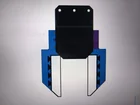
Hi everyone, I'm currently working on my bachelor's thesis, where I'm designing a modular hybrid robotic gripper. The idea is to combine: A rigid PLA backbone that transmits gripping force. A replaceable TPU insert attached using a dovetail. A compliant contact pad that deforms locally to conform to different object shapes. Unlike a Fin Ray finger, I don't want the whole finger to bend. I only want the contact pad itself to compress , almost like a soft mattress, while the rigid backbone continues transmitting the gripping force. My challenge is choosing the internal structure of the TPU pad. I've already tried: Vertical pillars (1 mm thick, initially 9, then reduced to 5). These turned out much stiffer than expected. In FEA, almost all the stress concentrated at the pillar joints and the contact surface barely moved. A completely hollow pad, which deformed very easily, but I'm concerned it may become too compliant and reduce force transmission. So I'm looking for an internal structure that provides controlled local compliance: The contact surface should deform under load Deformation should be distributed rather than localized. The rigid backbone should still transmit most of the gripping force. It should be printable with FDM using TPU. It should also be practical to model in FEA. My questions are: Is there a known lattice or compliant structure commonly used for this type of application? Should I be thinking in terms of lattice geometry, thickness, relative density, or something else entirely? Are there any compliant mechanism patterns (diamond, X-lattice, zig-zag, auxetic, etc.) that are known to behave like a compressible contact pad? If you've designed soft robotic fingers or compliant structures before, what worked well and what should I avoid? I'd really appreciate any advice, papers, or examples. I'm trying to make design decisions that I can justify academically rather than simply saying "this one seemed to work." submitted by /u/ghanoushi [link] [Kommentare]