A Cambridge-led team has developed a way to engineer better vaccines that could provide broad protection from thousands of variants of viruses - such as coronaviruses or Ebola - in a single vaccine. This represents a fundamental new vaccine technology that could prevent future pandemics before they begin.

A critical security update has been released for UpdraftPlus and UpdraftCentral. Learn who is affected, how to update, and how to stay protected.

This is an automated check to get rid of most bots. If you have JavaScript enabled, it should redirect to the real page soon. If you don't, it still should redirect soon, but you can click here if you're fast.
Hey all, I'm a robotics engineer by training turned ML/AI engineer because of passion right after school. I want to start combining these skills together and I think a competition is the best way of doing it. Here's an example of a challenge I'm talking about to set expectations : https://www.intrinsic.ai/events/ai-for-industry-challenge Anyone up for this? L.E.1. I'm based in Europe. I think online only competitions would be easiest to start with to get momentum going, then if the results are worth it, we can consider meeting in person if it makes sense. L.E.2. I don't have the next challenge in mind yet, I'm open to suggestions. submitted by /u/Due_Pickle1627 [link] [Kommentare]
Extension for Visual Studio Code - Ask coding questions inline and get answers in the format of a Stack Overflow thread — condensed, multiple competing answers, one accepted.
Money Manager: Cash Counter, Zakat Calculator, Age and Cow Weight Calculator
Batch export, download, and sync your PerplexityAI conversations to Markdown files. The ultimate Chrome Extension to bulk export thousands of searches with Spaces organization and smart deduplication.

Contribute to egeozgul/Incremental-3D-Reconstruction-SfM development by creating an account on GitHub.
Kean

A better concept model and more efficient tools for editing spoken word audio.

Why the historical classist and racist organization structure from the military to corporate America needs to change in the AI area

We introduce an automated, agent-driven approach to the design of photonic devices. We instruct large language models (LLMs) to solve photonic design problems, given access to software tools for performance evaluation (through numerical simulations) and quantitative acceptance criteria (e.g., fabrication rules, geometric constraints, physical-consistency checks). Within this context, agents run autonomous design loops (propose, simulate, evaluate, iterate) and generate devices with state-of-the-art performance. We demonstrate this approach in two stages: First, we run it individually on four canonical problem classes in photonic chip design: a) passive components (waveguide bends, splitters, crossings, etc.); b) active devices (silicon microring modulators (MRMs)); c) radio-frequency (RF) devices (traveling-wave electrodes for a Mach-Zehnder modulator (MZM)); d) chip layout (electrical routing). Then, we combine the previous studies in one demonstration to produce a silicon photonic modulator, incorporating layout, charge transport, optical mode, and RF electrode design. The approach generalizes to any problem that combines a numerical simulator with performance criteria that an LLM can evaluate.
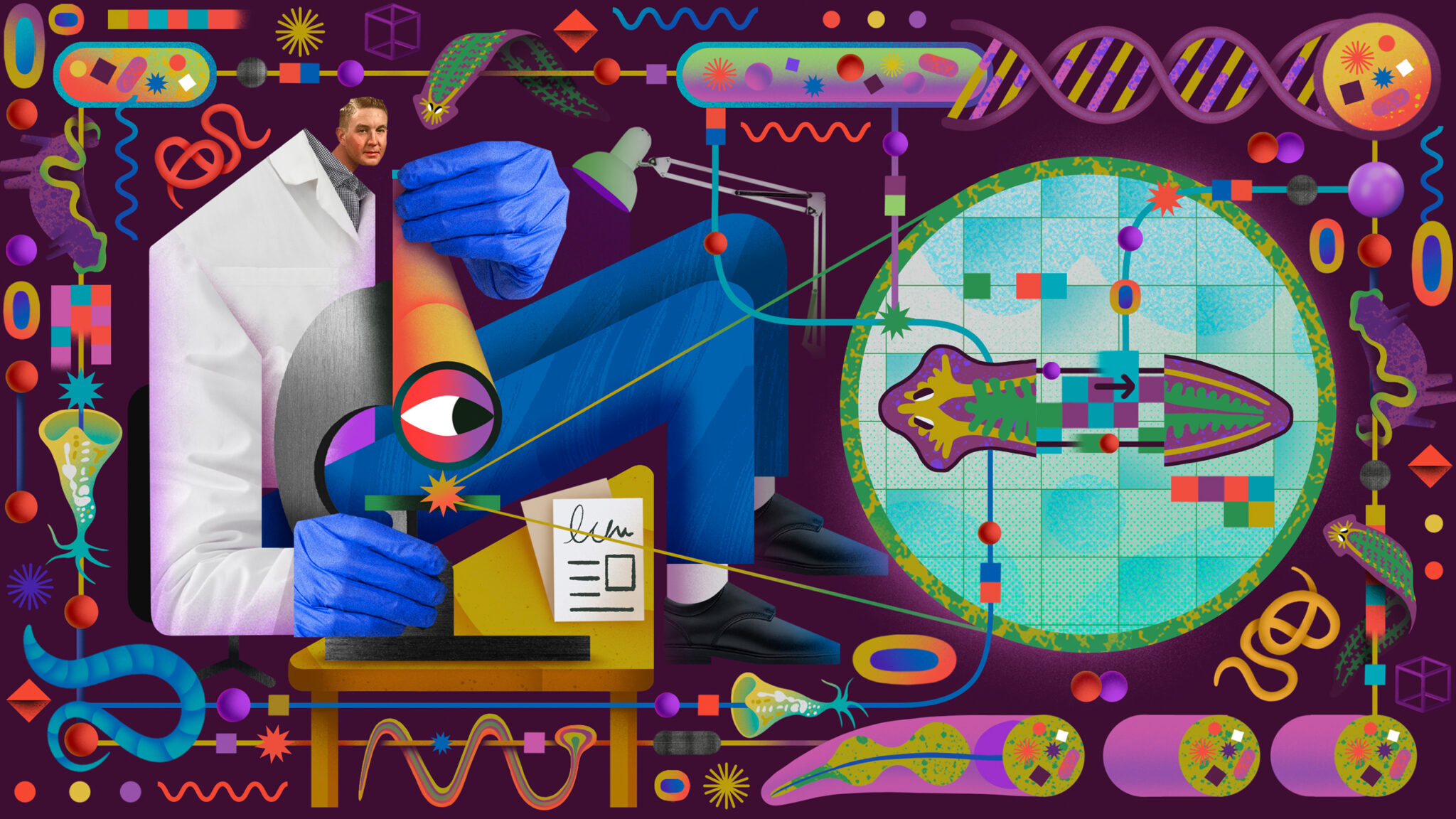
In the 1960s, worm-training experiments and their strange implications captivated the nation. Columnist Claire L. Evans follows the neuroscientists who attempted to recapture the magic.