Channels
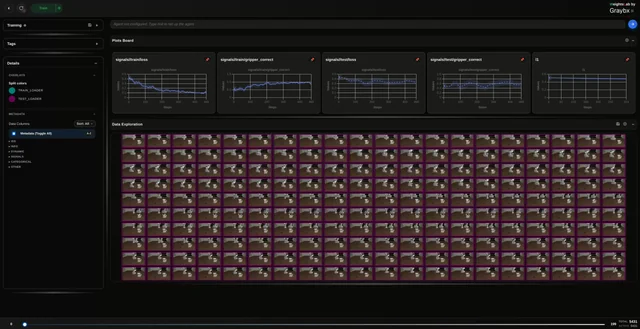
After months of chasing benchmark numbers and metrics that looked great, but our robot kept making weird, unnatural misses and dropping objects mid-grab, we finally stopped tuning the model and went digging through the data itself. By tracking per-sample loss, classifying each sample's loss-trajectory shape, and doing some manual inspection, we found at least 10 counterproductive sequences in the train split (and a few in eval) of LIBERO, a widely used robot-learning benchmark. In several of them, the object is missed or falls mid-grab, and the model is being trained and even evaluated on exactly those. Q1. What's the right way to handle these partial/failed sequences? Straight deletion feels wrong. Some of that "fail then recover" signal might actually be teaching the policy to recover. Q2. What do people use to actually understand their data in this space, beyond eyeballing episodes? submitted by /u/taranpula39 [link] [Kommentare]
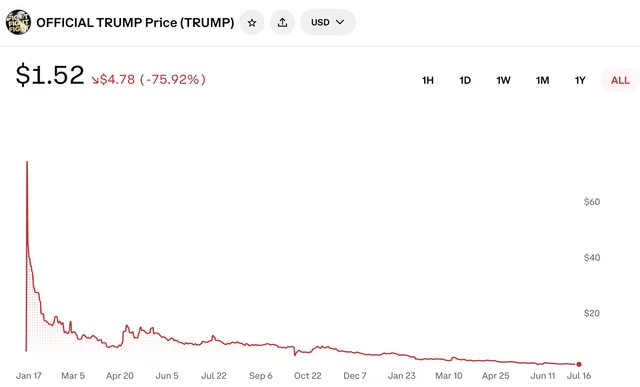
TRUMP has absolutely cratered, plummeting a staggering 98% from its all-time high of $74.34 down to just $1.52. This shows signs of the classic, textbook hallmarks of a pump-and-dump scheme, showing an instantaneous spike right at launch followed by a continuous, brutal slide as insiders and early creators quickly cashed out. Everyday retail investors who bought into the political hype are now left holding a massive, empty bag—staring at a devastating loss of $72.82 per coin. submitted by /u/Lower_Ad_1146 [link] [Kommentare]
Title: Researchers: Is this framework useful, or complete BS? I'm working on a visual framework that tries to describe how research progresses from simply collecting information to producing genuinely original discoveries. The image isn't intended to be a formal scientific model or a replacement for established research methodology. It's just an attempt to build an intuitive mental model that students and early-career researchers can use. The basic progression is: Level 0: Raw copy-paste / plagiarism Level 1: Information compilation Level 2: Understanding & summarization Level 3: Comparison & evaluation Level 4: Interpretation & analysis Level 5: Applying knowledge to solve problems Level 6: Designing experiments that generate new evidence Level 7: Combining existing ideas in novel ways Level 8: Making an original contribution (new method, dataset, benchmark, algorithm, theory, etc.) Level 9: Breakthrough work that significantly changes a field Level 10: Paradigm-shifting discoveries that redefine how we understand a domain Some examples I had in mind: Level 2: A literature review that accurately explains existing work. Level 4: An analysis explaining why Transformers scale better than earlier architectures. Level 5: Building and evaluating a better RAG pipeline for a real-world application. Level 6: Running controlled experiments to test whether a new training strategy improves performance. Level 7: Combining ideas from two different fields to create a new research direction. Level 8: Publishing a genuinely new architecture, benchmark, or algorithm. Level 9: Attention Is All You Need (Transformers) opening an entirely new direction for AI. Level 10: Think of discoveries on the scale of Einstein's relativity or Newton's mechanics—rare, civilization-level shifts. I know this is subjective, which is exactly why I'm posting it here. I'd really appreciate criticism from people who actually do research. Some questions I'm hoping you can answer: Is this progression fundamentally reasonable, or is it misleading? Which levels don't make sense? Are there levels that should be merged or split? Am I confusing difficulty with originality? What dimensions are missing? (Novelty, rigor, reproducibility, significance, etc.) Is there an existing framework in academia that already captures this idea better? If you were mentoring a new PhD student, would you find something like this useful, or would you throw it away? Please don't worry about being polite—I genuinely want to know whether this is a useful teaching tool or just academic nonsense. If it's flawed, I'd much rather understand why than keep refining something built on a bad premise. submitted by /u/farhadak_and2005 [link] [Kommentare]
Sharing a public write-up of our dual-pillar verification work: Policy stress under mass/friction tiers on Lift, Stack, PickPlaceCan, Door (robosuite / MuJoCo, n=50, paired seeds, Wilson CIs) Physics-consistency checks on generative video (CogVideoX I2V pilot documenting a freeze/hover failure mode) Positioning: fast private eval before hardware trials / institutional leaderboards — not a substitute for RoboArena or real-robot benchmarks. Article: https://haga.mushoodhanif.com/article/sim-physics-consistency-v1 Lab: https://haga.mushoodhanif.com/lab If you run sim-first policy work and want a scoped private report, the site has a submit-for-eval form (48h acknowledgment). submitted by /u/Divine-Demon7 [link] [Kommentare]