Channels

Let me show you how you can win $2.5M to fund your dream film. I originally made this trailer for the XPRIZE competition. Making this actually led to my film 'Nexus' being funded! You can steal my entire playbook to get your optimistic sci-fi film greenlit via XPRIZE 👇🧵 https://t.co/Ram8L7Zlk2

Over the last decade, building human-level artificial general intelligence has moved from far-fetched speculation to being a concrete next-decade target for many of the largest AI organisations. Achieving this goal would have profound and far-reaching impacts on human society, which raises many complex questions for the decade ahead. This report investigates how AI itself might continue to develop in a post-AGI world along the continuum of machine intelligence. The endpoint of this continuum, Universal AI, is theoretically well understood, which provides some formal grounding for the main focus of this report: the transition from human-level AGI to artificial general superintelligence, which, intuitively, can be understood as a system that is more intelligent and cognitively capable than large organisations of humans. After characterizing ASI, the report discusses four potential pathways from AGI to ASI: scaling AGI, AI paradigm shifts, recursive improvement, and ASI emerging from large-scale multi-agent collectives. The report then discusses possible frictions and bottlenecks along these pathways. Determining whether the impact of these frictions will be negligible or substantial raises a number of concrete open research questions. Due to large uncertainties for predicting ASI progress, it cannot be ruled out that AI progress might continue to accelerate over the next years. This could imply that the image of a single transformative step change, caused by the introduction of human-level AGI into our society, could be inaccurate. More apt might be the prospect of a series of transformative societal changes caused by AI-enabled progress and breakthroughs across many areas of science and technology. Preparing for this prospect requires a massively interdisciplinary endeavour of global scope and interest.

The Wolves are getting hammered. Game 6 Western Semis against the Spurs, who lead the series 3-2. I decided it wouldn’t hurt to do a little multi-tasking — half-watching the game, half-staring at a GitHub Actions tab — and figured if my evening plans were a little bitter, I might as well make it a bitter-sweet and dust off a side project that needed some love, ishi. A quick background on ishi, it’s essentially “pgvector storage for git intelligence”. You point it at a repo, it embeds your commit history into a pgvector database, and then you can ask it semantic questions like “what changed about the build system?” and it’ll pull the most relevant commits back. I hadn’t touched it in a few weeks. So I opened the repo and noticed the CI was red, and I’d been poking at Zig 0.16.0 in a tiny toy repo called hash to learn swiss tables, so I figured it was a good time to upgrade.

Programmatic video creation with web technologies you already know. CSS animations just work.
Compress tool outputs, logs, files, and RAG chunks before they reach the LLM. 60-95% fewer tokens, same answers. Library, proxy, MCP server. - chopratejas/headroom






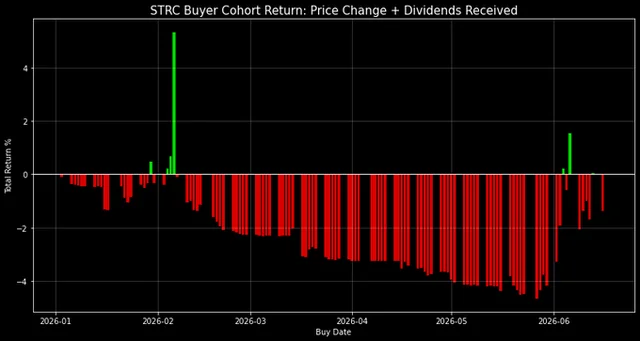
Saylor has repeatedly compared STRC to a high-yield money market. STRC is currently under $92. I can't remember the last time I've seen a High Yield Savings Account return negative 8% in a single month. This is chart from the weekend is already outdated since STRC dropped another 3.5% today even though BTC only dropped 1%. Somehow this supposedly-stable, bank-like STRC has been behaving more volatile than BTC lately. Cracks are showing. submitted by /u/HSuke [link] [Kommentare]

BYD isn't slowing down in just about any metric, but its recent push to expand its powerful supercharger network is impressive.