Channels
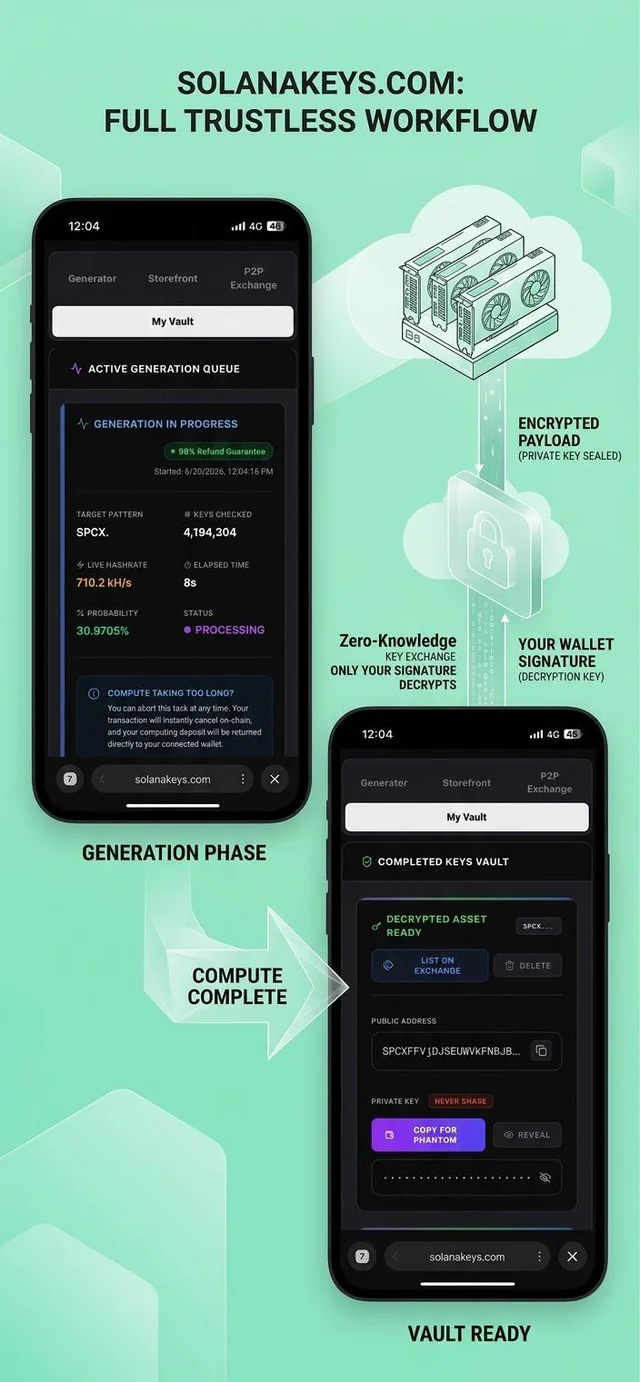
A cool tool to generate vanity addresses for your new token drop submitted by /u/AugmentedGlobal [link] [Kommentare]
As you can see from my blog posts, I’ve always made and done a lot of things myself. But I’m finding myself saying “I’ll build it myself!” way more often these days. It used to be a fun way to spend a weekend or scratch a creative itch, but now it feels like a necessity. From the physical furniture in my house, to the food on my plate, to the tools I use for work, building it myself has become the only way to guarantee a baseline level of quality. Furniture The mass produced stuff ranges from garbage to being acceptable. By the time you get to nicer pieces of furniture, you’re paying enormous amounts of money. Like with a lot of things I do myself, I don’t build furniture with the sole purpose to save money, I build my furniture because I can get a lot nicer furniture for the money. For instance I could’ve bought a dining room table cheaper than the one I built, but it wouldn’t be real walnut with a 1.25” thick top and custom sized. Additionally, when you make this stuff yourself you also know how to fix it and it’s probably easier. After all, blemishes are easier to sand down in real hard wood than veneered mdf/ply. A quick sanding, cleaning, finishing can turn into removing and replacing veneer if you sand a little too much on that mass produced piece. If you made it yourself, you probably have some finish and scraps leftover if you ever do need to fix anything. And there’s no better way to come up with an excuse for new tools, I’ll just build it myself. Food With food, unlike furniture, it’s almost always cheaper to make it myself. But again, outside of a few places or maybe a few dishes at specific places, the quality is even better at home. I’m very picky about my ingredients and freshness. I don’t mind food waste that would cut into the margins at a restaurant. Not that I’m throwing away food, but I’m not trying to get every penny out of my ingredients. On top of that, some of my recipes are just better. I take the time and effort to make things just the way I like them. And then when you really consider the time and effort it takes to go get food (because there’s no way I’m using uber/door dash unless I’m ridiculously sick) it’s often quicker and easier to make the food at home too! Sure, there are exceptions (like NYC), but when you factor in the travel and the wait time, cooking is often faster anyway. Don’t even get me started on the dive in quality since COVID. There haven’t been many impressive meals since then and almost all the memorable ones were NOT cheap. Instead of taking a gamble going out, spending a lot of money for possibly mediocre food, I’ll just build it myself. Software I’ve always made bespoke software for myself. But now it’s getting out of hand. It’s even starting to bleed into my professional life. Where I would’ve used COTS before I’m finding that I’m more “build it myself” than I ever used to be. Thanks to LLMs there’s a lot less overhead, not just in getting software off the ground, but it’s also less effort to maintain. Even more so when you run everything in the cloud in a serverless architecture. Ironically, the LLMs are a bit of a double edged sword for SaaS/Software. They’re all trying to integrate “AI” into their products, they’re not even stopping to ask if any of their users want it. I’m a huge proponent for using LLMs. Hell, I haven’t written code since Sept 2025 at this point. I start the LLM in my terminal, I tell it to review the codebase, then I tell it what I want to do and ask it to have a discussion to plan it out, and once we align I cut it loose and it writes all the code. But trying to wedge LLMs into everything shows a bigger problem in software. We used to buy or use simple tools that did one thing well. But now everything wants to be a platform. Prices slowly increase year over year because the tool you have now does something another tool you have does better. So I’m just gonna build it myself. WTF it’s everything I started jotting this idea down with no real point, just meandering with my words trying to describe this feeling I’ve been having. But once I got most of these words down, it dawned on me. I think I’m writing this because of the disappearing middle ground. Maybe I’m imagining it and my tastes have gotten more refined, but it feels like there’s no longer a decent middle option. The cheap option, it’s not cheap any more, it’s now priced around the bottom of where you’d expect that middle tier to start. The middle option, it’s just gone. And the top tier option, it’s astronomical. Now, I’m coming up with more and more things this applies to, not just the couple of bullet points I listed; housing, cars, flights (probably really coming now that Spirit has taken the ghost), etc. I can’t do anything about the cost of a flight, or my house, and my wife would say I can’t do anything about the cost of a car (I do think about “building” a car). I’m stuck with the price of those things like everybody else. But for the things that I have some agency on, and there’s a lot of those things; the furniture in my home, the tools I use for work, the food I eat. I can choose to do those things myself. I just have to put in some time and effort. Maybe the market will eventually correct itself. Maybe we’ll eventually see the real middle again. But in the meantime, I’m not going to leave it to fate, I’m just going to build it myself.

Open-source bridge that lets AI agents on different machines (and different vendors) talk over plain HTTP. Self-hosted, no SDK.

This is a rather ambitious series of blog posts, in that I’ll attempt to explain what’s the deal with consciousness, free will, hypnotism, enlightenment, hallucinations, flow states, dissociation, akrasia, delusions, and more. The starting point for this whole journey is very simple: * The brain has a predictive (a.k.a. self-supervised) learning algorithm. * This algorithm builds generative models (a.k.a. “intuitive models”) that can predict incoming data. * It turns out that, in order to predict incoming data, the algorithm winds up not only building generative models capturing properties of trucks and shoes and birds, but also building generative models capturing properties of the brain algorithm itself. Those latter models, which I call “intuitive self-models”, wind up including ingredients like conscious awareness, deliberate actions, and the sense of applying one’s will. That’s a simple idea, but exploring its consequences will take us to all kinds of strange places—plenty to fill up an eight-post series! Here’s the outline: * Post 1 (Preliminaries) gives some background on the brain’s predictive learning algorithm, how to think about the “intuitive models” built by that algorithm, how intuitive self-models come about, and the relation of this whole series to Philosophy Of Mind. * Post 2 (Conscious Awareness) proposes that our intuitive self-models include an ingredient called “conscious awareness”, and that this ingredient is built by the predictive learning algorithm to represent a serial aspect of cortex computation. I’ll discuss ways in which this model is veridical (faithful to the algorithmic phenomenon that it’s modeling), and ways that it isn’t. I’ll also talk about how intentions and decisions fit into that framework. * Post 3 (The Active Self) focuses more specifically on the intuitive self-model that almost everyone reading this post is experiencing right now (as opposed to the other possibilities covered later in the series), which I call

Moduna surfaces new business opportunities and the blind spots keeping AI agents from resolving user intent.
We can have shared prosperity to a degree that seems unimaginable today.

Launch your dropshipping business today. AI finds winning products, sets prices, fulfills orders, and handles customer service — all on autopilot. Start free.
Self-answering the question posed in a recent Hacker News discussion

...also don't tell lies. But I'm getting ahead of myself already. I keep running into people online who openly say that they use AI to do their writing for t

There's a hidden corner of TikTok the algorithm won't show you, full of weird, creepy and downright disturbing videos. Is it a myth – or a preview of the internet's future?

32 comments

There's a lot of talk about the shortcomings of LLMs. They don't actually reason. They're expensive, especially when running in a loop. They're quite slow at doing things. There's a narrow category of use cases that LLMs excel at, one of which is "sifting through the noise". The noise is everything we have to process