Channels
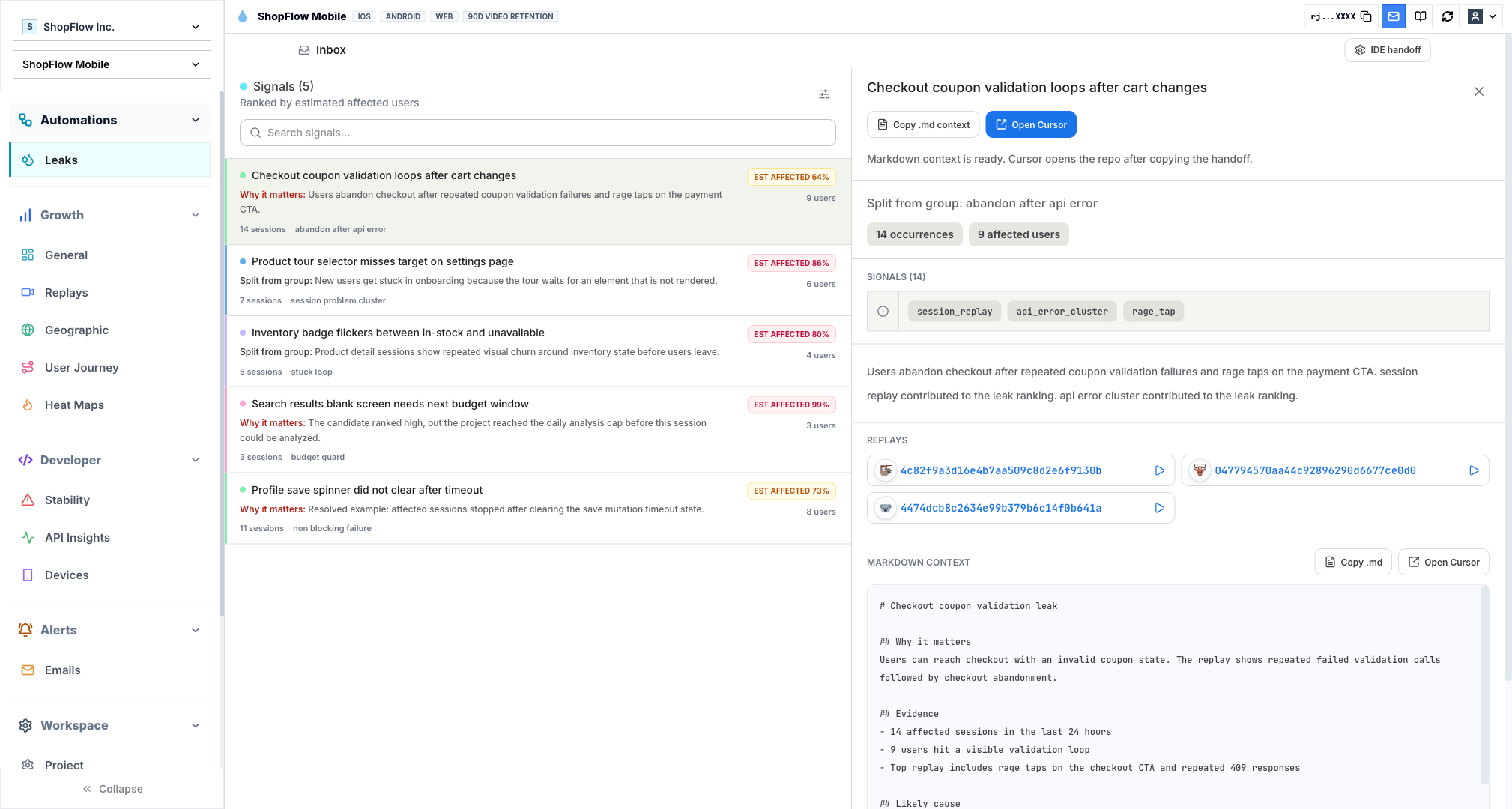
Research from 1.6M mobile sessions shows API errors drove 17.5% permanent user loss, making ambiguity worse than crashes for app growth.
Public mission A crowd search for the missing extremal Type II code The project tries to find or rule out a binary doubly-even self-dual [72,36,16] code. A construction would feed directly into related objects such as a self-dual quantum CSS code and conformal-field-theory data; a nonexistence proof would settle a long-standing coding-theory problem. How the search works: rather than sift through the astronomically many length-72 codes directly, we reason about their weight enumerators — the counts of codewords at each weight — and the finite list of arithmetic shadows those counts can take. Anchoring at a minimum-weight codeword and projecting down a residual tower, [72] → [56] → [40] → [24], forces each shorter descendant to carry a specific enumerator; computing these anchored projections, including their higher-genus (bi- and tri-weight) forms, squeezes out the constraints that decide a branch. When no code can meet the forced arithmetic the branch is ruled out, while explicitly building one up the tower would settle existence — so every result here is either an exact obstruction or a witnessed descendant. Current public posture: 72 compatible shadows remain. 51 have witnessed nonempty descendants; 21 are still unresolved as existence questions. Why this is a good crowd problem Many doors: algebra, coding theory, design theory, SDP, exact enumeration, and computational proof can all contribute. Finite checkpoints: every test has a page, an input menu row, a status, and a way to reproduce or improve the obstruction. Useful outcomes on both sides: construction gives new highly structured objects; impossibility resolves the length-72 extremal question. Automorphism group: narrowed, but not assumed A long series of papers has reduced the possible automorphism group of a hypothetical [72,36,16] code to one of just five: C1 (trivial), C2, C3, C2×C2, or C5. Excluded along the way: order 2 with fixed points (Bouyuklieva 2002); Z7, Z32, D10 (Feulner–Nebe 2011); C8, Q8, Z4×Z2, Z10 (Nebe 2012); order 6 (Borello 2012); C4 (Yorgov–Yorgov 2013); S3, A4, D8 (Borello–Dalla Volta–Nebe 2013); C23 (Borello 2014); with the short list and solvability consolidated by O'Brien–Willems (2011) and Bouyuklieva–O'Brien–Willems (2024). Full citations are in the References catalogue. We make no automorphism assumption. The trivial group C1 imposes no structure — every codeword orbit has size one — so it is the hardest case to rule out, and every test and enumerator on this site is automorphism-agnostic: it must hold irrespective of any symmetry. The narrowed list drives a parallel prescribed-automorphism search; it is not an assumption the menu relies on. If the code is found, these structures come with it A construction is not an isolated object — three structures follow, each by a proven map: A 5-(72,16,78) design. The 249849 weight-16 codewords form a 5-design: every 5 coordinates sit together in exactly 78 of them. Why: the Assmus–Mattson theorem applied to the extremal Type II code (minimum weight 16, dual distance 16) makes each weight class a 5-design, and counting fixes λ = 249849·C(16,5)/C(72,5) = 78. A code CFT at central charge c = 36. The code maps to a chiral conformal field theory of central charge c = n/2 = 36. Why: in the code–CFT dictionary (Henriksson–Kakkar–McPeak, arXiv:2112.05168) a length-n doubly-even self-dual code yields a chiral CFT of central charge n/2, whose genus-g partition function is the theta lift Θ of the genus-g weight enumerator — a degree-g, weight-18 Siegel modular form. This site computes that genus-3 Θ-projection (see the Enumerators tab). A [[71,1,≥15]] self-dual CSS code. Puncturing the self-dual [72,36,16] code in one coordinate and using the punctured dual C⊥ as both the X- and Z-stabilizer gives a self-dual CSS code (CX = CZ) with parameters [[71,1,≥15]]. Why: puncturing gives C = [71,36,≥15] with C⊥ ⊆ C, so CSS(C⊥,C⊥) is valid with k = 71 − 2·35 = 1 and distance ≥ d−1 = 15 (Jain–Albert, arXiv:2408.12752). Main route The 72 -> 56 -> 40 -> 24 hierarchy The public story should center this descent: start from a hypothetical [72,36,16] Type II code, take a weight-16 word, study the length-56 residual, descend through length-40 menus, and finally reach length-24 endpoint tests. Start [72,36,16] Type II code, A_16 = 249849 Residual [56,21,16] 5082 minimum words forced Menu [40,k,16] 132 shadows, 72 surviving Endpoint [24,1,24] local tests and exhaustions What the hierarchy buys The descent turns a global code-existence question into a finite set of compatible length-40 shadows. Each row can then be attacked by exact divisibility, local gluing, support-weight constraints, SDP layers, or direct existence searches. Forced n=72 enumerator (genus 1, Gleason) W_72 = 1 + 249849 y^16 + 18106704 y^20 + 462962955 y^24 + 4397342400 y^28 + 16602715899 y^32 + 25756721120 y^36 + 16602715899 y^40 + 4397342400 y^44 + 462962955 y^48 + 18106704 y^52 + 249849 y^56 + y^72 Forced n=56 residual enumerator W_56 = 1 + 5082 y^16 + 91168 y^20 + 507045 y^24 + 890560 y^28 + 507045 y^32 + 91168 y^36 + 5082 y^40 + y^56 n=40 menu row family (a,b) W_40(a,b) = 1 + a(y^16 + y^24) + b y^20 + y^40 |E| = 2 + 2a + b (a power of two), d(E) = 16 Higher-genus n=72 (also computed) genus-2 biweight : uniquely forced (1177 coeffs) genus-3 triweight: exact 6-dim invariant space (1 forced row + 5-dim freedom, none pinned) -> Enumerators tab Ledger from MENU MENU at a glance 132raw rows 60eliminated 72surviving 51witnessed nonempty 21unresolved existence Proof-grade eliminators TestRowsPublic label T02 pImg32dimension and fiber divisibility T05 3bNN7three-block nonnegativity T06 Smth16toggle-stabilizer Smith congruence T08 John1Johnson/Delsarte two-point bound T13 dShr1double-shortening forced intersections T19 Sim1Simonis support-weight feasibility T20 g21coupled genus-2 biweight feasibility T32 exists1route-3A direct existence exhaust C5 sub-menu — an automorphism-conditional tag The menu assumes no symmetry, but the C5 branch leaves a clean fingerprint: a code with a C5 automorphism forces a ≡ 0 (mod 5) on the length-40 row of a fixed disjoint anchor pair. So a C5-symmetric code must cast one of these 16 surviving rows (14, plus the two reinstated (7,15,96) and (8,55,144)): k6: (5,52) (15,32) (25,12) k7: (15,96) (25,76) (35,56) (45,36) (55,16) k8: (55,144) (75,104) (95,64) (115,24) k9: (135,240) (175,160) (215,80) k10: (295,432) What the tag means. Eliminating all of these by automorphism-agnostic tests would close the C5 branch with no Hermitian F16 search. The converse does not hold: ruling out C5 does not remove these rows, since a trivial-automorphism code could still realize any of them (RECURSIVE.md §30). Full list on the Menu page. Public test pages T1 through T32 Search Downloadable data Weight enumerator catalog Enumerator JSON The JSON bundle collects the enumerator-like outputs now staged for public review. Large triweight coefficients should stay machine-readable; the page can show summaries and let visitors download the data. JSON bundle Manifest JSON Genus-3 invariant spaces The invariant-space bundle collects AGL/GL nullbases, n=40 converted bases, d_n+ atoms, and n=72 candidate-space reconstruction artifacts. Invariant bundle Full triweight routines The routines bundle is meant to include row/column symmetrization, support-pruned transforms, different-prime runs, and reconciliation scripts. That makes the computation useful beyond this project. Source bundle Length-40 row family W_E(y; a,b) = 1 + a(y^16 + y^24) + b y^20 + y^40 Triweight service goal row/column symmetrization + modular prime runs + reconstruction/reconciliation -> reusable genus-3 enumerator tooling Community surface How people can help The public site should make contribution paths concrete: choose a menu row, choose a test layer, improve a certificate, or propose a new obstruction. Join the discussion Questions, ideas, and progress live in the #extremal72 channel of the Error Correction Zoo Discord — the place to ask where to start, claim an open problem, or share a computation. Join the EC Zoo Discord — #extremal72 Focused open problem: can a glue be ruled out? Many attempts to glue a known length-40 code up into the pivotal [56,21,16] residual have neither produced a glue nor proven one impossible. It is a sharp, self-contained challenge spanning exact algebra, SAT, and SDP, with a clean line between what is proven and what is only search-exhausted — a good place to bite in. Ruling out a glue — the open problem Immediate public tasks Turn each T-page into a short, checkable mathematical statement. Package the T32 direct-existence exhaust for independent replay. Upgrade T29 from linear feasibility to a stronger PSD-certified layer. Rank the 21 unresolved surviving rows by promise and cost. Prepare the full triweight routine bundle for public reuse. Write a one-page explainer connecting the code to CFT and CSS objects. Ideas sketched but not yet pursued Sharper design-theoretic constraints on length-56 minimum words. Alternative anchored SDP formulations with smaller exact blocks. Independent reconstruction from the length-24 endpoint upward. Classification-assisted searches in the length-40 layer. Public leaderboard for verified row eliminations and witnesses. Bibliography References Every paper the project drew on, each tagged with the tests and enumerator objects it fed. Generated from data/references.yml (81 entries). Search





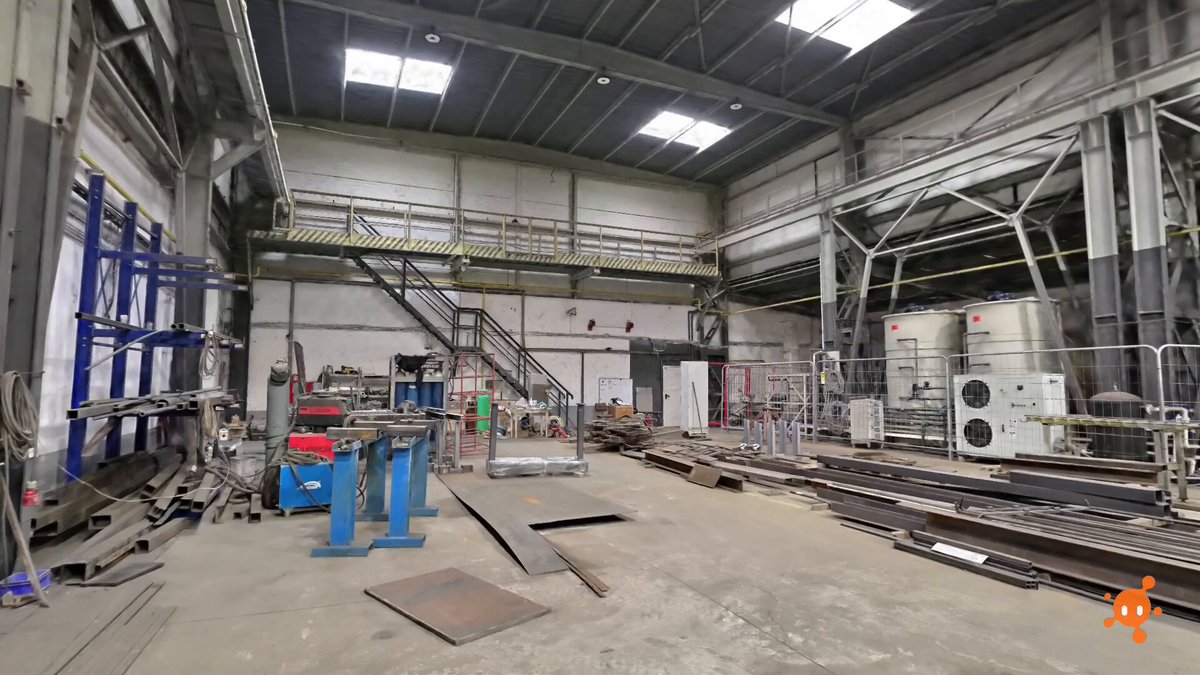
Voxel collision in SuperSplat is a game changer. 🧊 It turns any Gaussian splat into accurate 5 cm voxels, automatically. It's super-compressed and far more efficient than a mesh, yet solid enough to climb stairs and walk crossbeams. Free & open source from @playcanvas 👇 https://t.co/V5cIk3cUfc

A technical explanation of the AI intelligence layer: what it is, how it differs from connector platforms, ETL tools, and BI dashboards, and why it exists as a distinct software category.
AI designs a validated M5Stack parts list and a wiring diagram from your idea. Edit it, get build steps, and share.