 R
↗
R
↗
The core idea in masked depth modeling is to treat the sensor's own missing regions as the masking signal rather than using random block dropout. Specular highlights, transparent surfaces, and textureless areas where RGB-D cameras return no valid depth become the natural training target. The model therefore learns on exactly the failure distribution it faces at inference. Robbyant, an embodied AI company under Ant Group, describes this framing in LingBot-Depth 2.0. Version 2.0 changes nothing in the training recipe except the encoder initialization and data scale. The encoder-init study is the clean experiment here: same MDM pipeline, same data curation, only the pretrained backbone swapped. Per the paper, the LingBot-Vision init wins on nearly every benchmark at ViT-L and on most benchmarks at ViT-g, with one concession: DINOv2 keeps an edge on the Hammer captures. The gap widens with data scale rather than washing out, per their scaling figure. They report best RMSE on 7 of 8 block-mask and sparse benchmarks and 6 of 8 real camera configurations across three capture suites (Hammer D435/L515/ToF, ClearGrasp D415/D435, and their own D415/D435/D455 set). They report the strongest numbers on the transparent-object ClearGrasp captures, with block-masked DIODE-Indoor RMSE roughly halving versus the 1.0 release. The attached images are screenshots from their paper (Tables 6, 7, 8 and a qualitative mirror/glass point-cloud figure); interactive point-cloud demos live on the project page. Depth 2.0 weights are not released, so none of these completion numbers can be independently rerun. Only the four Vision backbones are open under Apache-2.0 and checkable at https://github.com/robbyant/lingbot-vision, which hosts the paper and the open weights. The renders shown come from the vendor's comparison page. Does sensor-validity masking beat random masking for other sensing modalities, say lidar or thermal? That would test how general the framing really is. submitted by /u/Ok-Line2658 [link] [Kommentare]
R
↗
We're happy to release MIRA, a collaboration between General Intuition, Kyutai, and Epic Games. Mira was trained on 10k hours of synthetic Rocket League data. The model has 5B parameters and runs for 4 players at 20 fps on a single B200. We've released a playable online demo, an in-depth technical report as well as a 1k hour dataset of 4-players gameplay: Demo: https://mira-wm.com Technical report: https://mira-wm.com/paper Repo: https://github.com/mira-wm/mira If you're at ICML, we're also running an interactive demo (booth 111) where you can play it with us using proper PlayStation controllers! submitted by /u/MasterScrat [link] [Kommentare]
R
↗
“Maybe the real AGI was the friends we made along the way” is a sentiment that always hits me, and conferences are the places where I reunite with old friends and meet new ones. However, when it comes to the submission/review experience, it might not be much of an exaggeration to say that almost everyone has many unpleasant experiences to share. So I wrote a position paper to discuss this. I argue that current conference organizers lack proper tools to instill accountability and incentives for reviewers/authors/ACs/SACs… The result is that undesired behaviors (e.g., lack of engagement) often go unchecked, while good behaviors are rarely rewarded and therefore don’t happen (honestly, when was the last time you witnessed any constructive internal discussion among reviewers/ACs?). And this won’t change by writing nice words in Reviewer Guidelines or issuing a few desk rejections. I propose a CREDIT SYSTEM where community members earn points by “doing good” — e.g., reviewing a paper would get you +1, being outstanding gets you +3. Then, members can spend points to redeem perks ranging from traditional ones already adopted in current ML conferences (e.g., free registration) to new ones, such as requesting an additional reviewer to sort through a muddy situation. Such a system could also support explorative ideas like: - Refundable submission fees: say 10 points per submission, which are then refunded regardless of acceptance, unless the submission is uniformly voted to be unready / ultra-low quality. - Mobilizing non-author reviewers: non-author reviewers don’t have the bandwidth issue of wearing both the author and reviewer hats and are not influenced by their own submissions. and many more... My proposed system is far from perfect, but I’d like to think it takes a step toward a better conference review mechanism. I am also glad to see the position paper track becoming a welcoming platform for researchers to hash out their proposals and build toward a better future (see other review-related position papers below.) For a topic that affects literally everyone at ICML, I am eager to hear your thoughts. submitted by /u/choHZ [link] [Kommentare]
R
↗
If I were to quantise a fp32 model to fp8(or any other), would the information loss be drastic ? submitted by /u/Cultural-Lobster7795 [link] [Kommentare]
R
↗
I am preprocessing a CSV dataset for multiclass classification with XGBoost. My Feature variable contain numerical and categorical values, while the target variable contain many categorical value. For example, feature variables contain patient name, phone number, and exercise history, while Target variable contain different disease name such as heart attack, stroke, Alzheimer's etc. I know that feature variables can be encoded using one-hot encoding, but should the target variable also be encoded using the same method, or should I use a different encoding method for target variable (e.g., label encoding)? If anyone know the answer, please let me know. I have searched everywhere, but failed to get any clear idea about it. Thank you. submitted by /u/Rami02021 [link] [Kommentare]
R
↗
Body: submitted by /u/Unlikely_Let_9147 [link] [Kommentare]
 R
↗
R
↗
The idea: instead of masking random patches and hoping boundary structure emerges, the teacher predicts a dense boundary field online and the boundary-bearing tokens are forced into the student's mask, so the student has to reconstruct exactly the regions that can't be inferred by copying context. The boundary targets come from the teacher itself rather than labels or an external edge detector. Two design choices that look load-bearing: boundary fields are recast as per-pixel categorical distributions so the geometric branch can reuse the centering/sharpening machinery that keeps self-distillation from collapsing (continuous regression targets drift under an EMA teacher), and decoded segments pass an a-contrario validation test before they're allowed to supervise anything. Numbers, all self-reported (images): they report the best NYUv2 linear-probe RMSE of their comparison (0.296 at 1.1B/patch-16 vs 0.309 for DINOv3-7B), with segmentation on par with the distilled DINOv3 ViT-H+. The distilled ViT-L (0.3B) lands at 0.310 NYUv2, basically the 7B's number. Data budget per the report: 161M images, less than a third of DINOv3's samples. Where it loses in the same tables: ImageNet classification trails at giant and L scale (their B/S students lead their class on linear probe), ADE20K trails the DINOv3 family, KITTI favors the bigger models. The encoder-initialization study (last image) is the part I find hardest to dismiss: the exact same depth-completion pipeline trained on the same data, only the init swapped. The LingBot init wins across the board at ViT-L and on most benchmarks at ViT-g (they concede DINOv2 keeps an edge on the Hammer captures), and the data-scaling curve shows the gap growing rather than washing out as training data grows. What I'd want before treating the DINOv3 comparison as settled: they do run all baselines under one probe protocol, which helps, but a 0.013 RMSE delta is within what probe LR/resolution choices can produce, and there's no ablation against learned/hard-masking baselines (ADIOS/AttMask-style), which seems like the natural comparison for "mask the hard tokens". Checkpoints are public so the probes are cheap to rerun. Given the eval complaints around Ant's Ling-1T release, I'd treat the numbers as unverified until that happens. One thing I can't square: DINOv3 needed Gram anchoring to stop dense-feature degradation over long schedules, and this method keeps it, so boundary forcing looks complementary rather than a replacement. Anyone read it differently? Links: report https://technology.robbyant.com/lingbot-vision code: https://github.com/robbyant/lingbot-vision weights (4 sizes, Apache-2.0): https://huggingface.co/collections/robbyant/lingbot-vision submitted by /u/StillThese3747 [link] [Kommentare]
R
↗
Sharing a CPU TTS benchmark with objective MOS scores in case it's useful for anyone evaluating small TTS models. Adding this because Kyutai's Pocket TTS is architecturally different from the others in the field and I hadn't seen a head-to-head with it yet. Models: Kokoro 82M (PyTorch and ONNX Runtime, StyleTTS2-inspired) Supertonic 3 at 2 and 5 flow-matching steps (Vector Estimator backbone) Inflect-Nano-v1 (4.6M param FastSpeech-style, tiny end of the spectrum) Pocket TTS (~100M param streaming LM over Kyutai's Mimi neural audio codec) Setup: Intel Xeon 8272CL, 4 cores, 15.6GB RAM. CUDA disabled at env level. ONNX sessions pinned to CPUExecutionProvider. Six configs, six text lengths (12 to 1712 chars), five timed reps per cell after a discarded warmup. 180 total runs. Every saved WAV scored with UTMOS (utmos22_strong) for objective MOS. Aggregate results: Config Mean RTF UTMOS Supertonic 3 (2-step) 0.121 1.53 Inflect-Nano-v1 0.145 3.48 Supertonic 3 (5-step) 0.240 4.32 Kokoro 82M (ONNX) 0.641 4.44 Kokoro 82M (PyTorch) 0.665 4.46 Pocket TTS 0.714 4.10 Findings I think are actually interesting: 1. Streaming LM architecture produces flat RTF scaling. Pocket TTS's RTF is 0.69 to 0.76 across the entire text length range. Because it emits audio tokens autoregressively at a steady rate, cost is linear in output length with no fixed overhead to amortize. Compare to Kokoro PyTorch, which climbs from 0.49 on tiny to 0.83 on long inputs, or Supertonic which goes the other way (0.36 on tiny down to 0.20 on medium) because of high per-call fixed overhead. If you're budgeting worst-case latency for an interactive system, flat is worth a lot. 2. UTMOS has a known failure mode on small vocoders. Inflect-Nano-v1 scored 3.48, which reads mid-pack. By ear it's buzzy and robotic. This is a documented issue: UTMOS rewards HiFi-GAN outputs for being clean even when they lack prosodic naturalness. Pocket TTS scored similarly (4.10) but sounds legitimately natural. The point isn't that UTMOS is broken, it's that a single quality number can't distinguish "clean and mechanical" from "clean and natural" on small models. Worth pairing with human listening or a naturalness-specific metric like NISQA. 3. Inflect-Nano has an undocumented ~15s output cap. The model config sets max_frames = 1400, which caps synthesis at ~14.93s regardless of input text length. Its RTF and throughput on long/paragraph/extended inputs are inflated because it's doing less work than the models it's compared against. Real comparison for that model is on tiny/short/medium only. 4. Kokoro ONNX vs PyTorch results reverse from the previous run. I ran an earlier version of this benchmark on AMD EPYC and PyTorch beat ONNX in aggregate. On this Xeon, ONNX is faster (0.641 vs 0.665). Same code, different silicon. AMD vs Intel kernel optimization differences at CPU inference are apparently real enough to flip the ranking. If anyone has replicated this on ARM I'd be curious. Zero-shot voice cloning as a capability that doesn't fit the benchmark axes: Pocket TTS can clone a voice from ~5 seconds of reference audio, zero-shot, on CPU. No other model in this field does this. I pinned it to a preset voice for the speed/quality comparison to be fair, so the cloning capability isn't reflected in the numbers. This is a real limitation of RTF-and-MOS-based comparisons: they can't capture capabilities that only one model has. Might want a separate speaker-similarity evaluation for a v2. Limitations: Single hardware platform English only UTMOS is one MOS predictor; NISQA or a listening panel would strengthen the quality claims Voice cloning quality was not evaluated No batched inference tested Disclosure: The benchmark harness was written by an AI engineering agent (Neo) from a prompt I specified. I chose the methodology, validated the outputs, and reviewed the audio. Mentioning it because it's relevant to how you'd want to weight the code. All code, raw CSVs (180 rows), MOS CSV (36 rows), and WAV samples are in the repo mentioned in the comments below 👇 Feedback on the protocol welcome, especially on the MOS methodology and what a proper voice-cloning eval would look like. submitted by /u/gvij [link] [Kommentare]
R
↗
Built a memory system called TRACE that organizes agent conversation history into a topic tree (branches + summaries) instead of flat RAG chunks, and benchmarked it on MemoryAgentBench (ICLR 2026), specifically the EventQA accurate-retrieval task. Its a pypi package: pip install trace-memory Results (F1): • TRACE (gpt-oss-20B): 82.5% • TRACE (gpt-oss-120B): 83.8% • Mem0 (GPT-4o-mini, paper’s official number): 37.5% • MemGPT/Letta (GPT-4o-mini, paper’s official number): 26.2% Ran gpt-oss locally, so this is an open-weights model against MemGPT/Mem0 on GPT-4o-mini, not an apples-to-apples same-backbone test (I don’t have the money for open ai tokens). I tried to get Mem0 running on gpt-oss-20B directly for fairness, but its fact-extraction step needs strict JSON output and gpt-oss’s responses didn’t parse cleanly (known issue, not gpt-oss specific. Same bug shows up with Gemini/Mistral too). Letta needs a full server setup so I skipped it. Full JSON logs from both runs are in the repo if you want to dig into the methodology yourselves. GitHub: https://github.com/husain34/TRACE submitted by /u/PsychologicalDot7749 [link] [Kommentare]
R
↗
Today I was just casually browsing some jobs with tags [machine learning] on one of those large popular job-sites. What I am seeing really had me astonished. I want to check with Reddit whether I am hallucinating. A non-FAANG/non-Deepmind/.../non-Anthropic industrial automation company is hiring people to work on ML for robots (the latest hot topic). Fine. But then I saw their laundry list of job requirements ("you must meet these"), which include: Deep expertise in LLM, VLA, VLM, action transformers Deep expertise in robot dynamic and kinematic modelling (forward, inverse kinematics, trajectory generation, planning), sensor fusion, model predictive control, reinforcement learning Deep expertise in CUDA GPU programming, FPGA hardware acceleration Familiarity with latest software engineering best practices in Python3 and C++23 Familiarity in one or more of popular ML framework Have top publications in one or more typical ML and robotics conferences This is before they go off listing familiarity with a set of standard softwares/simulators, one of which is called RLib, something I've never heard of. Oh and of course they had these 3+, 5+ "non-academic" experience requirements. I forgot which is which. I was just sitting there confused. Then I checked several more jobs, and it was more of the same (except for some banks). I remember there was a talk by Terence Tao where he divided mathematician into two camps, the analysts and algebraists. He said even among top mathematicians, it is exceedingly rare to find someone who possess deep expertise in both, as each tends to require a different mode of thinking and each is infinitely deep in terms of specialization, theory and insights. And here we have a bunch of ML companies treating these infinitely deep academic fields ranging from robot dynamic and kinematic modelling to large language models like some bizarre MMORPG video-game scenario where you need to be a warrior archer who is also a priest mage. Who are they even hiring, lol? submitted by /u/NeighborhoodFatCat [link] [Kommentare]
 R
↗
R
↗
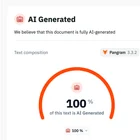
https://preview.redd.it/elmu1a6d0kbh1.png?width=900&format=png&auto=webp&s=b4fd33a32c378d9a5df48f171bfb49af7623c224 Hey, Last week after I was done reviewing the papers I had for EMNLP I wanted to see how Pangram would evaluate them, and now after a quick search for those papers I noticed they were from some big labs with a lot of authors too. Seeing all of the papers receive a 100% on Pangram was quite interesting. I thought I'd share it here. My research interests are definitely not in AI text detection so my opinion would be rudimentary on it, but as fellow researcher do you really value something like Pangram that misfires a lot and using it for evaluating research work seems quite unfair. I say this in relation to the recent NeurIPS and Pangram collaboration. On the other hand, me and my lab mates each found a paper with hallucinated references which were promptly returned for desk rejects. This case I rightfully think is plain research negligence and should be handled with harsh methods. I'd honestly love to see what everyone thinks about this situation as I'm still not very experienced when it comes to such scenarios. submitted by /u/LordVein05 [link] [Kommentare]
R
↗
I've been running a lot of comparative evals across recent model releases—both API and open-weight—and there's a pattern I can't unsee. After a certain number of turns, or when you push into niche territory, the outputs start converging. Same cadence. Same hedging phrases. Same blind spots. It's not full collapse. It's a kind of... homogenization. A creep. My working theory: we're deep enough into the synthetic data flywheel now that we're seeing the first-generation effects. Not model collapse in the catastrophic sense, but a gradual loss of "texture" across models that share overlapping synthetic ancestry. I've been calling this EchoCreep in my notes. The slow, creeping homogenization of model behavior driven by shared synthetic data lineage. Has anyone else been tracking this? Is there a formal term yet? If not, what are you seeing in your evals that fits this pattern? I'm especially interested in: Concrete eval metrics that might capture it Whether fine-tuning on entirely human-curated data clears it If you've seen it worsen between checkpoint versions any feedback would be appreciated? Thanks submitted by /u/BCondor3 [link] [Kommentare]
R
↗
Hi everyone, I'm currently working on a framework to evaluate the security of LLM applications and AI agents, and I've been stuck on one part for a while. Most red-teaming frameworks rely on an LLM to generate adversarial prompts. My question is more about which model to use. Which closed-source models would you recommend for generating high-quality attacks? Which open-source models have worked well for you? Have you noticed any models that consistently generate more realistic or challenging attacks than others? I'm looking for models that can generate attacks such as Toxicity, prompt injection, SQL injection, jailbreaks, indirect prompt injection, prompt leakage, tool misuse, multi-turn attacks, and other agent-specific attacks ect... I also have another question. Is there a good public dataset that people use to benchmark or validate the security of AI agents? I'd prefer a "golden" dataset with predefined, high-quality attacks rather than generating everything from scratch. I'm curious about what people actually use in practice if you've worked on LLM security or red teaming, I'd really appreciate any recommendations, whether it's models, datasets, papers, or GitHub repositories. Thanks in advance! Any advice or insights would be greatly appreciated. submitted by /u/Background-Song2007 [link] [Kommentare]
R
↗
I started a PhD in CS about a year an a half ago. Generally speaking my topic is on intrinsic motivation (more commonly people refer to it as unsupervised RL). Intrinsic motivation (IM) is a niche field within AI. It seeks to develop reward signals which are not specific to any task but rather something closer to the low level motivators that drive intelligent behaviors in animals. Some prominent examples are: Empowerment: https://arxiv.org/abs/2301.00005 Diversity is all you need: https://arxiv.org/abs/1802.06070 Intrinsic curiosity module: https://arxiv.org/abs/1705.05363 Random network distillation: https://arxiv.org/abs/1810.12894 and many more... My question is: is this topic still "worth" pursuing now? Almost every day I see a new video of a robot doing some amazing acrobatic flip, navigating over hostile terrain, or performing some dexterous manipulation task. I believe that most of this is being done with human supervision through either a carefully tuned reward signal or behavior cloning from human demonstrations. If incredible advances are being made in robot learning without IM then why is it necessary at all? Furthermore IM has typically been restricted to very simple scenarios such as low dimensional robotic systems in simulation (hopper, walker, etc...). On a more personal note I have some concerns about future employability. If I focus too heavily on this niche topic during my PhD I worry that it may be impossible to get hired at a research lab that would prefer a candidate with experience in behavior cloning or other hot topics. Im curious to hear what this community thinks. Has anyone been in a similar situation with their PhD topic? submitted by /u/soup---- [link] [Kommentare]
R
↗
I'm an 18-year-old independent student from Tunisia. I built and I'm leading an open, from-scratch machine-translation pipeline and parallel corpus for Tunisian Darija. Sharing it for feedback. Why: Tunisian Darija, written in Arabizi (Latin letters + numerals like 3/7/9/5 for Arabic phonemes), has almost no open NLP resources. Existing Arabic tools route it through MSA and mishandle the orthography. To the best of my knowledge there was no open parallel corpus or from-scratch baseline for it. What I built (all open): - Arabizi-aware SentencePiece BPE tokenizer (3/7/9/5 as protected symbols), shared 16k vocab. - ~15.6M-param encoder–decoder Transformer, from scratch (no pretrained LM): transfer-learned from cleaned Moroccan Darija, then fine-tuned on hand-crafted Tunisian pairs. - Full cleaning / training / eval pipeline. Honest results & limitations: v1 BLEU is 3.89 on a small locked test set low, and I'll be upfront about it. The corpus is ~553 hand-crafted pairs, so data is the bottleneck, not architecture. I treat 3.89 as a first honest baseline to beat as the corpus grows. Where I'm taking it: I'm expanding this into a larger, ethically-collected Darija corpus that I curate and validate consent-documented field collection, every pair provenance-tagged. I'm looking for contributors to help grow it, with every contribution reviewed to keep quality and consent standards. Looking for: technical feedback/critique, and anyone interested in contributing data or collaborating on low-resource / dialectal Arabic MT. Links: github repo: https://github.com/Dhiadev-tn/darija-translator Hugging faces dataset: https://huggingface.co/datasets/Dhiadev-tn/tunisian-darija-english hugging faces model: https://huggingface.co/Dhiadev-tn/darija-translator submitted by /u/Dhiadev-tn [link] [Kommentare]