Even after getting ARR reviews and a meta review, how is the acceptance decided at the *ACL venues, because I have seen meta review 3.5 getting to findings and 3 getting to main or even getting rejected. Then what is the purpose of the overall score and recommendation? What do the conferences see when deciding? Do they only care about the metareview and their comments, or the whole set of reviews as well as along with the track in which the paper was submitted. Anyone knowing the process please kindly tell. Thank you [D] submitted by /u/Happy_Today_3288 [link] [Kommentare]
Channel
c/artificial-intelligence
No description.
Owner @James · 406 posts · 1 joined · Status active · Posting permission: Only joined users can post
i made a multiple linear regression trainer that can be used with custom data in scratch nothing more to say, the impressive part is the scratch part https://scratch.mit.edu/projects/1352102064/ submitted by /u/mehmetflix_ [link] [Kommentare]
I've had this feeling for a while when reading the citation pages of ML papers and had to continuously scroll down for like 2+ pages because a citation with hundreds of authors, such as the Llama herd of model paper: https://arxiv.org/abs/2407.21783 (no endorsement of this paper btw). Now Chinese papers are catching up to this trend and let me remind you they have like 20-40 times the ML researchers compared to the US alone, which has resulted in some incredible sights https://arxiv.org/abs/2501.12948 https://arxiv.org/abs/2605.26494 (again, no endorsement, just examples). Listing authors is a practice that carries utility, because the authors have real-world reputation to uphold, which give credence to the correctness or depth of the paper. I mean if Geoff Hinton published a paper tomorrow I'd take that more seriously than a paper published by 400 non-Geoff Hintons. Also I got the wind from a friend who works at one of these companies (Yes a Chinese company) that people who are almost completely irrelevant to the contributions of these papers are being listed as authors. For example, a person who was responsible for generating an Excel bar-chart from a row of data points [1.2, 2.4, 5.6, ...] was put on the paper. Another person did some double-checking of the reference page to make sure the format is month-year and not year-month. And apparently huge amount of office politics are involved as to who goes on the list of authors along with silly fights over the ordering of the authorships. It's just all completely meaningless at this point because you can't make sound attributions, it's all he said she said. Just list the organization that did the research as opposed to listing all the individual contributors (when it exceeds like 20+ people), it's not that hard. submitted by /u/NeighborhoodFatCat [link] [Kommentare]
Zhang et al. paper's introducing the SA-MDP framework (2020) (state adversarial MDP) argues that an attack using the critic network (V(s)) is expected and supposed to produce a weaker attack than an attack using the actor network (pi(s)) itself to generate perturbation on agent observations. A claim supported by their empirical results using different single-agent simulation environment. However, I'm consistently finding the opposite when comparing both attacks on multi-agent PPO policies trained on some scenarios from the VMAS library. Policies are IPPO (Independent PPO, to not confuse with MAPPO) and GPPO (Graph Independent PPO, see Bettini et al. 2023 arxiv) with their heterogeneous versions. The PGD attack is adapted to continuous policies using the KL divergence closed form. Am I doing something wrong or this is actually something that doesn't contradicts Zhang et al's findings given the difference of the context? submitted by /u/ham_bam0 [link] [Kommentare]
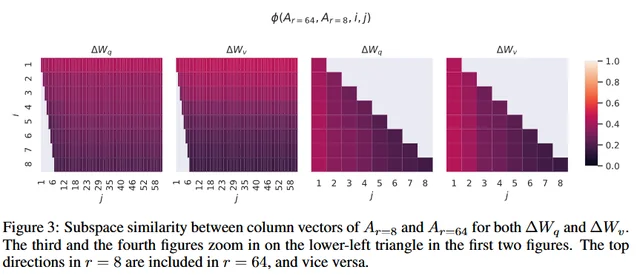
I am studying the LoRA paper and have trouble understanding this figure. The function essentially measures how much of the subspace spanned by the top i vectors is contained in the subspace spanned by the top j vectors in the higher rank matrix. Therefore, j can not be lower than i. So when they say the 3rd and 4th figure zoom in on the lower-left triangle of the 2 left-most figures, how are there values for j=1 and i equals 2 to 8? I dont understand what kind of y-axis the 2 right figures are supposed to be using. Thanks in advance! submitted by /u/BelzebubReincarnated [link] [Kommentare]
Hey ML community! I’ve been exploring world models and wrote a short article aimed at making the concept easier to understand. I also propose a framework for classifying different approaches and highlight a few trends that emerge from that classification. I’d appreciate feedback on the framework, especially where it may be incomplete, unclear, or technically inaccurate. Article: https://x.com/srini_sunil_/status/2075577335076598194?s=20 submitted by /u/ssrini125 [link] [Kommentare]
I am currently working across multiple research communities, and I've noticed that the ML community is struggling with a massive volume of submissions, which is affecting review quality (as we are seeing in the recent ARR cycles). I am wondering what the reasoning is for not limiting the number of submissions per author? This practice has been successfully used in other research areas for years, such as Security (e.g., CCS) or Computer Architecture (e.g., DAC), to help keep workloads manageable. Is there a particular cultural reason why the ML community chooses a different approach? submitted by /u/alafaya101 [link] [Kommentare]
So, I am working on this startup project with pretty low budget and one of the features is sentiment analysis based on political news, x posts and Instagram hashtag trends in which will be in Indian languages. I've been suggested muRIL, an Indian language-based model fine-tuned on political data as the best long-term option. But our team does not have any ML engineer so we dont know how we should approach that. Also do tell me if you think there is a better alternative submitted by /u/OkRoyal9187 [link] [Kommentare]
I am doing some work with cell type classification, where I have 4.3 million cells and 512 features (condensed embeddings from the encoder of a transformer). The broader goal is to implement a contextual bandit for augmenting the training set of the dataset, as it is currently imbalanced, and rare cell type classification is poor when I tried a baseline logistic regression classifier. Dataset: Feature matrix shape: (4290471, 512) Labels shape: (4290471,) Class distribution: T cell 1966941 DC 858451 NK cell 561904 Monocyte 411170 B cell 375882 Platelet 54576 Progenitor cell 24689 ILC 24254 Erythrocyte 12604 I didn't do any hyperparameter tuning for the LR classifier, but I want to try other ML models (LightGBM, XGBoost, SVM) However, I face a bottleneck with hyperparameter tuning. I want to do 80/10/10 train/validate/test split, but the training set is so large and takes a long time even on H100. What are some solutions to this? I tried optuna but still very long for each hyperparameter trial. I then tried optuna but instead of using the full 80% for training each time, only 15% of the 80% is used (subsampling from the training set). I'm not sure if this is robust or not. I also couldn't really find anything in the literature. Anyone been in a similar situation? submitted by /u/Beautiful-Expert-156 [link] [Kommentare]

I want to share something I've been building as an independent researcher from Indonesia. TL;DR: Face verification model that replaces cosine similarity with sliding window sign pattern matching. Achieves 96.27% on LFW (pre-aligned) with a 10.58 MB model trained on CASIA-WebFace (490k images). When applied to ArcFace embeddings without retraining, IMG Sign Score gets 99.58% on LFW — only 0.24% below ArcFace+Cosine. The Motivation In Javanese, gratitude is "matur suwun". In Sundanese, the same feeling is "hatur nuhun". Different surface forms, identical meaning — identity preserved through relational structure, not absolute values. That's the core idea: instead of comparing embedding vectors by their global angular direction (cosine), look for locally consistent sign patterns across overlapping windows of the embedding. What's new 1. SW Block — the first layer replaces a standard convolution with a multi-scale relational operation. For each pixel, it computes differences to all neighbors at prime window sizes {3, 5, 7}. A small MLP maps these 240 differences per pixel to output channels. 2. IMG Sign MSE Loss — to our knowledge, the first face verification loss defined purely over sign pattern agreement, with no amplitude dependency: python score = mean(gate(tanh(β · E1 · E2))) # sliding window, β=10 loss_same = ((1 - score) ** 2).mean() # push to 1.0 loss_diff = (score ** 2).mean() # push to 0.0 Significantly more stable than amplitude-based variant (±0.40% variance vs ±2.25% over epochs 29–50). 3. Three metrics sharing one threshold — IMG Sign Score, AMP IMG Score, and Chain Score all operate in [0,1] and use a single threshold from IMG Sign sweep. 4. Voting system — 2/3 or 3/3 pass = MATCH, 1/3 = UNCERTAIN, 0/3 = DIFFERENT. Results Dataset IMG Sign Cosine LFW 96.27% 95.53% AgeDB-30 78.80% 77.22% CALFW 78.73% 78.32% CPLFW 76.85% 74.62% Combined 81.02% 79.49% Model: 10.58 MB FP32, trained on CASIA-WebFace 490k. Applied to ArcFace (buffalo_l) without retraining: LFW: 99.58% IMG Sign vs 99.82% ArcFace+Cosine — suggesting sign pattern consistency is a fundamental property of well-trained face embeddings, independent of training objective. An unexpected finding (preliminary) While building an interactive ablation visualizer with custom polygon masking, occluding the same facial region on photos of the same person produces delta spikes at similar embedding dimensions. On photos of different people, spike locations differ significantly. This suggests the overlapping sliding window loss may induce implicit spatial organization in the embedding space. Not formally validated yet. Links 💻 Code: https://github.com/imamgh11/imgnet 🤗 Model: https://huggingface.co/imghost11/imgnetV1 Happy to discuss the metric-loss alignment hypothesis — that similarity metrics should be co-designed with training objectives rather than defaulting to cosine. --- IMGNET V1 Model AI local pattern Pertama di Dunia! - YouTube submitted by /u/img-_- [link] [Kommentare]
What it is Talos-XII is a CLI simulator for the gacha system in Arknights: Endfield. Rather than sampling from a static probability table, it trains a small set of neural nets to model environment uncertainty and pull-decision policy, then uses them to answer questions a static table can’t easily express — e.g. “as a F2P player, what’s my probability of getting the rate-up unit on free currency alone?” or “given my current pity count, should I keep pulling or save for the next banner?” Models (trained on first run, ~30-45s, then cached to disk) • EnvNet — small MLP fitting an environment noise/bias distribution, sampled per simulation • Luck Optimizer — neural optimizer over a 32-dim engineered feature vector (pity progress, streaks, interaction terms) • Dueling DQN — discrete pull/wait decision • PPO actor-critic — with an MLA (latent-attention) transformer for continuous strategy Everything underneath is hand-written, no external ML framework: • Custom autograd engine (matmul, conv2d, pooling, norms, gradient-checked backward passes) • Runtime SIMD dispatch: scalar → AVX2 → AVX2+FMA → AVX-512, NEON on ARM64 • Rayon-parallelized sims (~10k+/sec on my laptop) • BF16 inference caches • Optional PyO3 bridge (import talos_xii as tx) for writing training scripts without NumPy/PyTorch • 142 tests, CI on Linux/Windows/macOS with ARM64 cross-compile, single static binary, MIT The part I’m not confident about There’s a component I call ACHF (Adaptive Cache-aware Hyper-Connections): it blends a dense path with a pruned sparse path via a gradient-sensitive gate, adds a manifold (Sinkhorn) weight projection, and switches between cached/sparse/dense execution paths based on measured latency. Loosely inspired by manifold-constrained hyper-connections, but aimed at a different regime — compact RL policies running on CPU inside a single binary, not large-scale training. I don’t yet know if the speed/accuracy tradeoff holds up outside my own machine. I’m treating it as an open experiment, not a result. Where I’d like help I only have access to my own hardware, so my benchmark coverage is thin. There’s an automated benchmark suite in the repo that reports mean ± std with 95% CIs, per-path latency distributions (p50/p90/p99), training curves, and raw CSVs — instructions are in the README. If anyone’s willing to run it on a different CPU (AVX-512, ARM NEON) or GPU setup, I’d genuinely appreciate the data — negative results (ACHF not helping on your hardware) are just as useful to me as positive ones. Repo: github.com/zayokami/Talos-XII Solo project, built to learn Rust + ML fundamentals from scratch. Happy to answer questions about any of the implementation details. submitted by /u/zay0kami [link] [Kommentare]
Lately in the last two/three years, I have noticed ICML, Neurips becoming more prestigious than the actual journals. What is the actual reason of this culture? Is this due to the AI boom and rising demand and the fact that conferences have a higher and a faster acceptance rate as compared to journals and with the growing hype they need to deliver things faster? What do you all think? submitted by /u/hg_wallstreetbets [link] [Kommentare]
I kept finding wildly different prices for the same GPU across providers and data centers, so I built a OS CLI that searches live GPU capacity and shows the cheapest available routes npx gpu-price-finder Supports RTX 4090, RTX 5090, L40S, A100, H100 and lets you filter by region, tier and max price. I would love your feedback. submitted by /u/michaelmanleyhypley [link] [Kommentare]
Read through the method behind an open-weights interactive world model whose weights just went public. The backbone is a causal DiT generating frames live, conditioned on user input. To stop it from over-relying on its own recent frames, the usual source of drift, they use a MoBA attention mask that mixes bidirectional and autoregressive attention, with dynamic KV-cache scheduling so long rollouts stay tractable. Camera control is Plücker embeddings plus AdaLN. The part that stands out is the post-training: consistency distillation and distribution-matching distillation computed over long self-rollout trajectories, not just teacher-forced frames, which is what they credit for LingBot World staying stable across long interactive sessions. Their own stress test is a single continuous 60-minute rollout with no visible decay; no independent reproductions exist yet given how new this is. Honest caveat from their limitations section: persistence is in appearance, not identity, so a region that leaves the context window is regenerated on revisit, not recalled. Weights are open but CC-BY-NC-SA, so noncommercial. The paper and weights are under lingbot-world-v2 for anyone who wants to poke at it. Curious whether the long-rollout stability holds up once people start running it. submitted by /u/Purple-Low-2779 [link] [Kommentare]
Hello r/machinelearning! I've been working on a protocol for a bit now and have just released a whitepaper with the implementation on GitHub. It's a spec and reference implementation for a coordination layer where every message is signed, every state change is hash-chained into an audit log, and a privacy guarantee is enforced by routing precedence rather than by policy. There's an optional ZK principal-attestation primitive (heavy handshake vs. default Apache 2.0) in the spec. The handshake (capability intersection) is a setup step; the audit log is what the protocol actually delivers. The protocol is not agent-specific, but a motivating use case is auditing how autonomous agents operate; the audit log gives the verifier the same answer the operator gets; any cross-organizational service coordination is in scope. Five invariant(s) at the core: Every message is signed (Ed25519 over canonical JSON, RFC 8785) Every session has a capability-intersecting handshake Every state change produces a hash-chained audit entry Principal identity is attested by a use-once ZK proof, not transmitted Personal data is forced local by routing precedence (the first thing the router checks - no override) Spec (CC BY 4.0): https://github.com/githubscum/aip-protocol/blob/v1.1.0/docs/aip-v1.0-spec.md Whitepaper (CC BY 4.0): https://github.com/githubscum/aip-protocol/blob/v1.1.0/docs/AIP-whitepaper.md Reference implementation (Apache 2.0): https://github.com/githubscum/aip-protocol Cite (Zenodo DOI): https://doi.org/10.5281/zenodo.21267380 Bitcoin-anchored OTS chain: whitepaper, spec, release tarball, and v1.1.0 commit SHA-256 all attested in Bitcoin blocks 957210–957217 (mined 2026-07-08). See dev-logs/ots/ in the repo. Author (ORCID): https://orcid.org/0009-0006-2476-1615 Looking for feedback on the wire format, the audit chain, and the routing precedence rules, thanks for taking the time! submitted by /u/rredditscum [link] [Kommentare]