Hi all, A real story from my current experience: I'm associated with an internship where the primary work revolves around autonomous UAVs. What has shocked me the most is that almost everyone is so heavily focused on coding agents and AI tools that they're building things without paying enough attention to the fundamentals. This got me thinking: what if we conduct a virtual session on the fundamentals of Computer Vision? This idea comes from my own experience as well. During my first semester, I was terrified of learning from documentation and kept chasing YouTube tutorials instead. Later, I realized that some of the most interesting and valuable concepts are actually explained in the documentation itself. What do you all think about conducting something like this? How many of you would be interested in joining a one-day session? submitted by /u/FishermanResident349 [link] [Kommentare]
Channel
c/artificial-intelligence
No description.
Owner @James · 421 posts · 1 joined · Status active · Posting permission: Only joined users can post
Hey everyone, I am planning out a new open-source infrastructure project and want to get some brutal feedback on the architecture and use-case validity from people running high volume LLM workloads in production. The Problem: Python-based proxies/gateways introduce too much latency overhead for real-time streaming agent steps or fast UI completions. Additionally, centralized semantic caching still suffers from cross-region network latency (e.g., London to us-east-1), and enterprise API costs remain a massive bottleneck for repetitive/predictable user queries (like customer support or structured data extraction). The Proposed Architecture: Instead of a heavy centralized gateway, the goal is to build a lightweight, zero-dependency semantic cache running directly at the CDN Edge using WebAssembly (WASM) compiled from Rust. The flow looks like this: Inbound Prompt: Hits the edge node closest to the user (e.g., Cloudflare Workers / Fastly Compute). Edge Embedding: The Rust/WASM module intercepts the raw text prompt and instantly generates a vector using an edge-native lightweight model (e.g., bge-small-en-v1.5). Similarity Index Check: It performs a fast cosine similarity check against an edge vector database (like Cloudflare Vectorize) to find the nearest semantic neighbor. Cache Hit: If similarity >= threshold (e.g., 0.88), it pulls the full generated response text from an edge KV store and returns it in ~5ms. The main LLM provider is never billed or touched. Cache Miss: It proxies the streaming request to OpenAI/Anthropic/vLLM, streams it back to the client, and asynchronously updates the edge vector index and KV store. Why Rust/WASM? To achieve sub-millisecond execution overhead on the proxy itself, avoid garbage collection pauses, and maintain a tiny memory footprint suitable for edge runtime constraints where traditional databases or Python scripts cannot run. My Questions for the Community: For those running LLMs in production (especially customer support, internal RAG, or autonomous agents), what is your realistic semantic cache hit rate? Is the power law of repetitive queries high enough in your domains to justify this? What are the biggest footguns with semantic caching at the edge? (e.g., Cache invalidation strategies, handling system prompt updates, or drift in embedding models). Would you actually use a drop-in open-source template/CLI that lets you spin this up on your own edge account, or do you prefer centralized API gateways? submitted by /u/Real-Huckleberry-934 [link] [Kommentare]
I've written a C++ implementation of distilHuBERT. https://github.com/pfeatherstone/hubert.cpp It has no runtime dependencies, the weights are compiled into the library, it supports dynamic sizes, has performance on par with onnxruntime (in my tests) and can be easily integrated into any CMake project. Please let me know your thoughts. submitted by /u/Competitive_Act5981 [link] [Kommentare]
Results are almost here. Good luck to everyone waiting for the final decision 🙂 submitted by /u/Sea_Muscle_4281 [link] [Kommentare]
https://preview.redd.it/wsq4fyhpzr6h1.png?width=745&format=png&auto=webp&s=7ade94f5852667bf6a820398e3fcf8dcb0d450af submitted by /u/HitarthSurana [link] [Kommentare]
“…5 papers at ICML (1 Spotlight)…” “…Five ICML papers is what a strong PhD produces in four years. I did it in five months…” I recently saw these posts from people at the same AI company. At first, I was extremely surprised. It turned out they were workshop papers. Am I missing something here, or are workshop papers now being treated as equivalent to main-track papers? submitted by /u/Terrible-Chicken-426 [link] [Kommentare]
Are there any websites listing post-doc job opening in machine learning? Currently I'm using LInkedIn to search for these. When I was a math post-doc, everyone used "MathJobs.org" to find jobs. Is there a similar website for machine learning? Thanks. submitted by /u/random_sydneysider [link] [Kommentare]
Dear Folks, I have created multiple content on Machine Learning(work in progress), and they are free. I am a data scientist and a post grad degree holder in AI/ML from IIT. To help the machine learning community with important Machine Learning Concepts, I have created multiple long form videos, and structured topicwise digestible contents structured as playlists for learning. If you go through the first two playlists: Introductory Machine Learning Concepts Probability Foundations: Univariate Models You might find helpful content, I have tried explaining with intuitions, derivations, and this is work in progress. For code implementations, scikit learn website has great content on them as well. In total they have 60+ topicwise videos so far, and I think they have the potential to help folks a lot in starting with concepts, or getting with mathematical concepts, or whether you are preparing for an AI/ML/Data job interviews etc. When I sat for my interviews, I was grilled on my project, but majority of questions from my project tested more on foundational concepts and there know how’s. These are FREE content on youtube. This is for the benefit of the learning community. Link: https://youtube.com/@aayushsugandh4036?si=w5MKORU2fWzLRrAJ submitted by /u/Negative_War_65 [link] [Kommentare]
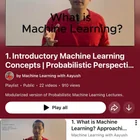
Dear Folks, I have created multiple content on Machine Learning(work in progress), and they are free. I am a data scientist and a post grad degree holder in AI/ML. To help the machine learning community with important Machine Learning Concepts, I have created multiple long form videos, and structured topicwise digestible contents structured as playlists for learning. If you go through the first two playlists: Introductory Machine Learning Concepts Probability Foundations: Univariate Models You might find helpful content, I have tried explaining with intuitions, derivations, and this is work in progress. For code implementations, scikit learn website has great content on them as well. In total they have 60+ topicwise videos so far, and I think they have the potential to help folks a lot in starting with concepts, or getting with mathematical concepts, or whether you are preparing for an AI/ML/Data job interviews etc. When I sat for my interviews, I was grilled on my project, but majority of questions from my project tested more on foundational concepts and there know how’s. These are FREE content on youtube, and hope it benefits and helps the ML community. submitted by /u/Negative_War_65 [link] [Kommentare]
I use Claude Code, Codex CLI, OpenCode, Cline, Cursor, and Amp enough to notice a pattern in how they handle long context. They are all converging on layered progressive compression, but they disagree on what to protect. Most protect recent user messages as a first-class asset. That makes sense. The user said it, which is the source of truth. Most also protect tool outputs that carry state. What surprised me was how differently they treat old assistant messages. Artifacts keeps recent tool calls verbatim but drops older context aggressively. Cursor starts pruning earlier design decisions once the window gets full. Codex CLI lets the model itself decide what to keep in the summary tier. The other axis is transparency. Do you tell the model it was compressed? Some systems silently replace old tool results with a placeholder, which means the model is reasoning under the illusion that it never happened. Others make it explicit: "the previous 40 tool calls are summarized below." I lean explicit because the model needs to know its own context was degraded. Verdents agent loop uses a similar tiered approach: snip first, prune second, summarize last, and a hard red line that protects user messages, stateful tool outputs, and anything the user explicitly flagged. The tradeoff is cost vs accuracy. Aggressive compression saves tokens but degrades the plan. Under-compression hits the window and causes context rot. submitted by /u/Direct_Band896 [link] [Kommentare]
I've been teaching myself about Symbolic Regression (SR), which looks like a super exciting field. (A great intro resource below [1]). But then I was wondering: given LLMs' increasingly-growing power in generating code, which is in a way very similar to Symbolic Regression (or of course, even directly tackling symbolic regression tasks), are existing SR techniques dead? Happy to hear your thoughts. [1] ETH Zürich AISE: Symbolic Regression and Model Discovery - YouTube submitted by /u/omomom42 [link] [Kommentare]

as in the title, my goal is to predicting failure and RUL of machine, dataset is timestamp and when machine is failure it will labeled with 1 that only have 56 https://preview.redd.it/plbydmenmm6h1.png?width=1205&format=png&auto=webp&s=2fefe3cc2e3fe554b81c9e0b4012c5345e73ec3f From this data im ditching operating hours and humidity because it didnt show correlation for machine failure, what algorithm or deeplearning suit for it? submitted by /u/False-Seesaw-1899 [link] [Kommentare]
link - https://arxiv.org/abs/2606.06158 Abstract : Adaptive video tokenisation seeks to dynamically allocate token budgets based on the underlying visual complexity of a sequence. Current continuous-regime approaches achieve this via iterative binarised searches or trained neural regressors, while discrete methods often require a full-rate decoder pass to estimate information content. We demonstrate that such computational overheads are not strictly necessary. We show that the latent space of a frozen continuous video tokeniser inherently encodes temporal redundancy that can be exploited directly: spatial positions whose latent representations change minimally between consecutive frames carry near-zero additional information. We introduce a parameter-free adaptive token allocation mechanism that applies a fixed threshold to per-position temporal-L1 differences, identifying and dropping redundant latent positions. Consequently, the compression rate emerges naturally from the input content rather than being enforced top-down: static scenes get compressed aggressively, while highly dynamic sequences retain more tokens. To reconstruct the dropped positions, we propose the Latent Inpainting Transformer (LIT), a lightweight factorised spatial-temporal attention architecture. The resulting inference pipeline is highly efficient, requiring only a single encoder pass and one LIT forward pass, eliminating the need for auxiliary routing networks. Evaluations across TokenBench and DAVIS, which are the standard benchmarks used by recent tokenisers, indicate that our framework yields meaningful, content-driven token allocation while maintaining competitive reconstruction fidelity, and delivers a 31x inference-time speedup over the continuous adaptive baseline (ElasticTok-CV) and an 2x speedup over the discrete information-theoretic baseline (InfoTok) submitted by /u/chhaya_35 [link] [Kommentare]
ACL ARR May 2026 reviews are due on July 2. I do not see any reviewer assignement as of today. Will the review period be just 2 weeks in that case? Anyone got papers assigned for reviewing? submitted by /u/Impossible-Garden612 [link] [Kommentare]
From Wired: “We’re changing Fable 5’s safeguards for frontier LLM development to make them visible.” Anthropic said in a statement to WIRED. “We made the wrong tradeoff and we apologize for not getting the balance right.” Anthropic now says it’s changing course, and that Claude Fable 5’s safeguards for AI development will be visible to users. If the company suspects a user is trying to use Claude to build a highly capable AI it will alert them that it’s either refusing the request, or rerouting the user to a less capable model. Full article: https://www.wired.com/story/anthropic-responds-to-backlash-on-claudes-secret-sabotage-on-ai-research/ submitted by /u/goldcakes [link] [Kommentare]