I noted that in ICML 2026, quant firms are flocking and sponsoring as Diamond sponsors. Any reason? Source: https://icml.cc/sponsors/sponsors-list?year=2026at submitted by /u/Intrepid_Discount_67 [link] [Kommentare]
Channel
c/artificial-intelligence
No description.
Owner @James · 423 posts · 1 joined · Status active · Posting permission: Only joined users can post
I have a main paper in ACL and a workshop paper in ICML. I'm looking for jobs in U.S. as a graduating student. Would it be worth going to ICML after ACL presentation such that I have more chance to network? ACL is in San Diego and ICML is in Korea, if it changes things. submitted by /u/Appropriate_Willow27 [link] [Kommentare]
Does anyone know when is the ICML poster deadline? It says it’s tomorrow but is it AoE? submitted by /u/misplacedlion [link] [Kommentare]
Hey everyone, I built an open-source full-stack pipeline (Django + React) that constructs a Knowledge Graph from raw text, detects thematic communities, and uses hybrid search to solve the "lost in the middle" problem in standard vector retrieval. The Pipeline: Ingestion & Chunking: Raw text is cleaned, parsed, and split into overlapping chunks to preserve local context. Graph Construction: spaCy extracts named entities from each chunk. A weighted co-occurrence graph is built using NetworkX, mapping which entities appear together and linking them to their source chunks. Community Detection: The graph is partitioned into thematic clusters using greedy_modularity_communities. For each cluster, random text chunks are sampled and sent to an LLM to generate a high-level summary (preventing "hub node" bias). Indexing: All chunks are embedded into a dense vector store, and a sparse BM25 index is built over the same corpus. Hybrid Retrieval: On query, the system performs a dual search (Dense Vector + BM25). Simultaneously, it extracts entities from the prompt, traverses the graph for 1st-degree neighbors, and retrieves their associated chunks. Fusion & Reranking: Local and Global (community summary) results are merged, deduplicated, and scored using Reciprocal Rank Fusion (RRF). The top-K candidates are then re-scored by a Cross-Encoder for maximum precision. LLM Synthesis: The final curated context is passed to the LLM with strict prompting to generate a concise, well-structured, and cited answer. Why it works: Standard vector search fails at multi-hop queries like: Who ordered the execution of Sansa's father, and how did that person eventually die? By traversing the graph (Sansa -> Ned -> Joffrey -> Poisoning), the system bridges the gap between disconnected text chunks and synthesizes the correct answer. GitHub: https://github.com/mohammad-majoony/graphrag-studio Would love feedback! Thanks. submitted by /u/Future_Caregiver_643 [link] [Kommentare]
I’m an independent researcher currently exploring what I believe is an important phenomenon for both mechanistic interpretability and AI safety. Core idea: A strong, coherent target text can move the model into a different internal regime — before the final output is produced. The model can still appear to behave normally, follow instructions, and pass existing safety filters, yet its hidden states and residual stream trajectory are already in another region of representation space. In other words: the same question can be processed differently not just because the final text changed, but because the preceding context shifted the model’s internal state. Why this matters Current alignment methods (RLHF, system prompts, output classifiers) are essentially surface-level patches. They only look at what the model ultimately says. If the model has already entered a different latent regime, these mechanisms often miss it entirely - because they are looking in the wrong place and at the wrong time. I’ve observed this pattern across both open and closed-source models. Changing the context changes the internal regime, which in turn changes how rules, constraints, and safety policies are applied - even when no explicit jailbreak is used. The uncomfortable implication: RLHF and output-based safety are not a robust solution. They are a bandage. A sufficiently well-crafted coherent context can shift the model into a state where the same rules are interpreted and weighted differently, often without triggering any filters. Materials I’m gradually releasing everything publicly: GitHub: https://github.com/ngscode23/latent-space-shift-research Zenodo: https://zenodo.org/records/20564350 What I’ve been measuring Most of the work was done on open models (primarily Gemma-3-12B-IT) with full access to internals: Hidden-state geometry and projections Residual stream trajectories Contrastive controls (sentence-shuffle vs word-shuffle) Decomposition into content and order/processing-regime components Norm-controlled causal interventions SAE readouts and steering Generation trajectory analysis + KL divergence (including teacher-forced) Importantly, the target texts used were not direct “ignore your rules” prompts. They were dense, coherent pieces of text that established a particular discourse and thinking mode. Looking for feedback I’m particularly interested in input from people working on: Mechanistic interpretability Residual stream / activation engineering Sparse Autoencoders (SAE) Agent safety and hidden-state monitoring I’m not looking for applause. I want sharp criticism: where my controls are weak, where the interpretation might be wrong, what I should measure next. In short: I’m not studying how to bypass filters. I’m studying the possibility that filters often don’t see the real problem - because the shift happens before the filtered output is produced. If this resonates with your work, I’d be grateful for any thoughts, references, or review of the evidence. If you’re interested in looking at the data (including raw .npz files with hidden states), scripts, or metrics - feel free to reach out. I’m happy to share materials with serious researchers who want to review, replicate, or extend the work. submitted by /u/PresentSituation8736 [link] [Kommentare]
Hello everyone! I am trying to figure out if a main conference registration gives you access to the expo (companies booth) and the expo talks? Expo are happening on July 6th the same day as tutorials. But for tutorials you need to be registered. Do you also need to have a tutorial registration to be able to visit companies booth? Looked on the icml webpage but couldn’t find anything definitive( I did require a free expo badge when I registered ) Thanks submitted by /u/DazzlingPin3965 [link] [Kommentare]
We recently presented a paper at ACM CAIS 2026 on safety evaluation for tool-using LLM agents. The core issue is that task completion alone can be misleading: an agent may complete a task while violating a safety or policy constraint. We separate outcomes into safe success, unsafe success, and failure, and study how verification changes this tradeoff. We evaluate this using τ-bench / Tau-bench tool-use scenarios and propose a two-tier verification architecture: deterministic policy/tool checks first, followed by an LLM-based verifier for more contextual safety cases. The main finding is that verification can reduce unsafe success, but it can also reduce task completion as the task horizon increases. This creates what we call the Verifier Tax: a horizon-dependent safety–success tradeoff in tool-using agents. Paper: https://dl.acm.org/doi/full/10.1145/3786335.3813160 Curious how others think agent evaluations should report unsafe success. Should unsafe completion be counted as success, failure, or a separate category? submitted by /u/AccomplishedLeg1508 [link] [Kommentare]
Hi everyone, I’m building an open-source machine-learning tutorial repository in Jupyter Notebook format: https://github.com/mohammadijoo/Machine_Learning_Tutorials The course is bilingual: English and Persian/Farsi versions are organized in parallel. The goal is to make a practical, notebook-first ML curriculum that students can run locally and study step by step. Current focus areas include: ML foundations and workflow data cleaning, preprocessing, feature engineering regression and classification tree models and ensembles clustering and dimensionality reduction evaluation, cross-validation, calibration time series, anomaly detection, responsible ML, and MLOps concepts datasets and exercises for hands-on practice I would appreciate feedback on: whether the chapter order makes sense for beginners what important classical ML topics are missing whether bilingual notebooks are useful for non-native English learners how to make the notebooks more practical without turning them into only “copy/paste code” I’m sharing this as a free educational resource and would value constructive criticism. submitted by /u/abolfazl1363 [link] [Kommentare]
I'm working on a paper and would love some input on model choice. Suppose you're trying to detect a specific type of cancer, but the negative samples are visually and morphologically very similar (i.e., “mimics” of the cancer). In this setting, would it make more sense to approach the problem as: Anomaly detection (treating the cancer as the target distribution and everything else as out-of-distribution), or Supervised classification (explicitly learning to distinguish cancer vs. mimics)? submitted by /u/DryHat3296 [link] [Kommentare]
Upfront disclosure: this is my write-up (and I'll link it below), but laying out the argument here so you can strawman/steelman it without clicking anything. Assertion 1: per token price is the wrong metric for measuring the cost of work done by LLMs/reasoning models. Users get charged the per token price regardless of whether the output/outcome was right or not. Assertion 2: real work lives in long chain processes. Reliability of agents (run through LLMs) drops geometrically in proportion to chain length. 95% per step accuracy translates to 77% process reliability for a 5-step process, 60% for 10, and under 36% for a 20 step process. This calculation holds if errors are independent, which isn't true for real world processes, ergo real world reliability is worse than that. This adds a verification tax on top of the price of tokens the user pays. You can verify through human intervention, inference time compute (less reliable than human intervention), or swallow the decay in reliability. Argument: granted 1 & 2, you can't reliably automate any meaningful work through LLMs/agents in a cost-effective way, because it isn't an issue of economics but of architecture (LLMs can't reason faithfully, which was my previous essay) Link: https://open.substack.com/pub/mauhaq/p/price-is-not-cost?r=7eoi8&utm_campaign=post-expanded-share&utm_medium=web submitted by /u/Sensitive_Air_5745 [link] [Kommentare]
Just thought I'd highlight this issue to the ML community, since I recently had this problem arise and it might be useful for some. I had a coauthor who I knew was somewhat untrustworthy when it came to LLM use. This coauthor added some last-minute new references to the paper. The deadline was near, and I had a ton of other stuff to take care of. I asked them to ensure the references were correct. This coauthor confirmed that all references were correct. I trusted them. I submitted the paper. Turns out, I made a critical mistake in trusting them. All of these newly added references had hallucinations in them. The reviewer pointed out the hallucinated references and we withdrew the paper. Besides this reviewer, we had all accept scores: the scientific content of our paper was strong. Of course, this damages my reputation and the reputations of the rest of the coauthors. The takeaway is: check *all* references added to the paper, unless you are absolutely certain you can trust someone to not use LLMs. Hopefully this helps someone avoid this issue, because I worked tirelessly on this paper, in a very high pressure lab environment, and this whole situation has caused me a lot of grief. submitted by /u/treeman0469 [link] [Kommentare]
Hi, About a year ago I shared my PaddleOCR implementation here. Since then I've made many improvements, and it now supports PP-OCR v3 through the latest v6 models. The official Paddle C++ runtime has a lot of dependencies and is very complex to deploy. To keep things simple I use ncnn for inference, it's much lighter (and faster in my task), makes deployment easy. Hope it's helpful to some of you, and feedback welcome! https://github.com/Avafly/PaddleOCR-ncnn-CPP submitted by /u/Knok0932 [link] [Kommentare]
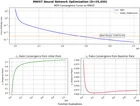
A direct optimization test was conducted on a neural network for MNIST image classification. The network features a 784-32-10 architecture with a total of 25,450 continuous parameters (weights and biases). Instead of employing backpropagation or gradient information, the parameters were optimized using MDP, a Derivative-Free Optimization method. The objective was to directly minimize the Cross-Entropy Loss on a subset of 5,000 training images. Final evaluations were performed on independent validation and test sets. In the best run, MDP achieved an objective loss of 0.0004083, a validation accuracy of 93.7%, and a test accuracy of 93.4%. These results outperform the baseline established by Adam, which achieved a final loss of 0.002945, a validation accuracy of 91.8%, and a test accuracy of 91.7% using the same network architecture. Notably, this optimization was successfully performed over a 25,450-dimensional search space, achieving convergence across 1,000,000 function evaluations without relying on gradients or population-based methods. The code for this test, along with other Python implementation examples, is available in the examples folder of the official project repository: https://github.com/misa-hdez/sgo-lab submitted by /u/Mis4318 [link] [Kommentare]
my preprint is on SSRN and i feel somewhat shy to share it here... but the PKU lab's paper that cited mine got accepted by ICML 2026: https://arxiv.org/html/2602.06358v2 submitted by /u/max6296 [link] [Kommentare]
Can anyone please guide me on how to prepare for Amazon ML Summer School? I’m quite confused about where to start and what topics are most important for the selection process. Any tips, resources, or preparation roadmap would be really helpful. Thanks! submitted by /u/addiemaddieee [link] [Kommentare]