Hi, I'm thinking of building a small community of 10-15 people where we can help each other to learn something new. The primary focus will be on ML research and open-source projects. We'll decide the direction based on the interests and ideas of the group members. If you're interested, DM me. knowledge of machine learning is a plus, as want to keep this a high-impact, collaborative group. submitted by /u/Tall-Gold-3553 [link] [Kommentare]
Channel
c/artificial-intelligence
No description.
Owner @James · 417 posts · 1 joined · Status active · Posting permission: Only joined users can post

Hi folks, Niels here from the open-source team at Hugging Face. I continue working on a revival of paperswithcode.co as we're back to the "age of research" per Ilya Sutskever! Hence, it's important to discover each other's research and build on each other's work, so we can collectively build the next Transformer. Below, I'll go over each of the new features that were recently added. ## Support for SOTA badges Yes, that's right, totally like the old website. You can see that GLM-5.2, for instance, is obviously the hottest blog post today, achieves SOTA on PostTrainBench, and performs well on many other benchmarks. It is displayed whenever a paper gets a score within the top 3 of a given benchmark. Note that these are displayed on any paper feed, including https://paperswithcode.co/tasks/video-classification, for example. https://preview.redd.it/wawma8paeu8h1.png?width=2418&format=png&auto=webp&s=0ba3b6a0eaef231b7f3ca468cc3db4120f1b9e4d ## New trending score The papers are now ranked based on a new trending metric. This is a combination of the GitHub star velocity and the trending score of the linked Hugging Face artifacts (models, datasets, and Spaces). Previously, this only took into account GitHub star velocity. Thanks to this, papers like IndexCache are now trending, which is a core technique behind the trending GLM-5.2 model. https://preview.redd.it/b6g04w2ogu8h1.png?width=2380&format=png&auto=webp&s=13d59bbadd5f8e8295deac2ee6e1e0e3dbc0f40f ## Support for external evals Second, I've added support for "external" evals. This is a feature the legacy PwC website didn't actually have. Oftentimes, a paper has way more evals than the ones introduced in the paper itself. You can now view these third-party evals. Some examples: FrontierSWE and PostTrainBench numbers for GLM-5.2: https://paperswithcode.co/paper/98456#results?task=agents Artificial Analysis has numbers on CritPt, a though physics benchmark. See e.g. https://paperswithcode.co/paper/85629#results?task=reasoning https://preview.redd.it/mfnfdzxpeu8h1.png?width=1914&format=png&auto=webp&s=2b909ecf7c6e3fc088fd0a46fbc56f6859dfaf17 ## More tasks, benchmarks and evals I'm adding more benchmarks and adding evals of more papers. This happens gradually, based on the legacy PwC data available on the hub. Some new benchmarks include: - ImageNet - 10% of the data https://preview.redd.it/wr55g27ofu8h1.png?width=2880&format=png&auto=webp&s=e6e5ef7e3a36cd5aa6d2841b149194239f4ad1e0 - 3D semantic segmentation: https://preview.redd.it/zxgobrnqfu8h1.png?width=2880&format=png&auto=webp&s=6ee2935981825d5d7825709294ddb84a4b7a3ac9 - object counting: https://preview.redd.it/uhv4wbrsfu8h1.png?width=2880&format=png&auto=webp&s=183decb144d9779e41bf12ca58fbaab66cd29cbf and a lot more. Browse all of them at https://paperswithcode.co/tasks ## New domain Papers with Code is now also available from paperswithco.de :) Let me know what is missing, bug/feature requests, and whether you want to contribute! Kind regards, Niels submitted by /u/NielsRogge [link] [Kommentare]
With the release of meta-reviews, ECCV sent out a google form for dissatisfied authors to submit an appeal for the following reasons: Policy errors, e.g., reviewers or Area Chairs applied a policy that does not exist, or reviewers or Area Chairs applied policies that are not applicable for the contribution type of the paper; Clerical errors, e.g., it is clear from the meta-review that an Area Chair intended to accept a paper but the paper was rejected; and Obvious and major misunderstandings on the side of the reviewers or Area Chairs (historically, these are extremely rare). Is anyone considering submitting an appeal? I was rejected with 6/4/3 final scores on criteria that policy and AC/Reviewer guidelines explicitly state my contribution type should not be penalized for. Also, according to their policies, if they were to use the criteria in their decision, they have to explicitly disagree with the declared contribution type and state so in the meta review (all three reviewers agreed with the declared contribution type and the AC does not mention changing the paper's type.) submitted by /u/Muted-Ad4511 [link] [Kommentare]
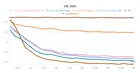
I recently revisited my matrix recurrent units algorithm (the MRU), a novel linear-time sequence architecture I created as an alternative to attention. I explain it in depth at the repo, but the gist is the MRU works by transforming the embedding into an input state matrix, cumulatively multiplying the matrices across the sequence dimension to get the output state matrix, and then transforming the matrices back into a vector. In order to make the MRU efficient on DL hardware, I created a parallel scan by utilizing the operation's associativity. About a year ago, I shared my project on Reddit (I've since renamed my account), with good results on the toy dataset shakespeare-char. A commenter asked the steps taken to bound the matrix states and another commenter found that training was inherently unstable when training on more comprehensive datasets. I addressed these by experimenting with different methods to create the input state matrix. Originally, I simply reshaped the input vector into a matrix and added the identity. Since then, I've implemented the following methods: Using the elements of the vector to fill a skew-symmetric matrix and using the matrix exponential or the Cayley Map to generate an orthogonal matrix Filling LDU factors with elements from the vector and using an activation function on D to enforce a determinant of 1. Creating QR, by using the matrix exponential or Cayley map to create orthogonal matrix Q and filling the upper-triangular matrix R. Dividing by a determinant-correcting scalar factor, found by taking the determinant. I found that these fixes prevented loss spikes with varying tradeoffs. Interestingly, the scalar factor method led to worse results. Dividing the input states should only affect the output states by scaling them, indicating that the unscaled model was "cheating" on the toy dataset by learning a simple scalar decay pattern instead of more complex relationships. Also, using the Cayley Map or matrix exponential to force the input states to be orthogonal surprisingly mostly prevented the model from learning information about the sequence, performing closer to the FFN than the Cayley QR method. The poor performance of orthogonal matrices indicates that the ability to learn shear transformations might be critical for the model. Possibly, rotations enforce dependence on the previous state, whereas shearing allows the model to adjust the state more independently of the previous state. https://preview.redd.it/9ebh98q6uo8h1.png?width=2528&format=png&auto=webp&s=03ccef7f9b90762281aba31ab88af0368e273f69 https://preview.redd.it/fkkud7q6uo8h1.png?width=2528&format=png&auto=webp&s=5e9a2ef2b0e4319990950f16aa0648adebc2c360 Above are the train loss and validation loss on the shakespeare-char dataset for a small MRU LM, transformer, and FFN, with the embedding, state, key, and value size set to 256. The MRU LM has a single MRU layer and 4 MLPs, the transformer has a single attention layer and 4 MLPs, and the FFN only has 4 MLPs. I only used a single sequence-mixing layer in order to isolate the effect of the MRU. Finally, I moved to a larger dataset, trying to replicate https://huggingface.co/roneneldan/TinyStories-33M by training a baseline GPT-2 model and a model with attention replaced with the MRU. I ended up quitting the training runs early, but the loss curves seem to already conclusively show that the MRU performs worse on this task. For the creation of the MRU's input state matrices, I used the method of creating LDU factors, since it has the best performance. https://preview.redd.it/p2uh1pyfuo8h1.png?width=2528&format=png&auto=webp&s=d6406574e0275f1aad52e89cca6462fd55116fcd Above is the validation loss for a transformer and a LM using MRU with the same hyperparameters and dimensions as the huggingface model card. The official TinyStories model was trained for 20 epochs, which corresponds to about 200k steps. In order to compare it to other linear-time models, I also briefly trained a linear transformer, using the algorithm described in Transformers are RNNs: Fast Autoregressive Transformers with Linear Attention. I think that my research shows that the MRU likely doesn't work as a direct replacement for attention for generative language modeling, but I've already laid the groundwork for this algorithm. The MRU has dramatically different strengths and weaknesses compared to other algorithms such as attention, state space models, traditional RNNs, and fast weight programmers. It performs significantly more cumulative computation along the sequence (as opposed to the computation for each token being independent), is significantly more lightweight and hence faster, but also has a much lower storage capacity. I believe that the MRU's alternative uses should still be explored. One usage of the MRU could be applying it to query and key vectors of attention. Similar to RoPE, it would rotate chunks of the vectors, but it would be able to rotate chunks in greater than two dimensions and with dynamic and non-commutative angles. This is one of many applications of the algorithm which I will continue to research, and I hope that others are interested in its applications as well. If you're interested, reach out to me at [mikayahlevi@gmail.com](mailto:mikayahlevi@gmail.com), Reddit, GitHub, or any other platform you can find me at. submitted by /u/mikayahlevi [link] [Kommentare]
Hey everyone, I’m wondering whether there are any newer or more effective methods for fine tuning whisper on domain specific speech. I’m working on a project where the model needs to reliably detect certain specific words and technical terms. The vocabulary and context are mostly in spanish. Does anyone have experience with a similar use case? Roughly how many hours of labeled audio would be needed before seeing the model converged? I know about lora, qlora, and spectrum, but Im curious if there are any newer or better ways to adapt whisper to specific vocabulary. any help is welcome! submitted by /u/gothenjoyer_ [link] [Kommentare]
We just did a big revamp of WeightsLab and wanted to share it here. If you’ve ever spent hours debugging a training run only to discover it was a data problem all along, this is for you. WeightsLab lets you pause training mid-run, inspect your live loss signals, and catch mislabels, class imbalance & outliers before they tank your model. Open source, PyTorch-native, built for CV engineers working with images, videos & LiDAR point cloud data. Would love to hear what the community thinks and if it looks useful, and helps more people find it: [ https://github.com/GrayboxTech/weightslab] submitted by /u/taranpula39 [link] [Kommentare]
Hi guys Does anyone know of papers where EMA on LoRA adapters has been used successfully? Im interested in cases where the EMA adapter acts as a self-teacher generating soft labels for the trainable adapter. On-policy self-distillation [1] uses ema for the teacher. However, they seem to fully fine-tune. Any empirical results showing the idea is working on lora/ left models? [1] https://arxiv.org/abs/2601.19897 submitted by /u/South-Conference-395 [link] [Kommentare]

Hey! I came across this post, which I found quite neat as a minimal demonstration of JEPA. However, as the comments pointed out, there was some room for improvement. So I added a few things such as environment noise and a fair* comparison to a pixel-space baseline. I think the inclusion of environment noise is pretty key, as LeCun himself has stated often and clearly that one of the key motivating factors for JEPA is its ability to disregard unpredictable and irrelevant environment details. Anyway, here’s the result which I think speaks for itself: https://i.redd.it/kadcsrx4nn8h1.gif I think my version paints a much clearer picture of JEPA’s promise. I did remove the web-demo and anomaly detection bit as I felt that wasn't so important to the core demonstration of JEPA as an idea Linking my fork for those interested. Note: Since this was a very quick afternoon-project , I did use AI to make most of the changes, though I did try to do so thoughtfully. Hate that if you must. *fair as in: roughly same parameter count and compute budget. I considered the linear probe and decoder compute budget to be independent from core model training. submitted by /u/Kirne [link] [Kommentare]
Hello world I'm studying statistics and Cs, I have take cs50x, cs50p. Currently take linear algebra and calc 3 (multivariable) to start andrew ML courses, my question is do I need alot to get job in ml I was think maybe should take goggle data analytics to get quick job and let ml journey takes it's time but I don't like that I like math and want studying math but I need money can someone give me advice how get job and still be in path to ml submitted by /u/DevilNeverCryy [link] [Kommentare]

I want to team up on a ML project, no fixed idea yet. Open to whatever's interesting: NLP, CV, time series, whatever you're into. Looking for: anyone with an idea (Or without, we can think about something togther) + ML engineer to build it with Goal: my goal is to strengthen my portfolio and collaborate Drop a comment or DM if you've got something brewing and want a hand. submitted by /u/Sea_Smile1129 [link] [Kommentare]
I'm working with a client on a curve-fitting optimization problem. They are currently using a constrained Levenburg-Marquardt optimizer for their task which is complex, slow, and sometimes gets stuck in local minima. I suggested using particle swarm optimization (PSO), and the client suggested genetic algorithms (GA). I would like to compare the existing method to at least these two other options. For this first phase, I don't need to worry about speed or GPU-friendliness. I would like data visualization to be easy. I have experience with scikit-learn, and I just discovered scikit-opt. I have also found several other packages which implement only PSO, or only GA. Is anyone out there using scikit-opt? What do you think of it? If you have used other PSO or GA packages, what do you think of those? Thanks for any advice you may have. submitted by /u/bwllc [link] [Kommentare]
This happened a few months ago when I was working on an analysis project that dealt with time-series data. The dataset was large (10 years of data). I was using a standard profiling tool to check the pipeline. Everything looked fine because the tool reported 3% missing data rate for volume columns. I didn't think much about it because I thought it was noise, as this was my first time working with time-series data, but the downstream models weren't acting right. That's when I thought something was off, and I actually looked at the data and found the 3% missing data was not noise; in fact, it was a 6-day worth of missing data. It didn't stop here, though, as the data also had leakage, and the model hit 99% accuracy. The rolling windows and lag features were also messed up, as the chronological sequence was broken. Looking back, if I had done proper EDA, this would not have happened. But I decided to make a small validation tool called tsauditor that catches chronological breaks, leakage, and sudden sequential spikes present in global boundaries. It also adds a description along with evidence on why the data point is faulty and suggests fixes It's open source, lightweight, and on PyPI. I also added an example notebook, which has a side-by-side comparison of tsauditor with a standard profiling tool. You can also check out the comparison notebook on NBViewer. I wanted to simplify the EDA process and reduce the number of custom scripts for a dataset. Link in comments submitted by /u/severecaseofsarcarsm [link] [Kommentare]
If you've tried to study modern diffusion models by digging through the official diffusers library, you know it can be overwhelming with its complexity and abstractions. I wanted to simplify FLUX diffusion models, so I built minFLUX: a PyTorch implementation focused on its core architecture and math. Here is the project: https://github.com/purohit10saurabh/minFLUX What’s inside: - Minimal FLUX.1 + FLUX.2 implementation with VAE and transformer model. - Line-by-line mappings to the source HuggingFace diffusers. - Training loop (VAE encode → flow matching → velocity MSE) - Inference loop (noise → Euler ODE → VAE decode) - Shared utilities (RoPE, timestep embeddings) The most interesting part for me was seeing that FLUX.2 is not just a scaled-up FLUX.1. It improves the transformer blocks, modulation, FFN, VAE normalization, position IDs, etc. The architecture overview of FLUX.2 is attached. Let me know if you find this interesting! 🙂 https://preview.redd.it/9evuthx2vg8h1.jpg?width=1080&format=pjpg&auto=webp&s=47e4f72f4751e1c11d3928f6dcb43c9e96cbbc0b submitted by /u/Other-Eye-8152 [link] [Kommentare]

c0mpute: A decentralized AI built from the collective compute of its users.