I am currently doing research on world models, specially in tje field of robot learning, and, as probably most of you alredy know, JEPA-like models are mentioned over and over. I read the main recent papers from lecun as well as other research groups, and I personally think the whole approach is very promising and can really go somewhere. But after listening a bunch of the recent Y Lecun conferences his ideas looks even too cool compared to "literally everything else" (as he's dissing LLM, RL, etc and pitching his ideas are the "only next big things"...). So I am asking myself if there are red flags about his approaches that I do not see yet and maybe I need somebody being the "devil advocate" with whom breaking down ideas. Where do you think are the biggest downside of this models, compared to other world models approaches? submitted by /u/Amazing-Coat5160 [link] [Kommentare]
Channel
c/artificial-intelligence
No description.
Owner @James · 406 posts · 1 joined · Status active · Posting permission: Only joined users can post

Or more broadly: how do you train a machine learning model to capture the nuances of entirely different, conflicting rule sets? I built a XGBoost classification pipeline to answer that. To stress-test the architecture across heterogeneous environments, I applied it to a highly debated and popular hypothetical: cross-universe power scaling The domain is silly. The engineering underneath it isn't. When predicting outcomes across disparate environments, the core challenge is avoiding a lookup table of your own biases. If I manually dictate how these distinct rule sets resolve, the model just learns my heuristics. Here is how I built the architecture to prevent that: Synthetic Data Generation: I engineered an LLM to act as a blind labeler across 2,300+ cross-domain matchups. It only saw character names and their native rule sets, never the underlying stats. This forced my XGBoost classifier to derive its own feature weightings from raw, unbiased outcomes. Catching a Silent Data Leak: My initial accuracy looked suspiciously great. I audited my pipeline and caught a data leak in my train/test split that was mirroring matchups into both sets. I stripped the leak out, expecting the metric to tank. Instead, it went up—hitting 93% on a clean hold-out. The leak had actually been masking a sharper model. Explainable AI (XAI): Raw SHAP values mean nothing to an end-user. I engineered a generation layer that feeds the model's SHAP attributions into an LLM alongside strict domain constraints. The pipeline translates its own mathematical feature importance into a plain-English, logically grounded breakdown of how the conflicting rule sets resolved. It doesn’t just output a winner; it mathematically justifies how it navigated the nuance without hallucinating. Full stack, deployed, and live. Repo: https://github.com/aidentejada/anime-versus-ml Live Endpoint: https://versus.aidentejada.com submitted by /u/iBoomer69 [link] [Kommentare]
I have a technical interview for a machine learning position coming up, and I'm really nervous. Can you tell me about your experiences with this process? It's my first technical interview, and I don't know what to expect submitted by /u/Abatistta [link] [Kommentare]
So, from what I've seen across twitter(x) and reddit, I've inferred that we'll be seeing NeurIPS reviews drop on July 22nd 5:30 pm AoE(Anywhere on earth), what's your thoughts to those who've submitted to NeurIPS 2026 ? Would love to hear your opinion by the reviewers, the people who've submitted to the workshops (who should've already gotten their decisions too by now I think) and to the main tracks and other available tracks. submitted by /u/Practical-Buddy6323 [link] [Kommentare]
I’ve been deeply interested in AI and machine learning since around 2019, back when GPT-2 was still one of the major talking points. Since then, I’ve been amazed by how quickly the field has evolved. It genuinely feels like one of the most exciting times to be involved in technology, research, and innovation. My background is in audio. I’ve spent most of my life working as an audio engineer, and I’ve always loved learning about sound, digital signal processing, and the technology behind audio systems. Since 2022, I’ve been working toward a long-term goal of becoming an AI researcher, specifically in the audio and music technology space. To move toward that goal, I went back to school, completed coding bootcamps, studied the mathematics behind machine learning, and I’m currently working on a master’s degree in artificial intelligence and machine learning. I’m also planning to pursue a PhD after graduation. Many of my classmates and colleagues are interested in business applications of AI, but I’m still completely committed to audio. I currently work as an AV systems designer and consultant, and while I’m grateful to have a career, I often feel disconnected from the work. Most days, I would much rather be studying AI, audio, machine learning, DSP, and research. I’ve started applying for roles, but I’ve faced several rejections. I also recently wrote and submitted a research paper to ISMIR. Unfortunately, it was rejected, but the process was still incredibly valuable, and I received feedback that will help me improve. I think what I’m ultimately trying to say is that this is not a career path I’m pursuing because AI is popular or because I expect to make a huge amount of money. I genuinely love audio and AI, and I want to spend my life working on problems that combine the two. I want to wake up each day and feel like the work I’m doing matters to me. For anyone currently working as an AI or machine learning researcher, especially within audio, music, speech, or signal processing, I would really appreciate your perspective: What did it actually take for you to get your first research role? What qualifications, education, projects, publications, or previous experience helped you stand out? What are the best and worst parts of being a researcher? What do you wish you had known before entering the field? And if someone came to you today and said they wanted to become an industry researcher, what advice would you give them? Thank you in advance to anyone willing to share their experiences. Even honest or difficult feedback would be genuinely appreciated. submitted by /u/Consistent_Sundae540 [link] [Kommentare]
Hey everyone, Seeing a ~170× slowdown running a point-tracking model on an NVIDIA T4 compared to an A100. On A100 the tracker takes ~0.5 seconds per half-video. On T4 the same call takes ~85 seconds. Video is 47 frames at 256×256, batch 1. I expect a meaningful gap between these cards, but 170× feels too large to explain by generational hardware differences alone. Setup: Precision: pure FP32 Architecture: builds local 4D correlation volumes (dense matching between frames) followed by transformer layers for temporal context Already ruled out: GPU is at 99% utilization during the call (via nvidia-smi) Model is actually on GPU (torch.cuda.is_available() = True, device prints "cuda") Enabling torch.backends.cudnn.benchmark = True had no effect Same slowdown on two independent T4 machines, so it's not a driver/setup issue Given the architecture (4D correlations + transformers) and pure FP32 execution, what would cause a T4 to be this much slower than A100? What should I look for or profile first? submitted by /u/Future-Structure-296 [link] [Kommentare]
OA 3.17 SHORT paper interp track, do you think any chances for EMNLP findings? submitted by /u/No_Cardiologist7609 [link] [Kommentare]
Building a sports prediction model ,I found consistent edge when backtesting against closing lines. At inference time tho, I predict 12-24 hours before the event where closing lines don't exist yet. I use the current line instead. My strongest feature is line movement (opening to closing implied probability). At prediction time this feature is incomplete as the market hasn't fully moved yet. This creates a paradox: Closing lines are considered nearly impossible to beat because they contain all available information : sharp money, injury news, everything. Yet the backtest shows consistent edge against them. If closing lines are truly efficient, beating them implies genuine model signal. But at inference time we're betting against earlier, less efficient lines with an incomplete version of our strongest feature. The question: does edge against closing lines transfer to earlier bets where lines are less efficient ? Or does the incomplete line movement signal hurt prediction enough that the edge disappears before close? My intuition is the edge is smaller earlier because the market is less efficient but the model signal is also weaker. These two effects might cancel out or one might dominate. Curious if anyone has studied this tradeoff in sports or financial prediction. submitted by /u/MrProbability101 [link] [Kommentare]
I have recently started working in mechanistic interpretability independently, starting with distill circuits thread My work is on disentangling and closely studying a single neuron, a 1x1 convolution in inceptionv1 model (and applying the method to other neurons in the same layer). The key insight was that the hadamard product of the receptive field and the weight of a neuron is what the neuron is 'seeing' or detecting. We can cluster the hadamard product to get all the patterns a neuron detects. It gave clean monosemantic clusters (cars, cats, dogs which it was known to activate on). We also get more clusters however, letters, human faces, and many more low valued activations. This gave me a new technique to analyse the neuron very closely. On close analysis the most peculiar thing I found was that the low valued clusters (like letters) had all its dependent neurons also firing on the same concept (letter), and the positive and negative weights were evenly distributed between them to bring down the sum. An evidence of gradient descent working deliberately to put patterns and concepts in a noisy range. I've tried to keep it very distill like with good visualisations. I hope you give it a read. https://pages.narang99.in/posts/2026-07-12-disentangling-mixed4e-55/ I made a mistake honestly by starting with convolutions, nobody seems to care about it. I'll start working on language soon, but it would be good if anyone can read this, it would be good to have some feedback on whether I've actually found anything useful. Thank you :) submitted by /u/narang_27 [link] [Kommentare]
So I was belatedly reading Matthew Colbrook’s paper on unstable neural networks https://www.pnas.org/doi/10.1073/pnas.2107151119, and the paradox therein sent me back to my university days and reminded me of Kurt Godel. It kind of amazes me that so few people have heard of him given Einstein clearly thought he was more than an equal. Anyway, with the default assumption currently being that any problem will yield to more data and compute, it was timely to revisit this. It’s a long read and I’m not sure it’s fully coherent but if you like logic then you might enjoy this and I‘d welcome your thoughts and feedback. https://iain.so/infinities-impossibilities-and-the-man-in-the-white-linen-suit submitted by /u/iainrfharper [link] [Kommentare]
Does anyone else miss when conferences like BMVC, ACCV, FG, ICIP, and ICASSP had much bigger communities? FG was the place for face analysis, ICASSP for signal processing, and BMVC/ACCV regularly featured strong papers. Now it feels like everything is concentrated into a handful of flagship conferences. With exploding submission numbers, limited capacity, and inconsistent reviews, I wonder how many good papers end up as non-archival submissions, arXiv-only, or never get shared at all. I also miss the focused communities. Is it just nostalgia, or has the research ecosystem become too concentrated? submitted by /u/Sep29493919 [link] [Kommentare]
I've been working on incremental indexing pipelines lately, basically keeping a vector store in sync as the source data changes, and I keep finding the same bugs never show up until it's been running a while. Biggest one for me is deletes. I tested the "new doc comes in, gets embedded" path a hundred times and it was fine. Never really tested what happens when a doc gets deleted upstream. Turns out if you don't handle that, your index just keeps growing with stuff that shouldn't be there anymore, and you don't notice until search starts returning weird results. Partial updates got me too. I didn't want to re-embed a whole doc every time something small changed so I did partial updates instead. Cheaper, but I ended up with drift between what's in the index and what's actually true in the source, especially once chunk boundaries moved around. Didn't notice until a query happened to hit the stale part. Also learned the hard way that idempotency isn't optional. My pipeline gets retried and backfilled all the time, and if reprocessing the same input twice doesn't give the same result, I get duplicate docs every time something routine reruns. None of this feels like new information, it's just normal distributed systems stuff, but I feel like it gets way less discussion than embedding models or chunking strategies. Anyone else dealt with this or have a setup that's actually held up long term? submitted by /u/Whole-Assignment6240 [link] [Kommentare]
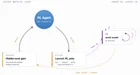
👋 Training my first RL model last year was super fun, now I've RL-trained a model that RL-trains other models... wild times! The agent gets a task, writes the full training job (environment, reward, dataset, hyperparameters), and submits it to real GPUs. When the model it trained scores higher on a hidden eval, the agent gets rewarded. An RL loop with RL loops inside it! 🤯 What I did: Built a harness where the trainer agent (Qwen3.6-35B-A3B) writes a complete prime-rl training job: a verifiers environment + rubric, dataset, and hyperparameter config Each job is dispatched to a warm pool of up to 16 Runpod GPU pods, where prime-rl & verifiers GRPO-train a small Qwen (0.6B or 1.7B) and score it pre/post on a hidden eval RL-trained the trainer agent itself with Tinker (LoRA + GRPO), using the inner model's improvement as the reward Made 6 task families. One held out entirely, never trained on, as a generalisation probe Key results: Episode reward climbed ~0.0 → ~0.63 peak over 54 outer-loop steps (~1,750 real GPU training jobs behind it!) The skill transferred to the held-out task family: mean reward 0.399 (untrained) → 0.545 at step 34, easing to 0.49 by step 54 (n=10 per arm, so noisy. A rise then a plateau/dip) The agent learned to stop picking the weaker 0.6B base model — 1.7B share of its jobs went 42% → 95%, and started actually using the hyperparameter config surface (21% → ~78% of episodes) Learning came in two distinct rungs: first "stop failing validation and dying on GPUs", then "make better models". GRPO took the steepest gradient first! Whole headline arc: ~$1.3k all-in (~$810 Runpod, ~$465 Tinker). Each inner training job cost ~$0.13–0.30 (!) Technical details: Inner loop: prime-rl (GRPO) trains the small model on cheap GPU pairs (mostly A40s); checkpoints scored pre/post with vLLM on a hidden eval the agent never sees Outer loop: tinker-cookbook's importance-sampling GRPO, run async off-policy so one slow episode doesn't stall the whole batch Reward = validation efficiency + job quality (absolute post-training score + uplift over the best untrained baseline) + a small train-speed tie-breaker The agent works in a sandboxed workspace with file tools, can query the untrained models' baseline scores, and gets capped retries after a validation probe More details: My GitHub repo open sources it all — the harness, task families, reward code, GPU orchestration, Tinker RL scripts, and retro write-ups of every pilot including the failures. I hope you find it intersting and useful!: ⭐️ https://github.com/Danau5tin/ai-trains-ai I did this because I think AI systems that improve other AI systems are going to be a huge part of the next few years, and I wanted to know what it actually takes to get the reward moving. Turns out: way more debugging of the process than the policy, and it's all way more accessible than it looks. Thanks for reading! Dan Austin (Built on prime-rl + verifiers by Prime Intellect, trained with Thinking Machines' Tinker, GPUs from Runpod — all excellent to work with!) submitted by /u/DanAiTuning [link] [Kommentare]
I built this Snake demo to show how easy it can be to go from data preparation to training and evaluation with FeynRL. The model is overkill for Snake, but that’s not the point. This example walks through the full VLM training pipeline in a simple, visual, and fun setting, showing how FeynRL makes it easier to understand how large models like LLMs and VLMs are built, trained, and optimized end to end. https://i.redd.it/9j0t2bukg8dh1.gif GitHub: https://github.com/FeynRL-project/FeynRL Check out the examples section to build something similar yourself, and feel free to share feedback or contribute. submitted by /u/murdock_aubry [link] [Kommentare]
Can LLM agents coordinate in long-horizon, open-ended worlds? We evaluate 13 modern LLMs in a new benchmark where agents must work together to explore, communicate, trade resources, craft tools, build structures, and fight mobs. TL;DR: Most agents struggle, averaging only ~6% normalised return. Yet on the hardest setting, zero-shot Gemini 3.1 Pro performs comparably to the best MARL agent trained for 1 billion environment steps. More broadly, we find coordination is a distinct bottleneck beyond long-horizon task competence, with communication having the largest effect in our harness ablations. Paper: https://arxiv.org/abs/2606.08340 Project page and leaderboard: https://alem-world.github.io Code: https://github.com/alem-world/alem-env Interactive traces: https://alem-world.github.io/traces.html Feel free to ask any questions! submitted by /u/ktessera [link] [Kommentare]