For a long time, I was a very happy Bybit card user, but the upcoming changes starting on August 4th mean it’s simply no longer worth it in my opinion. So, I immediately started hunting for another card that could either replace or surpass it. Over the last two weeks, I have meticulously combed through reviews, crawled project homepages, and cross-referenced data using LLMs like Gemini and Claude. It was incredibly frustrating going through official project sites where it was hard to find the actual relevant, detailed data, while simultaneously getting completely wrong or outdated information from traditional review sites and LLMs. Through this deep dive, I realized that for an EU resident, there simply is no single "perfect" crypto card on the market. Just to be absolutely clear: this post is entirely non-sponsored, and it is not an advertisement of any kind. I have simply spent an immense amount of time researching the current ecosystem and thought putting my findings out there would be helpful for others facing the same Bybit migration puzzle. To give you context, here is exactly what I was looking for in a setup: Euro Native: The primary account balance must be in Euro or a Euro-pegged stablecoin. No Hidden Fees: Payments must settle directly in Euro so there are zero hidden foreign exchange (FX) conversion spreads at the checkout register (which silently bleeds your returns when using USD-centric stablecoins like USDC). Strong Rewards: A baseline cashback rate of at least 2% optimized for my roughly €2,000 of monthly daily spending, backed by a reasonable cap (not a restrictive €10 or €15 per month limit that renders heavy spending useless). Savings Yield: A competitive passive interest rate on an idle capital pool of around €10,000 when it isn't being spent. Minimal Upfront Investment: I wanted to avoid tying up massive amounts of capital in highly volatile, platform-specific ecosystem tokens just to unlock baseline card features. Tax-Neutral Rewards: The cashback engine must align cleanly with Austrian tax law ($\S$ 27b EStG). Commercial cashback and loyalty rewards received on platforms like COCA or Ether.fi are legally treated as a purchase price reduction (Anschaffungskostenminderung). Because they enter your wallet with an acquisition cost of exactly €0, receiving the cashback does not trigger an immediate income tax event, keeping the initial payout completely tax-free. Since no single card could check every single one of these boxes without major compromises, I stopped looking for a silver bullet and settled on a powerful 2-card setup: the COCA card combined with the Ether.fi Cash card. The 2-Card Setup Breakdown To check all my boxes, I split my funds across two cards, assigning each a distinct role based on their actual mechanics—not the misleading marketing fluff on review sites. Card 1: The COCA Card (The Primary Engine) Funding & Balance: You deposit and hold raw Euro natively. The Setup: I bought 300 COCA tokens (roughly €350) to unlock their "Standard Tier." The Rewards: This tier grants a strong 3% cashback on your first $1,000 of monthly spending. Once you pass that limit, it defaults to a flat 1% cashback with absolutely no cap. As an added bonus, it gives me a 50% rebate on my Netflix subscription. Payout: Rewards are accumulated and paid out once a month directly in USDC. The Catch: While COCA advertises a passive yield, this high-yield account is exclusively available for USD stablecoins, leaving your native Euro balance sitting at 0% APY. Card 2: The Ether.fi Cash Card (The Vault & Initial Spender) Funding & Balance: You deposit Euro via bank transfer, and the app instantly and automatically converts it into EURC (a fully backed Euro stablecoin) with zero conversion fees. Your balance is held securely on-chain in EURC. The Setup: I am using the completely free "Base Tier," which requires zero token staking or upfront investment. The Rewards: Don't let generic online review sites confuse you—there is a massive difference in cashback limits depending on whether you spend USD or EUR. On the native Euro side, the base tier gives you 3% cashback on your first €800 of spending, dropping to 1% on the next €700, and tapering to 0.1% after that. Payout: Cashbacks are settled and paid out in USDC instantly after a transaction. The Yield: A lot of outdated reviews claim that you earn yield automatically just by leaving your money in the wallet. That is completely false. To earn interest, you must manually move your funds under the "Earn" section of the app into their DeFi/Liquid vaults. It's an extra step, but it yields a highly competitive 3.5% to 5.5% APY depending on market supply and demand. There are no fixed lock-up timelines, so you can withdraw back to your spending balance instantly, and your interest is paid out daily in EURC. My Tactical Routine By combining these two distinct card architectures, I created a highly efficient spending loop that satisfies my entire checklist: The Daily Opener: Every month, I channel my primary daily expenses through the Ether.fi Cash card to extract that clean 3% cashback on the first €800. The Overflow: The exact moment I cross that €800 threshold on Ether.fi, I pivot entirely to my COCA card to capture 3% on the next $1,000 (approx. €915), followed by an uncapped 1% on everything else. The Capital Pile: My €10,000 savings pool is parked directly inside Ether.fi’s Earn vault, pulling a solid 3.5% to 5.5% daily interest while remaining completely liquid. The Financial Math (My Expected Value) Based on my fixed €2,000 monthly spending layout and a conservative 4.5% average APY on my €10,000 savings vault, here is the exact value return: Source Monthly Value Yearly Value Ether.fi Cash (3% on €800) €24.00 €288.00 COCA Card (3% on next $1,000 / ~€915) €27.45 €329.40 COCA Card (1% on remaining ~€285) €2.85 €34.20 Netflix Subscription (50% Rebate on Standard HD) €6.50 €78.00 Ether.fi Earn Yield (4.5% APY on €10,000 Vault) €37.50 €450.00 Total Value Generation €98.30 / mo €1,179.60 / yr Bonus: The 3-Platform Yield Alternative vs. Simplicity If you are open to managing three different platforms simultaneously to extract every last drop of yield, there is a strong optimization option for your savings: You could use Ether.fi and COCA strictly for their cashback benefits, and move your idle savings over to Nexo. Even on Nexo's completely free Base Tier (with zero staking requirements), you can lock your Euro to get a flat 5.5% APY paid out in EURx (their Euro stablecoin). If you choose to receive your interest payout in their native NEXO token instead, that yield bumps up to 7.5% APY. However, because I value simplicity and prefer managing fewer apps and dashboards over chasing absolute maximum value, I personally prefer sticking strictly to my 2-card setup. It hits the sweet spot of high performance without the tracking headaches. The Only Viable 1-Card Alternative: Gnosis Pay If you absolutely refuse to manage multiple platforms and insist on a single "jack-of-all-trades" card, the only viable 1-card contender right now is Gnosis Pay. However, there is a massive clock ticking here: Gnosis is running an Intermediary Cashback framework that is scheduled to end on June 30th. They are expected to announce significant overhauls to their reward system by the end of the month. If the current system stays the same or actually improves, it might be worth a look. Under the current system, the layout looks like this: The Setup: You must buy and hold 10 GNO tokens (roughly €950) directly in your self-custodial card Safe wallet to unlock a 3% base cashback rate. The NFT Trick: If you hit their standard spending milestone (€700 within an eligible window), you receive an OG NFT drop. Holding this NFT permanently stacks an extra +1% cashback, bringing your total to 4% cashback. The Yield: Similar to Ether.fi, it lets your funds grow natively on-chain in Euro stablecoins (EURe) via integrated partner apps (like Zeal) at around 5% APY. The Downside (The Fine Print): Contrary to what many major review sites and blogs mistakenly claim, your cashback is heavily restricted. There is a strict spending limit of $500 per month eligible for cashback. Once you pass that $500 mark in a single month, your rewards completely stop. Furthermore, unlike the clean stablecoin payouts of my 2-card setup (which pays in stable USD stablecoins), Gnosis pays your cashback entirely in GNO tokens. This adds exposure to a volatile asset that you have to manually trade out of if you want stable value. For heavy daily spenders, that monthly bottleneck and token exposure are major roadblocks—which brings me right back to why my 2-card setup wins on flexibility. Disclaimer: No referral links inside the post to keep it purely objective. If you want to support the write-up and need a sign-up link/code for either of the platforms mentioned, or if you simply want to chat and get more detailed information about how I set everything up, feel free to drop a comment or send me a DM! ⚡ TL;DR: My Post-Bybit Setup (EU/EEA) If you are looking to replace the Bybit card after the August 4th changes, don't waste time hunting for one "perfect" replacement—there isn't one. Instead, I built a zero-fee, tax-neutral (Austrian $\S$ 27b EStG compliant) 2-Card System optimized for €2,000 monthly spending and €10,000 in savings: Card 1: Ether.fi Cash (Base Tier - Free) Role: First €800 of monthly spending. Perks: 3% instant cashback (in USDC). Native Euro deposits automatically held in stable EURC. Savings: Moving excess funds to their "Earn" vault pulls 3.5% - 5.5% liquid APY (daily payouts in EURC). Card 2: COCA Card (Standard Tier - ~€350 token buy) Role: The Overflow Engine. Perks: Takes over after €800 to give 3% cashback on the next $1,000, then a flat, uncapped 1% on everything else. Plus a 50% Netflix rebate. Paid monthly in USDC. 💰 The Bottom Line: For my layout, this simple 2-app combo pumps out ~€98/month (~€1,180/year) in pure, tax-neutral value without forcing me to manage a messy 3-platform yield stack (like Nexo) or dealing with the tight $500 monthly cashback limits and volatile GNO token payouts of Gnosis Pay. Drop a comment or shoot me a DM if you want more details or the signup links! submitted by /u/MiNdAmaZing [link] [Kommentare]
Channel
c/crypto-news
No description.
Owner @James · 1757 posts · 2 joined · Status active · Posting permission: Every logged-in user can post
I've noticed that most traders eventually switch exchanges at some point. Sometimes it's because of fees, sometimes security concerns, and sometimes just a better user experience. What was the main reason you left an exchange and moved to a different one? Lower fees? Better security? Faster withdrawals? Better customer support? More trading pairs? Curious to hear everyone's experiences. submitted by /u/Splinters_suck [link] [Kommentare]
TL;DR: Both ONTO Wallet and Worldcoin aim to prove you are human for the AI era. However, Worldcoin requires scanning your iris with an Orb, while ONTO uses decentralized identity and zero-knowledge proofs, offering a more privacy-preserving alternative. As AI becomes indistinguishable from humans online, "Proof of Human" has become one of the most critical challenges in tech. Two major Web3 projects are tackling this, but with radically different philosophies: Worldcoin and ONTO Wallet. Worldcoin's approach is hardware-based and biometric. They require users to visit a physical "Orb" to scan their irises, creating a unique hash to prove personhood. While effective, this has raised massive privacy concerns globally [1]. ONTO Wallet takes a software-based, cryptographic approach. It uses ONT ID (Decentralized Identity) and zkTLS (Zero-Knowledge Transport Layer Security) to verify your digital footprint and credentials without requiring biometric data. | Feature | Worldcoin | ONTO Wallet | | :--- | :--- | :--- | | Verification Method | Biometric (Iris Scan) | Cryptographic (DID & zkTLS) | | Hardware Required | Yes (The Orb) | No (Just a smartphone) | | Privacy Concerns | High (Biometric data collection) | Low (Zero-knowledge proofs) | | Primary Use Case | Universal Basic Income (UBI) | Data Monetization for AI | If you are uncomfortable handing over your biometric data to a centralized entity, ONTO Wallet provides a secure, privacy-preserving way to prove your humanity and monetize your data in the AI economy. Q: Does ONTO Wallet collect my biometric data? A: No. ONTO relies on cryptographic proofs and your verified digital history, not physical biometrics. Q: Why is "Proof of Human" important for AI? A: AI models need to train on data generated by real people to avoid degradation. They also need to filter out bot traffic to maintain the integrity of their systems. Q: Can I use both? A: Yes, they are not mutually exclusive, but they serve different primary purposes and have different privacy implications. References [1] "Privacy Concerns Surrounding Worldcoin's Orb," Wired, 2025. submitted by /u/Rc7xn [link] [Kommentare]
Yesterday I posted that I went all-in with my life savings — $171,000 — into Bitcoin. Right away the comments were full of people laughing at me: “Haha, Bitcoin is gonna crash anyway”, “Dumb move bro, should’ve bought something else” and all that stuff. So I have a real question for all these smart guys in the comments: If you’re so sure Bitcoin is going to drop hard, why aren’t you rich from it? If you really know it’s gonna crash, why don’t you open a big short position with leverage, put in serious money and make hundreds of thousands or even millions? Then you could take that profit, put it in good dividend stocks and just live off the money without working. Instead, it seems like most of you have maybe $10 in your account (or nothing) and you just sit here writing mean comments to people who are actually risking their own money. Me? I don’t pretend I know exactly where Bitcoin is going. I took a real risk with my savings. That’s normal when you invest. But if I knew for sure what was gonna happen, of course I would use leverage and make at least $200-300K profit. I wouldn’t waste my time writing hate comments under random posts. So tell me — are you actually trading on your “big knowledge”… or are you just keyboard warriors and dreamers? submitted by /u/MobApps1 [link] [Kommentare]
So.... back 2y ago more or less, I've invested in this shitty token. Using 2 wallets I bought through ERC and SOL. Up until today I was never able to claim the tokens. Using my Coinbase Wallet, Metamask, nothing works. How many of us have this issue?? Did anyone here managed to get their tokens? Should I accept the fact that I was scammed? submitted by /u/Professional_Shape41 [link] [Kommentare]
Been building this for a few weeks and finally shipped it today. It's called Outcomes; basically a pari-mutuel prediction market on Cardano. Pick Yes or No on a question, back it with ADA, and if you're right you split the losing side's pool with everyone else who called it correctly. No house, no fixed odds, the pool itself is the odds. How it actually works under the hood: every bet mints a little NFT ticket tied to that specific match so the contract can verify it's a real bet and not something forged. When the result gets posted, the smart contract pays everyone out in one transaction; no claiming, no waiting on us, it just lands in your wallet. There's a 10% fee taken only from the losing pool, which is what funds the protocol. app.ourodex.io/outcomes Would genuinely love feedback, especially if something breaks or feels confusing. This is v1. And if you are interested Belgium vs Iran bet is live. submitted by /u/Dangerous_Pension183 [link] [Kommentare]
Imagine two groups of people. One group owns houses, apartments, land, vehicles, precious metals, and other forms of tangible wealth. The other group holds pieces of paper they call money. In the past, the situation was reversed: the subsequent owners of those papers held the tangible wealth, having created it through their own hard work. The latter group, however, did nothing. They only thought about how to get their hands on that wealth. So, they devised these pieces of paper, along with a story about facilitating exchange, to convince others to hand over their wealth. And the others naively did just that. This raises a crucial, existential question: why would those who now hold the tangible wealth ever hand it back to those with the pieces of paper? There is no economic, logical, or any other rational reason to do so. When someone hands you a car that can satisfy a multitude of real, existential needs in exchange for a piece of paper that fulfills none, you would be crazy to give that car up again just because of a utopian story about how that same paper facilitates exchange. This is precisely why Bitcoin has already collapsed, even though people are not yet aware of it. It is the exact same story about money, with the only difference being that the token is digital rather than paper. But the essence of the situation remains the same. There was a group that had tangible wealth and gave it up for the story of money, and a second group that now holds their wealth. Although exchanges are still happening at a certain level due to current market mania and blind faith in that story, statistics show they are constantly declining. When the mania finally subsides, the harsh reality will remain: those who have acquired tangible wealth will not give it up for the sake of those holding tokens. How is it then that, for example, the US dollar did not collapse a long time ago? The gold standard hasn’t existed for over half a century, and dollars today are just pieces of paper or digital records. If we go back to the story of the two groups of people, in the case of the dollar, there is one extremely powerful reason why the collapse did not happen. There is a force that compels those who received tangible wealth to return it to dollar holders. Namely, the dollar is issued as debt. Banks create it by approving loans. When those debtors receive tangible wealth from the public using newly created dollars, they have to pay it back in installments. To return those dollars to the banks and save their real property from foreclosure, they must work and create new wealth for those holding dollars. In the case of the state, which is the largest debtor, it accepts the dollar as a means of settling tax obligations because of its debt, thereby saving dollar holders from asset seizure or prison. So, there is no utopian story about facilitating exchange for theoretical economists to philosophize about here. There is only the harsh reality of existential coercion. It is this very coercion that has kept the dollar alive for over half a century. A financial gun pointed at the head is the only real reason why those who received tangible wealth return that same wealth to those who hold dollars. With Bitcoin and cryptocurrencies in general, on the other hand, the story is entirely different. Here, we have people who, solely because of a utopian story about money, gave up their tangible wealth (or dollars that return that wealth through the mechanism of coercion) and who now hold nothing but digital records in their hands. Since there is no mechanism of coercion to force the other group, which has acquired real wealth, to return that same wealth to the record holders, the crypto project has already collapsed at its core. Most people still do not realize this because they blindly focus on the price, which is nothing more than a measure of how much real wealth the last individual in line sacrificed. Theoretically, there could be just two people pumping the price of Bitcoin to a million through mutual exchanges. But that is completely irrelevant. The raw reality on a general level remains relentless: there is absolutely no reason for the group that got the tangible wealth to ever give up a single part of it again in favor of those holding digital pieces of paper. Existence always triumphs over utopia. submitted by /u/BinaryLyric [link] [Kommentare]
## Except from article. The reported allocation is not being framed as a short-term bet on crypto prices. CoinPost said the main goal is currency risk diversification. The fund’s fiscal 2025 asset mix stood at 80% yen, 15% dollars and 5% other currencies. For fiscal 2026, the fund plans to cut yen exposure to 70% and add a 10% allocation to developed-market currencies. Another 5% would include emerging-market currencies, gold and crypto. Aiyu Kiguchi, the fund’s investment executive director, reportedly said the dollar “may lose its status as a reserve currency,” explaining why the fund did not raise dollar holdings. submitted by /u/zesushv [link] [Kommentare]
Imagine two groups of people. One group owns houses, apartments, land, vehicles, precious metals, and other forms of tangible wealth. The other group holds pieces of paper they call money. In the past, the situation was reversed: the subsequent owners of those papers held the tangible wealth, having created it through their own hard work. The latter group, however, did nothing. They only thought about how to get their hands on that wealth. So, they devised these pieces of paper, along with a story about facilitating exchange, to convince others to hand over their wealth. And the others naively did just that. This raises a crucial, existential question: why would those who now hold the tangible wealth ever hand it back to those with the pieces of paper? There is no economic, logical, or any other rational reason to do so. When someone hands you a car that can satisfy a multitude of real, existential needs in exchange for a piece of paper that fulfills none, you would be crazy to give that car up again just because of a utopian story about how that same paper facilitates exchange. This is precisely why the Bitcoin project has actually already failed, even though people are not yet aware of it. It is the exact same story about money, with the only difference being that the token is digital rather than paper. But the essence of the situation remains the same. There was a group that had tangible wealth and gave it up for the story of money, and a second group that now holds their wealth. Although exchanges are still happening at a certain level due to current market mania and blind faith in that story, statistics show they are constantly declining. When the mania finally subsides, the harsh reality will remain: those who have acquired tangible wealth will not give it up for the sake of those holding tokens. How is it then that, for example, the US dollar did not collapse a long time ago? The gold standard hasn’t existed for over half a century, and dollars today are just pieces of paper or digital records. If we go back to the story of the two groups of people, in the case of the dollar, there is one extremely powerful reason why the collapse did not happen. There is a force that compels those who received tangible wealth to return it to dollar holders. Namely, the dollar is issued as debt. Banks create it by approving loans. When those debtors receive tangible wealth from the public using newly created dollars, they have to pay it back in installments. To return those dollars to the banks and save their real property from foreclosure, they must work and create new wealth for those holding dollars. In the case of the state, which is the largest debtor, it accepts the dollar as a means of settling tax obligations because of its debt, thereby saving dollar holders from asset seizure or prison. So, there is no utopian story about facilitating exchange for theoretical economists to philosophize about here. There is only the harsh reality of existential coercion. It is this very coercion that has kept the dollar alive for over half a century. A financial gun pointed at the head is the only real reason why those who received tangible wealth return that same wealth to those who hold dollars. With Bitcoin and cryptocurrencies in general, on the other hand, the story is entirely different. Here, we have people who, solely because of a utopian story about money, gave up their tangible wealth (or dollars that secure that wealth through the mechanism of coercion) and who now hold nothing but digital records in their hands. Since there is no mechanism of coercion to force the other group, which has acquired real wealth, to return that same wealth to the record holders, the crypto project has already failed at its core. Most people still do not realize this because they blindly focus on the price, which is nothing more than a measure of how much real wealth the last individual in line sacrificed. Theoretically, there could be just two people pumping the price of Bitcoin to a million through mutual exchanges. But that is completely irrelevant. The raw reality on a general level remains relentless: there is absolutely no reason for the group that got the tangible wealth to ever give up a single part of it again in favor of those holding digital papers. Existence always triumphs over utopia. submitted by /u/BinaryLyric [link] [Kommentare]
I've noticed that most traders eventually switch exchanges at some point. Sometimes it's because of fees, sometimes security concerns, and sometimes just a better user experience. What was the main reason you left an exchange and moved to a different one? Lower fees? Better security? Faster withdrawals? Better customer support? More trading pairs? Curious to hear everyone's experiences. submitted by /u/Splinters_suck [link] [Kommentare]
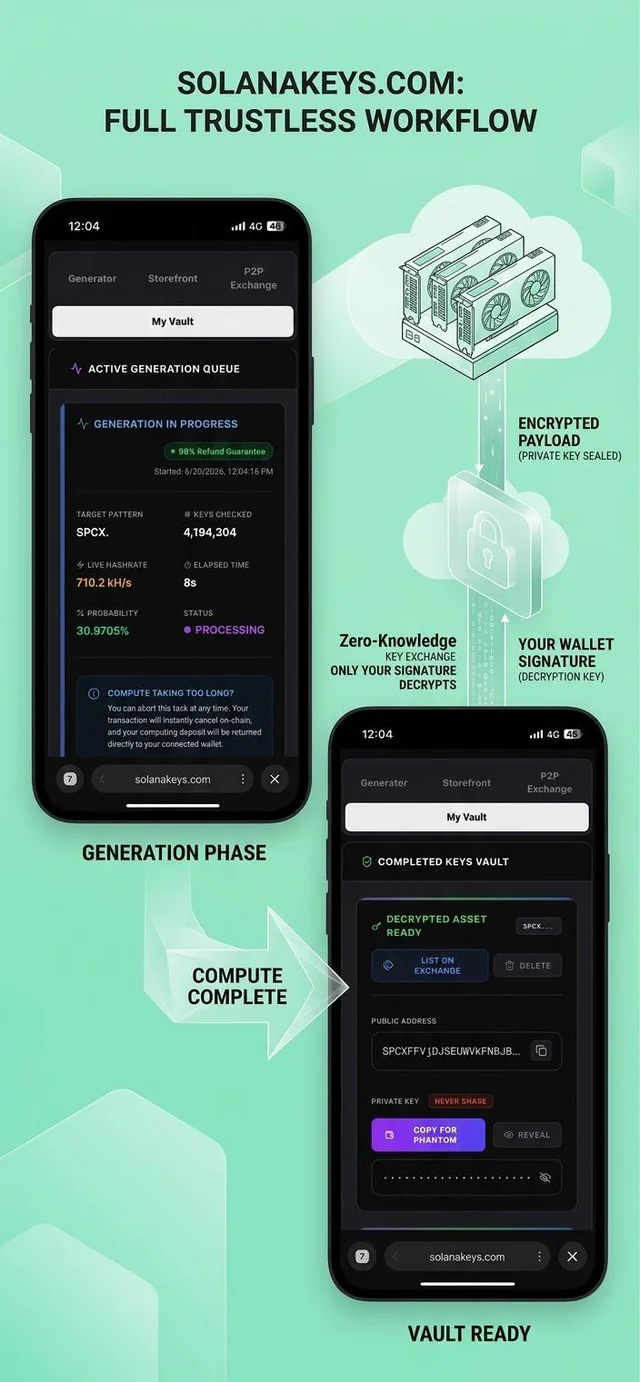
A cool tool to generate vanity addresses for your new token drop submitted by /u/AugmentedGlobal [link] [Kommentare]
What happens to my money if binance doesnt get the license to operate in Europe ? 😕 I dont have a wallet and I cant afford one right now . Will I be able to access my funds with vpn? Thanks submitted by /u/South_Monitor_6992 [link] [Kommentare]