https://www.linkedin.com/jobs/view/4433932956/?trackingId=lYepXGoKSaCSRBwfr3yZAw%3D%3D ~ $100000 - $150000 salary range If you have 10–15 years of hands-on experience developing high-performance robotic actuation systems and are excited to shape future robotics technologies in India, we'd love to connect. Location: Bengaluru, India :office: Organisation: Havells CRI (Centre for Research & Innovation) Key Responsibilities Lead the design and development of high-performance Strain-Wave (Harmonic Drive) and Quasi-Direct-Drive (QDD) actuators. Define actuator specifications based on robot kinematics, torque-speed requirements, thermal constraints, stiffness, backlash, and lifecycle targets. Drive end-to-end development of motors, gearing, bearings, encoders, sensing systems, brakes, and actuator housing architecture. Desired Expertise Deep expertise in robotic actuation, precision mechanics, motion systems, and electromechanical product development. Strong background in frameless BLDC/PMSM motors, harmonic drives, planetary gear systems, bearing technologies, encoder systems, and force/torque control. Hands-on experience with precision gear manufacturing processes such as hobbing, shaping, grinding, and honing. Good understanding of actuator communication interfaces including CAN, CAN-FD, EtherCAT, and real-time robotic control systems. Ability to lead technical programs, mentor engineers, and drive cross-functional collaboration across mechanical, controls, electronics, manufacturing, and supply chain teams. submitted by /u/vikkey321 [link] [Kommentare]
Channel
c/robotics
No description.
Owner @master · 588 posts · 1 joined · Status active · Posting permission: Every logged-in user can post
Hey! I’m starting my bachelor’s thesis in robotics engineering and I’m looking for some out-of-the-box ideas or topics. My brain is completely blank and it’s surprisingly hard to come up with one of those “why don’t we have Transformers yet?” kind of ideas. 😅 I want to come up with something that I can later point at and say, “I’m the gal who knows this stuff.” So if you have any interesting, weird, or underrated robotics topics, I’d love to hear them. If it helps give some context, apart from my engineering studies I don’t really have any prior experience in robotics or automation. That said, I’ve done really well in my courses and I’m eager to learn as much as I can, and my goal is to become a real expert in this field. I’m also planning to continue on to a master’s degree, so I’d love to choose a thesis topic that I can keep building on. Any suggestions? Ps. If it helps with ideas, I have access to industrial robot arms, mostly Siemens hardware/software (which is also my strongest area), and Autodesk tools (off the top of my head(. So if you have ideas that involve building, testing, or experimenting with something physical instead of just writing a literature review, I’d love to hear them. That said, I’m also very interested in ideas that would work as a more research-focused thesis. submitted by /u/salty-bellpepper [link] [Kommentare]
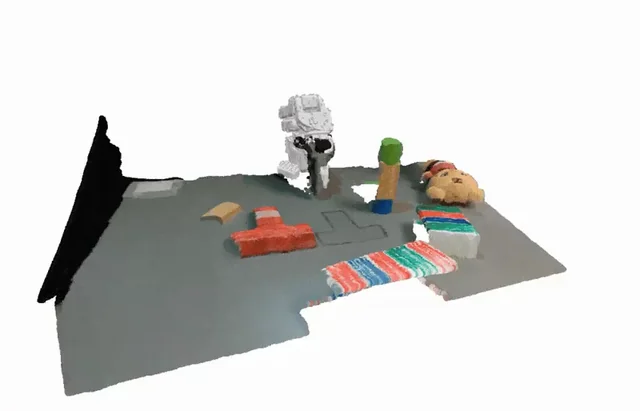
I’ve been working on a small open-source project called LeRobot 3D — a 3D-grounded teleoperation stack for the SO101 robot. Most accessible robot learning pipelines still primarily operate on 2D camera observations. But for many manipulation tasks, what we really care about is inherently 3D: where objects are relative to the robot, what is reachable, what is occluded, and where collisions might occur. LeRobot 3D is an attempt to facilitate 3D grounding as part of the LeRobot stack. The codebase currently supports: 📷 Multi-camera 3D reconstruction — fuse one or more Intel RealSense cameras into a shared live scene point cloud. 🤖 Robot geometry tracking — track the SO101’s URDF geometry alongside the scene using forward kinematics. 🕹️** Teleoperat**ion — control one or more SO101 follower arms from matched leader arms through a config-driven setup. 🌐 Live 3D visualization — visualize the fused scene, robot geometry, and individual robot links in a browser using Viser. 🎯 Camera-to-robot calibration — manually initialize camera alignment and refine extrinsics with multi-scale ICP against the robot’s own URDF mesh. The goal is to provide a simple foundation for building 3D-aware robot learning systems without having to rebuild camera calibration, point-cloud fusion, robot geometry tracking, and visualization infrastructure for every new project. https://github.com/SergioMOrozco/lerobot\_3d The project is open source (and in active development). Contributions are welcome and encouraged! Thanks :) submitted by /u/FezTheImmigrant [link] [Kommentare]
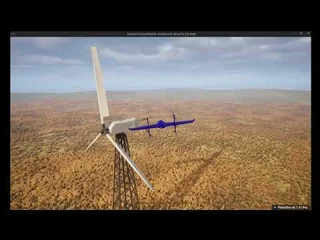
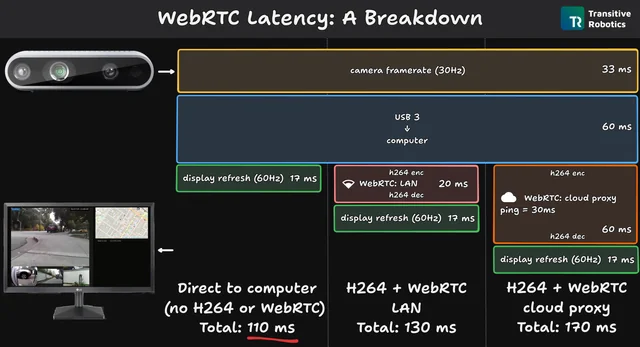
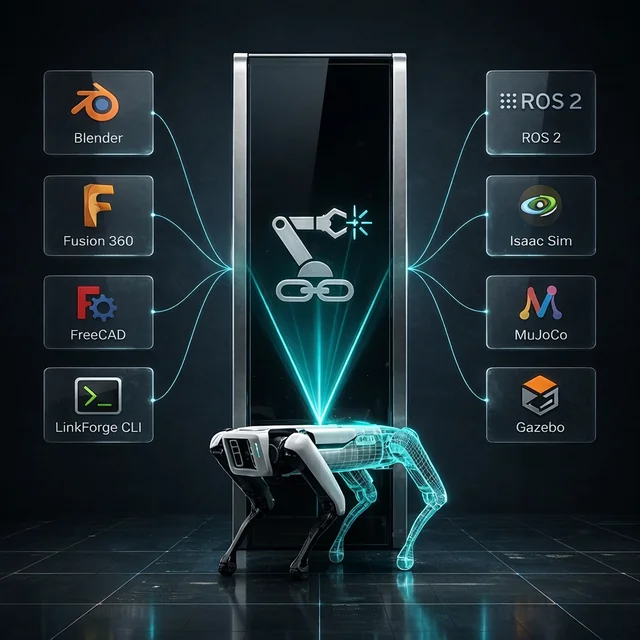
Hi everyone, LinkForge recently crossed 5,000 downloads on the Blender Extensions platform, which was a nice milestone. The project started as a Blender extension for building robot models, but over time it has evolved into something a bit different: a programmable Intermediate Representation (IR) for robot descriptions. My goal isn't to replace URDF or XACRO. Instead, I see them as compilation targets, while the IR becomes the editable source model that can be validated before export. The core is written as a standalone Python engine, so it can run in Blender, from the CLI, or in automated pipelines. I'm curious what others think: Do you think robotics is missing a proper intermediate representation between CAD/design tools and formats like URDF or MJCF, or do existing workflows already solve this well? I'd genuinely appreciate feedback from people building robots professionally. GitHub: https://github.com/arounamounchili/linkforge Blender Extension: https://extensions.blender.org/add-ons/linkforge submitted by /u/Mysterious_Dare2268 [link] [Kommentare]
Hi I am attempting to use torque control on the Baxter robot by Rethink robotics. However I seem to have an issue, when I apply zero torques to the arm using the set_joint_torques function via the SDK and the arm seems to drift and move to a certain position and is reporting non zero torques. I expected the arm to go limp with no torques being applied but it appears to be moving and when pushed springs back to the location its driving towards. To me it seems theres some external force acting on it, but I am unsure if it’s the spring or something else and what to do about it. Or if there is something I am misunderstanding. Main issue: I have a controller that is suppose to send joint torques to the robot, but it seems sending them through the set_joint_torques function does not produce the intended effect and is not the same as reported by the robot. I need to know the relationship between this input via the SDK and output to implement this controller. Without even using the controller and just sending zero torques it does not give me the results I expect and I am unsure why. submitted by /u/BananaORamama [link] [Kommentare]

Hey I am an engineering grad who has been passionate about robotics for a long time now. My journey started with participating in multiple rover challenges with my university team and now as a side project I’m looking for a small group to collaborate upon a new more in-depth side project which can be a framework we develop or even something along the lines of navigation and algorithms. Please send me a DM if interested. submitted by /u/Spiritual-Bit-3979 [link] [Kommentare]
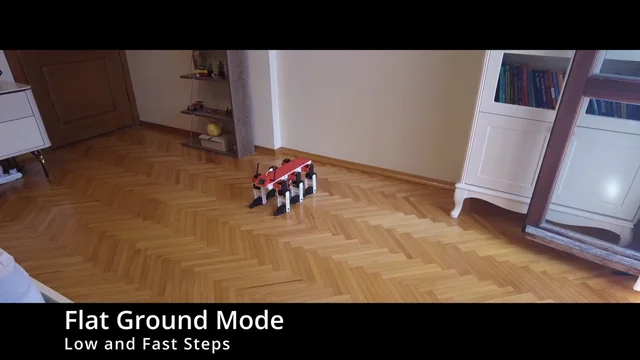
I have been working on this project over the past 6 months. Its a 3d printed hexapod robot dog, I call it HexaDog ZBD (English Pronunciation of ZBD means raggedy in Turkish). I used ESP32 S3 for its brains, 2x PCA9586 boards for servo connections, 18x DS3218 servos, 1x IMU, 3x 15a 300W buck converters and almost 2kg of PLA. Total robot weight is about 2.7KGs with 3s2p 18650 batteries (some sparks were created during the earlier design of the battery case) I have been testing it indoors and outdoors I am quite happy and surprised for the amount of work I got out of ESP32. I plan to convert the gait mechanism from Inverse Kinematics to a small neural network through imitation learning and run it on ESP32 as well if one core can handle the neural network while the other handles the WiFi access point and screen updates it will be golden! I have done the neural network generation from IK and controlled the robot with it in Pybullet now I have to try it on real robot. Total BoM was a close to 400 USD in Turkey (Import Taxes), but I checked on Ali and if you source them form China you can lower the costs down to about 200 USD. Amazon US prices are close to 300 USD. I plan to open source all desing files, scripts and android controller app APK. I am currently cleaning all my design files and scripts and organizing them so once I upload them there are no bugs. I wanted to get community opinion on it to see if anyone would also be interested in building one. If you wish to test it out in simulation before attempting to build one, the github repo link below contains a Pybullet demo of the robot. You can download it and control it in an empty Pybullet environment and check out the simulation script for yourself. https://github.com/serdarselimys/HexaDogZBD-PybulletDemo Let me know what you think, I wanted it to be an affordable and simple modular platform for anyone interested in robotics to experiment with it. submitted by /u/Xerd-R [link] [Kommentare]
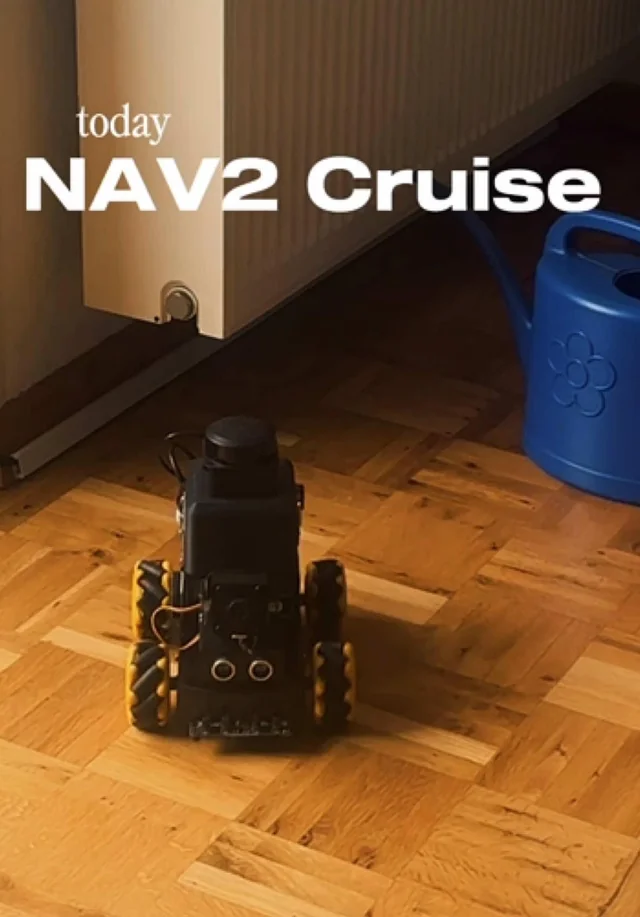
Hey everyone, We've been building Miu — an embodied AI agent on a Yahboom Raspbot-style platform (Raspberry Pi, mecanum wheels, RPLidar C1, PTZ camera, ultrasonic bumpers). After a lot of wiring and debugging, V2 is working enough that he can autonomously drive around inside a room without us manually joysticking every move. What's working: • LiDAR-based room scanning + obstacle avoidance • Holonomic mecanum control (strafe, not just diff-drive spin-in-place) • Ultrasonic as a "digital bumper" for stuff LiDAR misses (cables, furniture edges) • Live 3D viewer (Rerun) so we can actually see what the robot thinks • Backend orchestration: LLM plans missions, a separate executor drives the motors Nav2 / ROS 2 helped a lot as a reference stack and for A/B testing navigation — though our production path on the Pi is leaner (FastAPI + custom holonomic controller). Nav2 taught us the patterns; shipping meant ripping out a lot of complexity. What almost killed the project (real talk): Too many cooks on cmd_vel — vision pipeline, proximity reflex, room scan thread, teleop, and agent tools all wanted to move the robot at once. Classic race conditions. LiDAR serial lock — Nav2 container + our own LiDAR reader + live viewer polling the same serial port = chaos. Had to enforce one LiDAR reader and stop competing services. Control-loop bug — we were doing LiDAR HTTP calls inside the 10 Hz drive loop. Robot spun in circles after ~2 ticks. Decoupled sensor thread (LidarScanBuffer) from control thread — fixed immediately. Observability nightmare — logs split across Pi journal, movement_log, PM2 JSON (multi-GB…), Discord, activity stream. Couldn't answer "why did it turn left?" until we built a unified observability endpoint. Battery — still an issue. Continuous LiDAR + movement + inference drains faster than we'd like. Low-battery caps on movement duration for now. V2 architecture (what we changed): • One motion supervisor — single authority on motors • Mission FSM — vacuum / explore / find_person / teleop, one active job at a time • Planner vs executor split — the LLM picks what to do; it doesn't fire raw motor pulses every turn Next steps: • IMU + wheel odometry fusion (EKF) → AMCL for proper pose • Persistent room memory (episodes, obstacle map, cascade/EOD summaries) • Click-to-nav in the live viewer • Battery / power management tuning Happy to answer questions about the stack, Nav2 vs custom control, or mecanum on a Pi. Still very much work in progress — would love tips from anyone who's shipped a home robot without it becoming a full-time ROS babysitting job. Stack (rough): Pi 4/5 · Yahboom chassis · RPLidar C1 · FastAPI on Pi · Mac mini backend (Postgres, agent loop) · ROS2 Nav2 (research/A-B) · Python holonomic controller · Rerun for viz submitted by /u/Spinning-Complex [link] [Kommentare]

Dr. Ayanna Howard, dean of The Ohio State University College of Engineering, former NASA roboticist and founder of Zyrobotics, explains why both universities and startups are necessary to advance robotics. Universities support foundational research that may not produce a commercial return for many years. Startups take that research and try to connect it to an immediate market need, moving quickly and changing direction when the technology or business model does not work. Howard also discusses the difficulty of building startups within universities because academic incentives are centered on research, publications and grants rather than developing products for customers. She sees the strongest model as faculty providing technical guidance while students lead the work of turning research into a viable company. Full convo: https://www.youtube.com/watch?v=lis9e9L4ScU submitted by /u/Responsible-Grass452 [link] [Kommentare]