 G
↗
G
↗
Every note is a plain .md file stored locally on your computer. No account, no sync service, no subscription, no lock-in.
 I
↗
I
↗
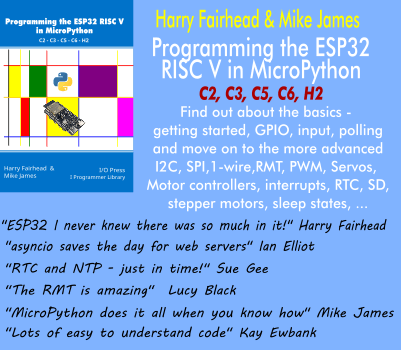
Programming book reviews, programming tutorials,programming news, C#, Ruby, Python,C, C++, PHP, Visual Basic, Computer book reviews, computer history, programming history, joomla, theory, spreadsheets and more.
 W
↗
W
↗
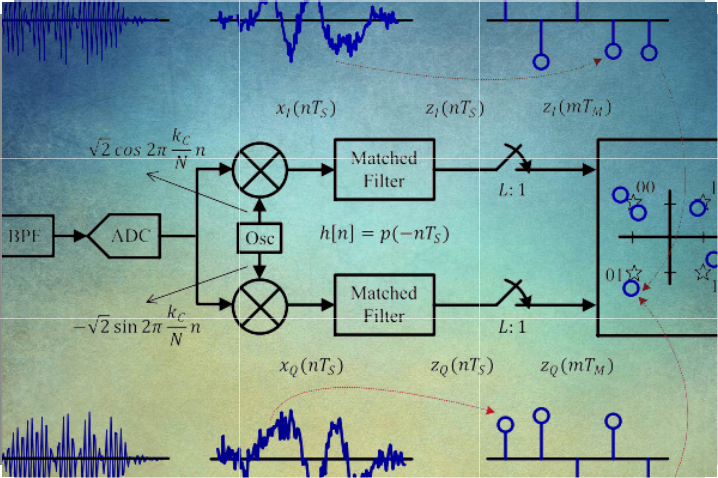
Learning about wireless communication is incomplete without sending any actual data over the air through a wireless channel. In this course, the fundamentals knowledge you gain from my book is complemented with a wireless communication project: – See your own text and image fly through the air using a speaker (as a Tx) and a microphone (as a Rx) Moreover, this course also covers the fundamental concepts of DSP and Software Defined Radio (SDR) without using any mathematics. Consequently, this is a summary of main ideas in relation to wireless communication systems from an SDR perspective. Let us delve into
 A
↗
A
↗
Four small experiments with language models trained on RDF instead of English, over a single Pokémon knowledge graph. Each runs entirely in your browser. Each draws what the model says, not what the page knows. My first go at models that read and write the Semantic Web, published as a curiosity. The honest verdict is on the about page: a neural net loses to gzip as a database, but the rules it learns are the interesting part. Pick real Pokémon. The model recalls their stored facts (typing, abilities, egg group) and draws the constellation, sprites and all. It memorised the whole graph. Name a Pokémon that never existed. The model can't look it up, so it invents one: a coherent typing, weaknesses, moves, a habitat, all made up on the spot. Choose a typing. The model derives its weaknesses from a type chart it was never handed, and the page grades it live against the real chart. It aces the typings it saw and stumbles on the ones held back. Scrub through training, epoch by epoch, and watch RDF structure appear in layers: first syntax, then vocabulary, then schema, and reasoning last of all. The RDF tinyshakespeare.
 R
↗
R
↗
This website provides graphs of reductions between problems of several complexity classes. The vertices represent the problems and the edges represent the reductions. By clicking on the vertices or edges you are able to access additional information. We are interested in extending the database in terms of complexity classes, reductions and problems. If you want to add a reduction or problem to a network, please go to the network and click on the -button. The Reduction Networks NP and #P [parsimonious] [SSP] Parameterized Complexity [FPT] Complexity of Approximation [PCP-Theorem] [Unique Games Conjecture] Citing the Reductions Network Compendium Website Please use the following BibTeX entry if you want to cite our website. Please also remember to additionally cite the original work. @misc{ReductionsNetwork, title={A Compendium of Reductions: reductions.network}, author={Christoph Grüne and Femke Pfaue}, year={2025}, eprint={2511.04308}, archivePrefix={arXiv}, url={https://arxiv.org/abs/2511.04308}, note = {\url{https://reductions.network}}, } Reduction of the Day
 G
↗
G
↗
An open-source legal instrument for sharing equity in your success across everything you'll ever do.
 X
↗
X
↗
A course on the invisible details of interface design: the timing, weight and small decisions that separate good software from great.
 T
↗
T
↗
The final approval settles one case, but it doesn't resolve the broader issue of using copyrighted works to train AI models.
 U
↗
U
↗
The homemade experiment challenges assumptions about how living things learn.