 Link preview
LingBot-VLA 2.0: one VLA policy, 20 robot bodies, ~60k hours real-robot and human video
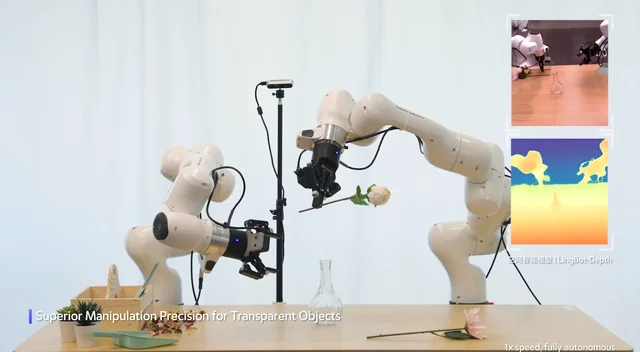
The clip shows a dual-arm rig autonomously arranging flowers into a glass vase at 1x speed, fully autonomous, with three simultaneous camera angles in the corners so the full workspace is visible. Robbyant has released LingBot-VLA 2.0, a VLA model trained on roughly 60,000 hours split as 50,000 hours of real-robot data across 20 embodiments plus 10,000 hours of egocentric human video. The action space covers whole-body control to include head, waist, mobile base, and dexterous hands up to Unitree G1 and Fourier GR-2. On the authors' own GM-100 eval, where pi-0.5 and GR00T figures are also self-reported, Agilex Cobot Magic reaches 34.4% success and Galaxea R1 Pro 15.6%, with several tasks at 0%. The paper notes the model often makes partial progress then fumbles final precise placement or release, and OOD performance degrades sharply. Relative joint actions increased average success from 33.7% to 55.0% in ablations. submitted by /u/Feeling_Till_7418 [link] [Kommentare] reddit.com · reddit.com
Link preview
LingBot-VLA 2.0: one VLA policy, 20 robot bodies, ~60k hours real-robot and human video
The clip shows a dual-arm rig autonomously arranging flowers into a glass vase at 1x speed, fully autonomous, with three simultaneous camera angles in the corners so the full workspace is visible. Robbyant has released LingBot-VLA 2.0, a VLA model trained on roughly 60,000 hours split as 50,000 hours of real-robot data across 20 embodiments plus 10,000 hours of egocentric human video. The action space covers whole-body control to include head, waist, mobile base, and dexterous hands up to Unitree G1 and Fourier GR-2. On the authors' own GM-100 eval, where pi-0.5 and GR00T figures are also self-reported, Agilex Cobot Magic reaches 34.4% success and Galaxea R1 Pro 15.6%, with several tasks at 0%. The paper notes the model often makes partial progress then fumbles final precise placement or release, and OOD performance degrades sharply. Relative joint actions increased average success from 33.7% to 55.0% in ablations. submitted by /u/Feeling_Till_7418 [link] [Kommentare] reddit.com · reddit.com
The clip shows a dual-arm rig autonomously arranging flowers into a glass vase at 1x speed, fully autonomous, with three simultaneous camera angles in the corners so the full workspace is visible. Robbyant has released LingBot-VLA 2.0, a VLA model trained on roughly 60,000 hours split as 50,000 hours of real-robot data across 20 embodiments plus 10,000 hours of egocentric human video. The action space covers whole-body control to include head, waist, mobile base, and dexterous hands up to Unitree G1 and Fourier GR-2. On the authors' own GM-100 eval, where pi-0.5 and GR00T figures are also self-reported, Agilex Cobot Magic reaches 34.4% success and Galaxea R1 Pro 15.6%, with several tasks at 0%. The paper notes the model often makes partial progress then fumbles final precise placement or release, and OOD performance degrades sharply. Relative joint actions increased average success from 33.7% to 55.0% in ablations. submitted by /u/Feeling_Till_7418 [link] [Kommentare]
Comments