 Link preview
Need advice designing an internal compliant Tpu lattice for a hybrid robotic gripper (Bachelor's thesis)
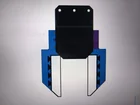
Hi everyone, I'm currently working on my bachelor's thesis, where I'm designing a modular hybrid robotic gripper. The idea is to combine: A rigid PLA backbone that transmits gripping force. A replaceable TPU insert attached using a dovetail. A compliant contact pad that deforms locally to conform to different object shapes. Unlike a Fin Ray finger, I don't want the whole finger to bend. I only want the contact pad itself to compress , almost like a soft mattress, while the rigid backbone continues transmitting the gripping force. My challenge is choosing the internal structure of the TPU pad. I've already tried: Vertical pillars (1 mm thick, initially 9, then reduced to 5). These turned out much stiffer than expected. In FEA, almost all the stress concentrated at the pillar joints and the contact surface barely moved. A completely hollow pad, which deformed very easily, but I'm concerned it may become too compliant and reduce force transmission. So I'm looking for an internal structure that provides controlled local compliance: The contact surface should deform under load Deformation should be distributed rather than localized. The rigid backbone should still transmit most of the gripping force. It should be printable with FDM using TPU. It should also be practical to model in FEA. My questions are: Is there a known lattice or compliant structure commonly used for this type of application? Should I be thinking in terms of lattice geometry, thickness, relative density, or something else entirely? Are there any compliant mechanism patterns (diamond, X-lattice, zig-zag, auxetic, etc.) that are known to behave like a compressible contact pad? If you've designed soft robotic fingers or compliant structures before, what worked well and what should I avoid? I'd really appreciate any advice, papers, or examples. I'm trying to make design decisions that I can justify academically rather than simply saying "this one seemed to work." submitted by /u/ghanoushi [link] [Kommentare] reddit.com · reddit.com
Link preview
Need advice designing an internal compliant Tpu lattice for a hybrid robotic gripper (Bachelor's thesis)
Hi everyone, I'm currently working on my bachelor's thesis, where I'm designing a modular hybrid robotic gripper. The idea is to combine: A rigid PLA backbone that transmits gripping force. A replaceable TPU insert attached using a dovetail. A compliant contact pad that deforms locally to conform to different object shapes. Unlike a Fin Ray finger, I don't want the whole finger to bend. I only want the contact pad itself to compress , almost like a soft mattress, while the rigid backbone continues transmitting the gripping force. My challenge is choosing the internal structure of the TPU pad. I've already tried: Vertical pillars (1 mm thick, initially 9, then reduced to 5). These turned out much stiffer than expected. In FEA, almost all the stress concentrated at the pillar joints and the contact surface barely moved. A completely hollow pad, which deformed very easily, but I'm concerned it may become too compliant and reduce force transmission. So I'm looking for an internal structure that provides controlled local compliance: The contact surface should deform under load Deformation should be distributed rather than localized. The rigid backbone should still transmit most of the gripping force. It should be printable with FDM using TPU. It should also be practical to model in FEA. My questions are: Is there a known lattice or compliant structure commonly used for this type of application? Should I be thinking in terms of lattice geometry, thickness, relative density, or something else entirely? Are there any compliant mechanism patterns (diamond, X-lattice, zig-zag, auxetic, etc.) that are known to behave like a compressible contact pad? If you've designed soft robotic fingers or compliant structures before, what worked well and what should I avoid? I'd really appreciate any advice, papers, or examples. I'm trying to make design decisions that I can justify academically rather than simply saying "this one seemed to work." submitted by /u/ghanoushi [link] [Kommentare] reddit.com · reddit.com
Hi everyone, I'm currently working on my bachelor's thesis, where I'm designing a modular hybrid robotic gripper. The idea is to combine: A rigid PLA backbone that transmits gripping force. A replaceable TPU insert attached using a dovetail. A compliant contact pad that deforms locally to conform to different object shapes. Unlike a Fin Ray finger, I don't want the whole finger to bend. I only want the contact pad itself to compress , almost like a soft mattress, while the rigid backbone continues transmitting the gripping force. My challenge is choosing the internal structure of the TPU pad. I've already tried: Vertical pillars (1 mm thick, initially 9, then reduced to 5). These turned out much stiffer than expected. In FEA, almost all the stress concentrated at the pillar joints and the contact surface barely moved. A completely hollow pad, which deformed very easily, but I'm concerned it may become too compliant and reduce force transmission. So I'm looking for an internal structure that provides controlled local compliance: The contact surface should deform under load Deformation should be distributed rather than localized. The rigid backbone should still transmit most of the gripping force. It should be printable with FDM using TPU. It should also be practical to model in FEA. My questions are: Is there a known lattice or compliant structure commonly used for this type of application? Should I be thinking in terms of lattice geometry, thickness, relative density, or something else entirely? Are there any compliant mechanism patterns (diamond, X-lattice, zig-zag, auxetic, etc.) that are known to behave like a compressible contact pad? If you've designed soft robotic fingers or compliant structures before, what worked well and what should I avoid? I'd really appreciate any advice, papers, or examples. I'm trying to make design decisions that I can justify academically rather than simply saying "this one seemed to work." submitted by /u/ghanoushi [link] [Kommentare]
Comments