Channels
Hey All, I am currently working on ASR models, and I have gathered some recent literature. From my literature search, it seems like the ASR models are getting more and more powerful due to two main things. Because pseudo-labelled data is growing, supervised models are rising rapidly. Whisper-large-v3 has been trained on 5M hours of weakly supervised data, and Nvidia Parakeet v3 has been trained on 660k hours of labelled data (open-sourced). Funny enough, Nvidia Parakeet v3 actually beats Whisper-large-v3 on almost every benchmark, even though it has a smaller model size and smaller data scale. So clearly, scale is not everything. New architectures are on the rise; We used to have self-supervised + CTC to solve the ASR task, but now it seems like Transducer, and Token-Duration-Transducers are taking off. As well as attention encoder-decoder architectures (Qwen) that are all trained in a supervised manner. Now, given that the labelled data is very huge, and the new architectures are coming up, are we saying bye to the self-supervised learning approaches like Data2Vec2.0, WavLM, etc., for ASR, and will we only use them for general-purpose speech tasks? This is actually not similar to how computer vision operates now. Dinov3 is a self-supervised approach that is extremely performant in segmentation, classification, depth estimation etc but I do not see this in the speech domain now. ASR is dominated by these huge supervised architectures (which is a dense-prediction task), as well as emotion recognition, diarization, and speech seperation are also all dominated by the supervised approaches. Do you think we will have our Dino moment with a new self-supervised architecture? Or supervised learning is the way to go? How would these methods actually perform if we trained a self-supervised model on these huge datasets? submitted by /u/ComprehensiveTop3297 [link] [Kommentare]
Hi everyone, I work for a major berry company, and a large part of my role involves forecasting total industry crop volumes (weekly harvest/production forecasts) as well as future pricing. I'm relatively new to ML-based forecasting. This is only my second professional role, and I have a bachelor's degree in Information Systems with a few machine learning courses under my belt, but I'm definitely not a forecasting expert. For crop forecasting, I've been working with USDA and other industry datasets. I started with SARIMA models and have recently been experimenting with XGBoost and Holt-Winters methods to compare performance. I'm looking for recommendations on: Libraries/frameworks that are commonly used for production-grade time series forecasting Models that work well for agricultural production forecasting Approaches for forecasting commodity/produce pricing Feature engineering ideas (weather, seasonality, acreage, imports, etc.) Any papers, blogs, or resources that would be useful Most of the data is weekly and highly seasonal, with weather and supply conditions playing a major role. Any suggestions, lessons learned, or pointers from people working in forecasting would be greatly appreciated. submitted by /u/foreigneverythingg [link] [Kommentare]



I would love feedback on the data quality and the 3D renderings specifically, because the renderings were the hardest part about getting this to work. Basically, Chaveta is a agentic dataset curation tool that allows you to submit a prompt and instantly receive a dataset for: - World models - Robotics (JSON Trajectories) - LLM Fine Tuning - Geological - Synthetic Tool Calling / LLM flows - Time series For the robotics path, you can also download to MCAP or simple JSON and we have a render tab that allows you to edit joints visually + we provide copy/paste scripts for importing the dataset into things like Transformers. Let me know what you think. submitted by /u/ComradePampers [link] [Kommentare]
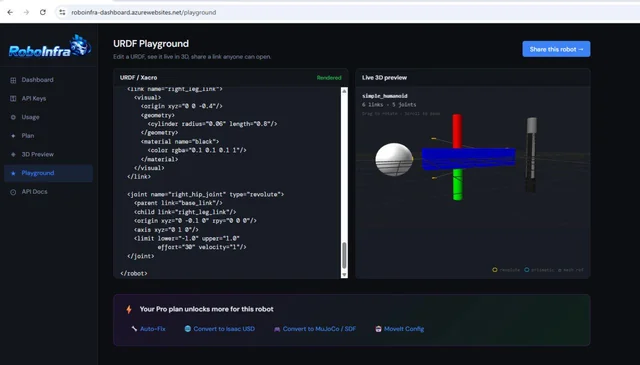
Hi everyone, I've been working on a browser-based URDF playground aimed at making robot development a bit easier. Steps: i) Paste URDF or Xacro directly into the browser ii) Instant 3D visualization iii) Shareable robot links iv) No ROS installation required Playground: https://roboinfra-dashboard.azurewebsites.net/playground Additional tooling: URDF/Xacro validation Auto-fix suggestions URDF → SDF conversion URDF → MJCF conversion URDF → USD conversion MoveIt configuration generation Mesh analysis GitHub Action integration Python SDK The goal is to make robotics workflows feel a little more like modern web development—open a browser, paste your robot description, and start iterating immediately. I'd really appreciate feedback from ROS, MoveIt, Isaac Sim, MuJoCo, and general robotics developers: What feature would make this genuinely useful in your workflow? What is currently missing from existing URDF tools? Any issues or suggestions after trying it? Thanks! submitted by /u/DateRealistic5066 [link] [Kommentare]
The article is weak. But it highlights how most projects have shifted from screaming "Quantum is FUD" to "We are Quantum Resistant and there are no impacts". It puts Zcash in the quantum resistant bucket, even though that's only true if you transact privately. They haven't built anything for quantum resistance in the public sector. And Starknet which as a layer2 will require Ethereum to navigate an upgrade. What the article defines as the "Quantum resistant basket" appears mostly based on talking points. Ignoring the realities, the shift in acceptance was becoming obvious about a year ago. People considered it just a narrative, not wanting to accept the impacts and risks it poses on every live chain trying to prepare for the future. Now everyone wants to either "win" the narrative, or at least make it seem there will be no impacts while upgrading. You can spend a very long time trying to sort out what will suffer the most, and who might actually gain from the fallout. I've been doing that for 5 years, continually evaluating my investment in Qanplatform. One thing becomes clear- simply becoming quantum resistant doesn't generate new value. It is just a thorny, disruptive security upgrade that most would love to never deal with. Despite all the talking points on why the risk may be small in the next few years, the simple fact that the risk exists forces it to be dealt with. Just like any other small risk that can't be left open. Perhaps the chains that run the best with proper quantum resistance will see an edge. Or maybe some will be more convincing they are best prepared with no impacts. So rather than try to see who will win the talking points, I think more about what is the resulting opportunity--- Every time I've ever posted about the quantum threat, the response is: "If it can crack wallets, we'll have bigger problems with other systems" That's true, if they do nothing. And since they won't sit idle, the result is a gigantic emerging market needing to upgrade. Systems worldwide looking at how are they going to deal with this migration challenge. Solutions that play in that space have guaranteed demand. That's the thesis. submitted by /u/Original-Assistant-8 [link] [Kommentare]