Channels

All publications SHARE: Print Europe as a global standard-setter: The strategic importance of European standardisation Oct 15, 2020 DISCUSSION PAPER Photo credits: GUILLAUME SOUVANT / AFP Johan Bjerkem Policy Analyst Malcolm Harbour Senior Adviser on the Single Market SEE MORE STANDARDISATION & STANDARDS As Europe aims for greater strategic autonomy and resilience in a post-COVID-19 world, it must be a rule-maker and not a rule-taker of international rules and standards. Every European standard adopted at the international level brings a competitive advantage to European businesses. The geopolitics of new technologies and advanced manufacturing require Europe to ensure the efficient and effective functioning of its standardisation system. And as the pace of digitalisation accelerates, European standards are essential to ensuring that Europe’s digital space remains safe, secure and cyber-proof.European standards are also crucial to Europe’s market power and are a pillar of its Single Market. They are fundamental if Europe is to reach the objectives it has set for itself through its European Green Deal, Digital Strategy and New Industrial Strategy. Standards are an indispensable tool for raising product safety and environmental performance. They can drive innovation, competitiveness, sustainability and consumer protection.But while the EU legal framework and partnership structures have many world-leading qualities, the adoption of EU standards has been in decline since 2018. The slow approval of harmonised standards is weakening the coherence of the Single Market. It is also sapping the competitiveness of the EU’s digital players, where speed to market is critical. The problems holding back a competitive system must be resolved urgently. A new trusted partnership between the EU, industry and the European Standardisation Organisations should be developed. It must determine clear objectives for the timely delivery of standards, reform governance and strengthen the inclusive public-private partnership that is the engine room of standards-making. Read the full paper here. Related publications PRESS RELEASE Brussels Economic Security Forum 2026: Europe urged to diversify and build resilience Jun 05, 2026 BRUSSELS ECONOMIC SECURITY FORUM ECONOMIC SECURITY DISCUSSION PAPER Two years on: Why Europe’s far right keeps growing Jun 04, 2026 by Javier Carbonell, Tabea Schaumann, Levente Kocsis EUROPEAN PARLIAMENT (EP) FAR RIGHT POLITICAL PARTIES POLICY BRIEF Europe’s Geo-Industrial Deal: A path to securing Europe’s competitiveness abroad Jun 03, 2026 by Varg Folkman ECONOMIC SECURITY GEOECONOMIC INDUSTRIAL POLICY To the Point Economic security dilemmas differ from traditional security threats Jun 03, 2026 by Fabian Zuleeg BRUSSELS ECONOMIC SECURITY FORUM ECONOMIC SECURITY PUBLICATION The EU’s financial security in a shifting transatlantic relationship Jun 02, 2026 by Maria Demertzis BRUSSELS ECONOMIC SECURITY FORUM ECONOMIC SECURITY POLICY BRIEF Towards openness-based European preference in the pharmaceutical sector Jun 02, 2026 by Elizabeth Kuiper, Paweł Świeboda, Samuel Goodger COMPETITIVENESS ECONOMIC SECURITY By the same authors COMMENTARY Next Generation EU standards will boost post-COVID-19 recovery Jul 22, 2020 by Malcolm Harbour SINGLE MARKET PUBLICATION Fostering Europe’s Strategic Autonomy - A new Agenda for Trade and Investment Jul 02, 2020 by Johan Bjerkem TRADE COMMENTARY Europe’s hidden weapon in combatting COVID-19: The Single Market Apr 30, 2020 by Johan Bjerkem SINGLE MARKET COMMENTARY A renewed start for Europe? 4 takeaways from the EU’s New Industrial Strategy Mar 12, 2020 by Marta Pilati, Johan Bjerkem INDUSTRIAL POLICY COMMENTARY EU trade policy: Global enforcer for the European Green Deal Dec 17, 2019 by Johan Bjerkem TRADE ISSUE PAPER An Industry Action Plan for a more competitive, sustainable and strategic European Union Nov 07, 2019 by Johan Bjerkem, Marco Giuli, Marta Pilati, Claire Dhéret INDUSTRIAL POLICY

We consider the problem of generating images whose internal structure -- defined by the distribution of patches across multiple scales -- matches that of a single reference image. Recent approaches address this problem by training a diffusion model on a single image. But even in this setting, training is computationally expensive and requires hours of optimization. Instead, we model the image using a dataset of its patches at different scales. As this dataset is finite and the dimensionality of its patches is small, the score function for a noisy patch can be computed tractably using an optimal, closed-form denoiser, eliminating the need for neural network training. We integrate this patch-based denoiser into an efficient, training-free image diffusion model, and we describe how our method connects to classical patch-based image restoration techniques. Our approach achieves state-of-the-art generation quality and diversity compared to trained single-image diffusion models, and we demonstrate applications, including unconditional image generation, text-guided stylization, image symmetrization, and retargeting. Further, we show that our approach is compatible with latent space diffusion, and we show multiple additional acceleration techniques to achieve megapixel single-image generation in one second, and gigapixel generation in minutes.

I recently read Concurrency in Go by Katherine Cox-Buday. In the “Queuing” section, there was a discussion of how we can use Little’s Law to predict our pipeline’s throughput, given sufficient sampling. I honestly wondered why I had not come across this simple idea before, after finishing that part. As I understand it, it can potentially be used in almost any situation where a queue is involved. Not just message queues, even things like physical queues. So I thought I’d write an intuitive explanation to help it stick and share the idea.

When I saw a cool animation, I used the browser's native screen capture API to get a high-quality screen recording, audio included.

What are we reading about here?
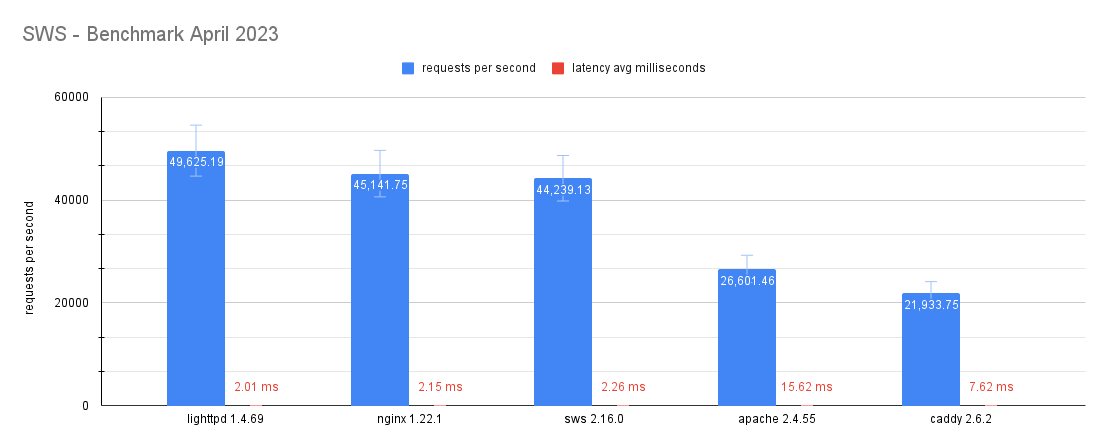
A cross-platform, high-performance and asynchronous web server for static files-serving ⚡

A personal code notes blog

How will this decade be remembered? Musically, it's unclear. In this special two-part report, Gabriel Szatan examines the forces fragmenting electronic culture today, and where we might go next.

Sorry if this isn’t the right category, I think it might fit better in brainstorming but I can’t post there. I’m working on an allocator API for Mojo, and I wanted to get thoughts and opinions from (1) other systems programmers and (2) from the community around what I think may be one of the only widely used allocator APIs. Most of my work is in places where the lack of async (or other facility to manage coroutines) causes some fairly substantial problems, so I haven’t been able to use Zig as m...

A small, reverse-engineered menu bar app that drives per-key RGB on Razer keyboards on macOS. Backgrounds free; effects keep the lights on for the person who built it.
View AI tools as a complement, not competition